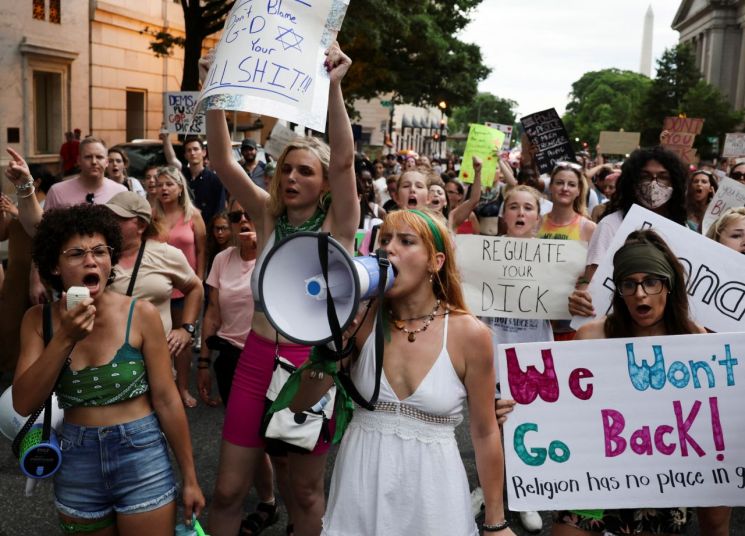
[Asia Economy New York=Special Correspondent Joselgina] "Her body, her rights, her choice."
The United States is divided over abortion rights. Six out of ten Americans do not support the Supreme Court's ruling that did not recognize abortion as a constitutional right. With the midterm elections coming up in November, abortion is emerging as a new political issue.
According to CBS News on the 26th (local time), a poll conducted together with the polling agency YouGov showed that 59% of respondents answered that they "do not support the Supreme Court ruling." Those who "support" the ruling accounted for 41%. Additionally, 58% supported the enactment of federal legislation to legalize abortion, while 42% opposed it. This survey was conducted over two days from the 24th, when the Supreme Court officially overturned the so-called "Roe v. Wade" decision that guaranteed women's abortion rights, targeting 1,591 adults.
With public opinion against the Supreme Court ruling prevailing, the Democratic Party is clearly trying to make abortion a key issue in this year's midterm elections. Democratic candidates for federal Congress, state governments, and state legislatures running in the midterms have all expressed their intention to highlight this issue as a frontline topic. Cheri Beasley, who is running for the U.S. Senate in North Carolina, appealed for support, saying, "We are facing a watershed moment for constitutional rights."
Since future decisions on abortion rights will be transferred to the authority of state governments and legislatures, the Democrats argue that only by holding the majority can they enact federal laws to guarantee abortion rights. In particular, within the Democratic Party, there is an expectation of rallying suburban areas and female voters, known as so-called "swing voters." The Washington Post (WP) reported, "The Supreme Court ruling has added a new element to the midterm election competition."
On the other hand, the Republican Party plans to emphasize economic issues, which are President Biden's weak point, although the abortion ruling may act as a somewhat unfavorable factor. John Brabender, a Republican campaign expert, told WP, "The universal issue is concern about the economy," adding, "This will drive the election more than any other issue." Samantha Block, spokesperson for the Republican Congressional Campaign Committee, emphasized, "The voters' biggest concerns remain inflation, soaring crime, and the disaster at the border."
Immediate turmoil within the United States is inevitable. As abortion regulations vary by state, it is expected that out-of-state procedures and unauthorized illegal procedures will become rampant. There is also a high possibility of legal disputes over whether individuals can cross state lines for abortion. The Guttmacher Institute predicts that 26 out of 50 states in the U.S. will ban abortion. Some states, such as Louisiana, have already implemented immediate abortion bans.
There is also a possibility that some state governments or legislatures will file lawsuits against companies such as JP Morgan Chase, Amazon, and Apple, which have announced support for out-of-state abortion costs.
On the same day, The New York Times (NYT) reported that inquiries about terminating pregnancy with medication instead of surgery have surged nearly fourfold since the Supreme Court ruling on the 24th, suggesting that abortion pill prescriptions will become a new source of legal disputes. Since the majority of abortions in the U.S. are already performed with medication, there is an expectation that demand for prescriptions, which carry a lower risk of identity exposure than abortion surgery, will sharply increase.
© The Asia Business Daily(www.asiae.co.kr). All rights reserved.

















