"Despite Base Rate Hikes, Real Interest Rates Remain Significantly Negative... Economic Slowdown Must Be Accepted to Curb High Inflation"
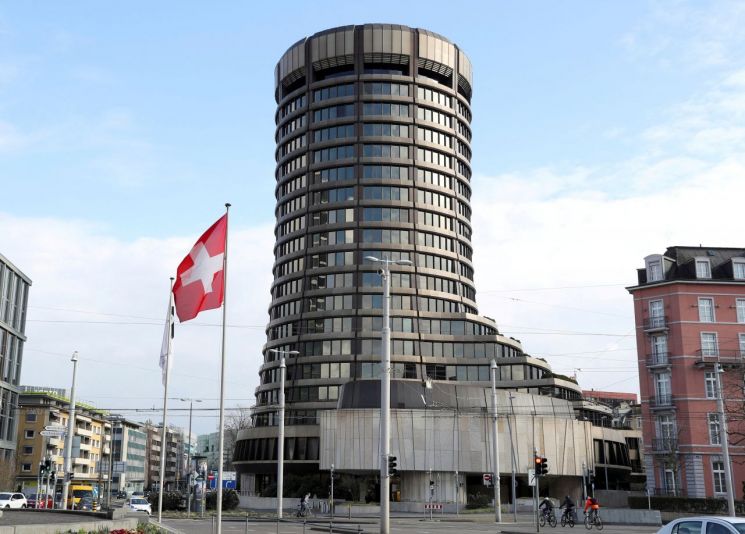 Headquarters of the Bank for International Settlements (BIS) in Basel, Switzerland
 Photo by Reuters Yonhap News
[Asia Economy Reporter Park Byung-hee] The Bank for International Settlements (BIS) advised central banks worldwide to raise benchmark interest rates more quickly and aggressively to prevent the entrenchment of irreversible high inflation.
According to the Wall Street Journal (WSJ) on the 26th (local time), the BIS stated in its annual report released that day that major countries are at a turning point entering an era of persistent high inflation where high price increases become the norm, and stronger measures are necessary. Although central banks, including the U.S. Federal Reserve (Fed), have recently implemented aggressive tightening measures to curb inflation?such as the Fed’s 'giant step' (a 0.75 percentage point increase in the benchmark interest rate) for the first time in 28 years?the BIS pointed out that these efforts are insufficient.
Besides the Fed, the BIS warned that countries like Australia, Canada, New Zealand, Switzerland, and Norway have recently decided on 'big steps' (0.5 percentage point increases in benchmark interest rates), but the real interest rates in these countries, including the U.S., remain negative. Because real interest rates are severely negative, the BIS believes that central banks are effectively stimulating economic activity rather than restraining it, even amid soaring inflation.
The BIS diagnosed that "the pace of benchmark interest rate hikes is not keeping up with the rate of inflation, causing real interest rates to fall," and that "a decline in real interest rates is incompatible with the need to control inflation." It further emphasized that "considering the increased inflationary pressures over the past year, a substantial increase in benchmark interest rates to reduce demand will be necessary."
The BIS warned that if central banks do not take decisive action, the global economy risks falling into entrenched high inflation similar to the 1970s. It also cautioned that even if central banks act decisively, the economy could enter stagflation, characterized by high inflation and low growth. Some degree of pain is inevitable under the current circumstances.
The BIS pointed out that major advanced economies are on the verge of entering a high inflation environment where rapid price increases become the norm. It noted that such high inflation situations are very rare but extremely difficult to reverse. Furthermore, the BIS advised that central banks should not hesitate to endure short-term pain and must be willing to accept a recession to prevent persistent high inflation.
Agustin Carstens, General Manager of the BIS, emphasized, "It is important for central banks to act quickly and decisively before inflation becomes entrenched."
A BIS study of 35 countries from 1985 to 2018 confirmed that when inflation rises and real interest rates remain low, the likelihood of an economic recession increases during the implementation of monetary policy tightening by central banks.
Additionally, the longer high inflation persists, the more likely it is to remain at elevated levels. When prices are high, people are willing to pay higher costs and act accordingly. Workers who have lost purchasing power demand wage increases, which in turn intensifies inflationary pressures.
According to the Federal Reserve Bank of Atlanta, the current wage growth rate in the U.S. is 6.1%. In Europe, Deutsche Bank expects wage growth to rise to 5% by the end of this year and for this trend to continue through the end of 2023.
© The Asia Business Daily(www.asiae.co.kr). All rights reserved.
![User Who Sold Erroneously Deposited Bitcoins to Repay Debt and Fund Entertainment... What Did the Supreme Court Decide in 2021? [Legal Issue Check]](https://cwcontent.asiae.co.kr/asiaresize/183/2026020910431234020_1770601391.png)















