The living population relative to the registered population is concentrated in the southwestern area but is evenly distributed throughout Seoul
Yongsan, Seocho, and Gangnam show high proportions of English speakers, people in their 30s and 40s, and professionals
[Asia Economy Reporter Lim Cheol-young] With more than 380,000 foreigners living throughout Seoul, it was found that the nighttime population is concentrated in the southwestern area, while during the daytime, foreigners live in various districts such as Seodaemun, Mapo, Jongno, Gwangjin, and Gangnam. In particular, Sinchon-dong in Seodaemun-gu and Seogyo-dong in Mapo-gu have emerged as new hubs where foreigners living in Seoul gather.
On the 27th, the Seoul Metropolitan Government announced the results of the "Seoul Foreign Resident Living Population Distribution" survey using big data. This survey was conducted in cooperation with the Migration Policy Research Institute to identify the living population in foreigner-dense areas through the living population big data held by the city, to be used as reference material for foreign resident support policies.
Seoul analyzed living population data by dividing long-term foreign residents (foreigners subscribed to KT who stay in Korea for more than 90 days) into residential and living areas, based on 3 a.m. and 3 p.m. on April 4, across 25 autonomous districts and 425 administrative neighborhoods in Seoul. According to the survey, the registered foreign population in Seoul was 363,887 as of the end of March according to Ministry of Justice statistics, but the living population in Seoul was higher at 384,036.
While the registered population appears to be mainly concentrated in Guro-gu, Geumcheon-gu, and Yeongdeungpo-gu, the living population is evenly distributed throughout Seoul. Notably, the living population in the southwestern three zones was lower compared to the registered population, whereas in Dongdaemun, Gwangjin, Mapo, and Yongsan, the living population exceeded the registered population. Additionally, unlike other districts where populations have dispersed to surrounding areas after the COVID-19 situation, the southwestern area showed a trend of population concentration in certain administrative neighborhoods such as Daerim 2-dong, Daerim 3-dong, and Guro 2-dong.
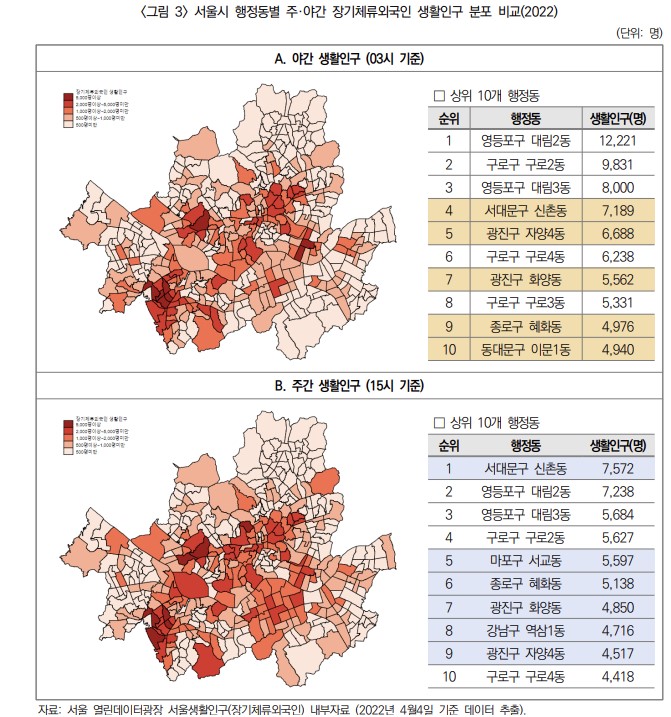
Specifically, analysis of long-term foreign resident living populations by 425 administrative neighborhoods during day and night revealed that the southwestern area mainly has a higher nighttime population, while during the day, foreigners live in various districts including Seodaemun, Mapo, Jongno, Gwangjin, and Gangnam. Sinchon-dong in Seodaemun-gu and Seogyo-dong in Mapo-gu have particularly emerged as new dense areas where foreigners living in Seoul gather.
The nighttime population was generally concentrated in the southwestern area (Guro-gu and Yeongdeungpo-gu), and outside this area, Sinchon-dong in Seodaemun-gu (4th), Jayang 4-dong (5th) and Hwayang-dong (7th) in Gwangjin-gu, Hyehwa-dong in Jongno-gu (9th), and Imun 1-dong in Dongdaemun-gu (10th) ranked within the top 10. The daytime population ranked within the top 10 as follows: Sinchon-dong in Seodaemun-gu (1st), Daerim 2-dong (2nd) and Daerim 3-dong (3rd) in Yeongdeungpo-gu, Guro 2-dong in Guro-gu (4th), Seogyo-dong in Mapo-gu (5th), Hyehwa-dong in Jongno-gu (6th), Hwayang-dong in Gwangjin-gu (7th), Yeoksam 1-dong in Gangnam-gu (8th), Jayang 4-dong in Gwangjin-gu (9th), and Guro 4-dong (10th).
Additional analysis of the registered long-term foreign resident population in Seoul showed a tendency to form residential clusters based on country of origin and language group, with differences in visa status and age distribution by district. By language group, over 90% of the southwestern area is Chinese-speaking, while Yongsan, Seocho, and Gangnam have many English speakers, and the northwestern areas such as Jungnang, Gwangjin, and Seongbuk have recently seen an increase in Mongolian speakers.
Regarding visa status, professionals and similar categories showed relatively high proportions in Yongsan, Seocho, Mapo, and Gangnam, while students were more concentrated in Dongdaemun, Seodaemun, Seongbuk, Gwangjin, and Gwanak, where universities are located. By age group, areas near universities such as Dongdaemun, Seodaemun, Seongbuk, Gwangjin, and Jongno had many people in their 20s, while Yongsan, Gangnam, Seocho, and Songpa had higher proportions of people in their 30s and 40s. The southwestern area showed a higher population aged 50 and above, indicating an aging trend.
Kim Seon-soon, Director of the Seoul Metropolitan Government’s Women and Family Policy Office, stated, "The living population is a statistical data that better captures the demand and supply of urban and administrative services than the registered population counted in administrative statistics. Since foreign resident support policies are important to solve population decline issues and strengthen global urban competitiveness, we will actively develop and implement policies tailored to the characteristics of foreign living populations concentrated in each district based on these survey results."
© The Asia Business Daily(www.asiae.co.kr). All rights reserved.

















