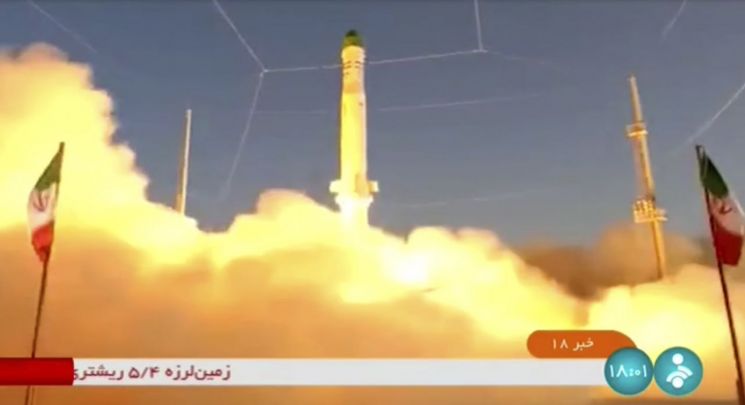
[Asia Economy Reporter Kim Hyunjung] Iran, which agreed to resume negotiations to restore the nuclear deal (JCPOA - Joint Comprehensive Plan of Action), reportedly launched a satellite launch vehicle using solid fuel, according to local media including Iran's state TV on the 26th (local time).
The semi-official news agency Fars posted a video on Twitter on the same day, describing it as footage of the launch of the solid-fuel satellite launch vehicle "Zuljanah." Iran's state TV also officially mentioned that the second test launch of the Zuljanah satellite launch vehicle took place on the same day.
The exact location and time of the launch are unclear, and it has not been confirmed whether the launch was successful. However, major foreign media outlets estimated that the launch preparations took place at the Imam Khomeini Spaceport in Semnan Province, where launches have frequently failed.
Iran had already acknowledged plans for additional tests of the satellite-carrying launch vehicle first launched in February last year. Seyyed Ahmad Hoseini, spokesperson for the Ministry of Defense, stated, "The third phase of development for the Zuljanah satellite launch vehicle will be based on the information obtained from today's test launch."
He also revealed that the launch vehicle is 25.5 meters long and can carry a 220 kg satellite, which will collect data in low Earth orbit and contribute to the development of Iran's space industry.
In December last year, Iran launched the satellite launch vehicle "Simorgh," but it was reported that the satellite failed to reach its target orbit at that time.
This rocket launch news came ahead of the nuclear deal restoration negotiations, which had reached a deadlock in the final stages. After visiting Iran the previous day, Josep Borrell, High Representative of the European Union for Foreign Affairs and Security Policy, and Iranian Foreign Minister Amir-Abdollahian announced at a joint press conference that negotiations would resume within days.
In 2015, Iran and six countries?the United States, France, the United Kingdom, Russia, China, and Germany?agreed to lift economic sanctions on Iran by the US, UN, and EU in exchange for freezing or reducing Iran's nuclear program. However, in 2018, former US President Donald Trump unilaterally withdrew from the nuclear deal and reinstated sanctions on Iran. In response, Iran limited IAEA inspections and increased uranium enrichment levels. Negotiations to restore the agreement began in April last year after the inauguration of the Joe Biden administration.
© The Asia Business Daily(www.asiae.co.kr). All rights reserved.

















