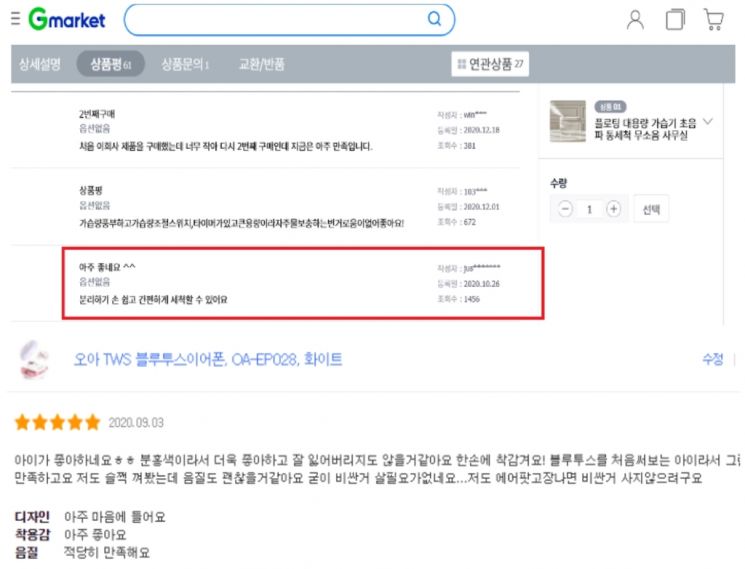
 Small home appliance company Oa was fined for hiring part-time workers and instructing them to leave false reviews about its products. The photo shows false reviews of Oa products posted on an online shopping mall. Photo by Korea Fair Trade Commission, Yonhap News Agency
[Asia Economy Intern Reporter Kim Se-eun] A business operator who mobilized part-time workers to leave thousands of fake reviews on its products sold on online shopping malls has been caught.
On the 26th, the Fair Trade Commission announced that it would impose corrective orders and a fine of 140 million won on Oa for violating the Act on Labeling and Advertising. Corrective orders will also be issued to the advertising agencies UN Media and Cheongnyeon Distribution.
Oa's method is called so-called 'empty box marketing.' Empty box marketing is a method of inducing customers to purchase the company's products and then sending an empty box without the product inside, thereby gaining the authority to write reviews.
Vacuum cleaners, electric toothbrushes, humidifiers, and other products sold on internet shopping malls such as Naver Smart Store, Gmarket, Coupang, and KakaoStory were targeted for manipulation. From May 2020 to May last year, the number of fake reviews for Oa products written over one year reached about 3,700 across 100 product groups.
Using empty box marketing costs less than the typical 'viral marketing,' which expects positive reviews by sponsoring actual products. It also helps avoid crackdowns on review manipulation in internet shopping mall businesses.
The advertising agencies UN Media and Cheongnyeon Distribution recruited part-time workers through KakaoTalk under the nickname 'Review Captain.' After the part-timers purchased products and wrote reviews, they were paid about 1,000 won per review.
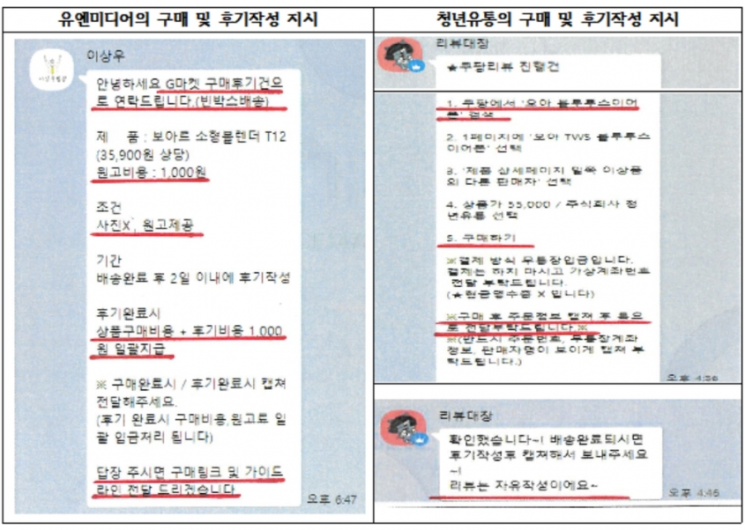 Small home appliance company Oa, which hired part-time workers and instructed them to leave false reviews about its products, has been fined. Photo by Korea Fair Trade Commission, Yonhap News Agency
The part-timers ordered items using their personal IDs and payment methods, then wrote reviews based on manuscripts, photos, and videos provided by the agencies. Additionally, reviews written autonomously by the part-timers were added to make it difficult to determine whether the reviews were manipulated.
The Fair Trade Commission pointed out, "Consumers who see fake reviews may mistakenly believe that the product has already been sold extensively and that its quality and performance are excellent."
It further explained the background of the unfair trade violation ruling, saying, "As the number of reviews, ratings, and purchases increase, the exposure ranking within the shopping mall also rises, causing damage to other competing companies."
Moreover, it stated, "The reputation created by fake review advertisements even affected sales in offline markets. Empty box marketing is malicious in its form and means, and its scale is large, so strict sanctions are necessary."
In fact, Oa's products were also sold in offline stores such as E-Mart, Lotte Mart, Hi-Mart, and Olive Young.
© The Asia Business Daily(www.asiae.co.kr). All rights reserved.


















