Unable to Train Next-Generation Technicians Due to Decreased Investment in Nuclear Power Industry
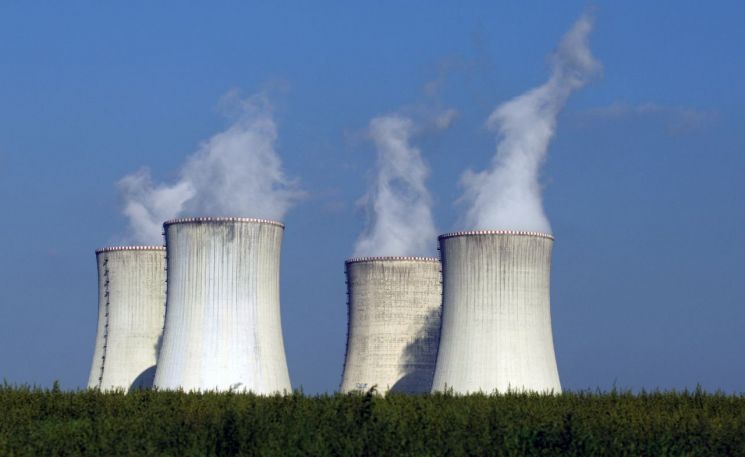 Dukovany Nuclear Power Plant in the Czech Republic. The photo is unrelated to specific expressions in the article. [Image source=Yonhap News]
[Asia Economy Reporter Yoon Seul-gi] Although the United States and Europe are returning to nuclear power generation, they are facing difficulties due to the previous 'nuclear power gap period.' Decades of reduced investment in the nuclear power industry have resulted in a failure to cultivate next-generation nuclear power technicians, leading to a shortage of experienced engineers.
Recently, The Wall Street Journal (WSJ) reported that countries increasing investment in the nuclear power industry to reduce dependence on Russian energy and achieve carbon neutrality by effectively reducing carbon dioxide emissions to 'zero' are struggling with a lack of knowhow.
Due to safety and other reasons, nuclear facility construction was halted for decades, and now, as they suddenly attempt to build reactors, they are experiencing difficulties in recruiting experienced technicians.
As a result, in the United States and Europe, some ongoing reactor construction projects have faced delays in completion or budget overruns.
In France, the completion of the next-generation European Pressurized Reactor (EPR) under construction in Flamanville on the Normandy coast has been delayed by more than 10 years. Originally scheduled for completion in 2012, welders are still correcting over 100 issues discovered seven years ago around the cooling system of the pressurized water reactor.
In the United States, the nuclear power plant in Georgia, being built for the first time in over 30 years, has also been delayed, with the budget exceeding by trillions of won. The South Carolina nuclear plant was also halted in 2010 due to welding defects.
At Finland's Olkiluoto Nuclear Power Plant Unit 3, completed last year, problems were revealed where incomplete welding reduced the waterproofing ability of the concrete floor supporting the reactor.
The media analyzed that the continuous emergence of problems in technical fields such as welding is due to reduced investment in nuclear power, which prevented the cultivation of nuclear technicians for decades, and that existing technicians have retired over time. Western countries had effectively stopped reactor construction after the 1979 Three Mile Island accident in Pennsylvania, USA, and the 1986 Chernobyl accident.
Given this situation, countries are focusing on training technicians. France, which plans to build 14 reactors, is currently educating thousands of technicians.
Meanwhile, TerraPower, a reactor company founded by Microsoft (MS) founder Bill Gates, pointed out that the shortage of skilled technicians is the biggest challenge in the nuclear power industry. TerraPower stated, "Experienced technicians in welding and construction are needed for reactor construction," adding, "Specialized training is required to cultivate some technicians."
© The Asia Business Daily(www.asiae.co.kr). All rights reserved.

















