Establishing an Early Infectious Disease Response System Considering Airport, Port, and Seoul Metropolitan Area Population
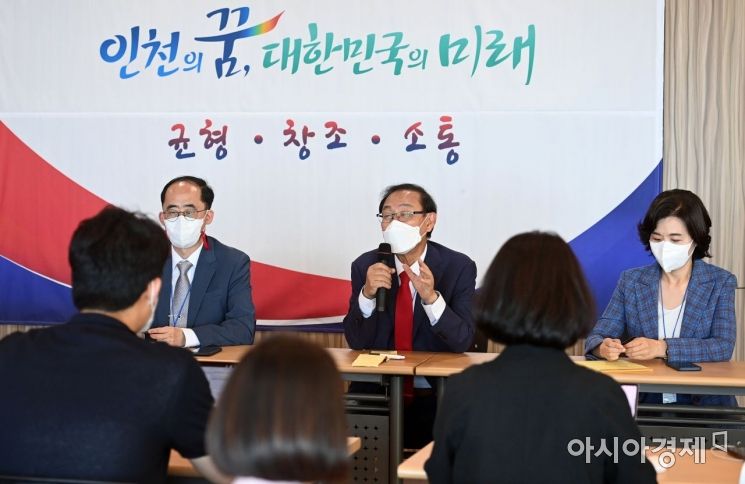 Jeong Yuseop, Chairman of the Incheon Mayor Transition Committee (center), is holding a meeting with reporters. [Photo provided by the Incheon Mayor Transition Committee]
[Asia Economy Reporter Park Hyesook] The transition committee for Incheon Mayor Yoo Jeong-bok has expressed the urgent need to establish an infectious disease specialized hospital in Incheon, as the first domestic monkeypox patient is currently hospitalized and receiving treatment at Incheon Medical Center.
The transition committee recently visited Incheon Medical Center and held a meeting with medical officials, stating on the 26th, "Considering Incheon's unique characteristics of international and domestic entry and exit through its international airport and port, we agreed on the necessity to establish a rapid initial response system for infectious diseases."
The first monkeypox patient is a man in his 30s who entered through Incheon Airport from Germany and is currently being treated at Incheon Medical Center.
Incheon City applied to the Korea Disease Control and Prevention Agency (KDCA) in January this year to be designated as a regional infectious disease specialized hospital to prevent infectious diseases and provide rapid treatment for its 3 million citizens and international and domestic users of the airport and port, but the application was rejected.
The KDCA designated five specialized hospitals nationwide by region: Yeongnam, Honam, Jungbu, Gyeongbuk, and the Seoul metropolitan area.
The reason for Incheon's rejection is known to be due to the applying private hospital's low COVID-19 treatment performance over the past three years and the low self-pay rate required from the hospital when constructing a specialized hospital.
However, the transition committee and city officials believe this evaluation overlooked the regional characteristics of having an international airport and port, as well as the fact that 25 million people, half of the population, live in the Seoul metropolitan area including Incheon. They especially consider that at least two to three specialized hospitals should exist given the metropolitan population.
The transition committee plans to propose to the 8th elected city government the additional designation of infectious disease specialized hospitals by establishing a cooperative system with local medical infrastructure such as Gil Hospital, St. Mary's Hospital, Incheon Medical Center, Inha University Hospital, and the future Songdo Severance Hospital and Cheongna Asan Hospital.
A transition committee official stated, "Incheon, with its airport and port, is the primary gateway to block the inflow of new infectious diseases, and must have specialized personnel and facilities to manage this. We will continuously request the government for additional designation of infectious disease specialized hospitals to establish a system for infectious disease prevention and rapid treatment."
© The Asia Business Daily(www.asiae.co.kr). All rights reserved.

![A Woman with 50 Million Won Debt Clutches a Stolen Dior Bag and Jumps... A Monster Is Born [Slate]](https://cwcontent.asiae.co.kr/asiaresize/183/2026021902243444107_1771435474.jpg)















