Labor Sector Announces Estimated Job Losses Next Year by Scenario
① 10,000 KRW (9.2% increase) up to 165,000 jobs
② 10,500 KRW (14.6% increase) up to 264,000 jobs
③ 10,890 KRW (18.9% increase) up to 340,000 jobs lost
Accommodation, Food Service, Youth... Employment Challenges May Persist Post-COVID
Despite Corporate Investment, 'Jobless Growth' Could Continue
Federation of Korean Industries Calls for Differential Application by Industry and Region in Policy Improvements
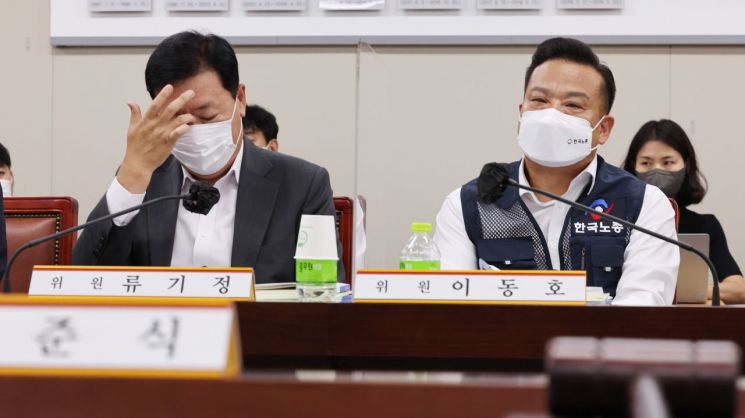 On the afternoon of the 21st, at the 5th plenary meeting held in the Minimum Wage Commission meeting room at the Government Complex Sejong in Sejong City, Ryu Ki-jung, Executive Director of the Korea Employers Federation, a user committee member (left), and Lee Dong-ho, Secretary General of the Korean Confederation of Trade Unions, a labor committee member, were present. On this day, the labor sector proposed an hourly minimum wage of 10,890 won for the next year. (Photo by Yonhap News)
[Asia Economy Reporter Moon Chae-seok] Amid fierce battles between labor and management over next year's minimum wage, concerns have been raised that excessively raising the minimum wage could lead to a sharp decline in jobs. Even under a more conservative scenario of paying 10,000 won per hour, compared to the labor sector's proposed 10,890 won per hour, an analysis predicts a nationwide reduction of up to 165,000 jobs.
On the 27th, the Federation of Korean Industries (FKI) presented the scale of job losses under various scenarios based on next year's minimum wage increase rates proposed by the labor sector, through a report titled "The Impact of Minimum Wage Increase on Employment," commissioned to Professor Choi Nam-seok of Jeonbuk National University. Using household panel data from the Korea Welfare Panel from 2017 to 2020, the report estimated the employment elasticity of the minimum wage and analyzed the effect of minimum wage increases on job losses. Employment elasticity is defined as the rate of change in jobs divided by the rate of change in the minimum wage for the given year.
At the 6th plenary meeting of the Minimum Wage Commission held on the 23rd, the labor sector proposed 10,890 won per hour, while the management sector proposed maintaining this year's rate of 9,160 won.
"Raising to 10,000 won could reduce jobs by 165,000"
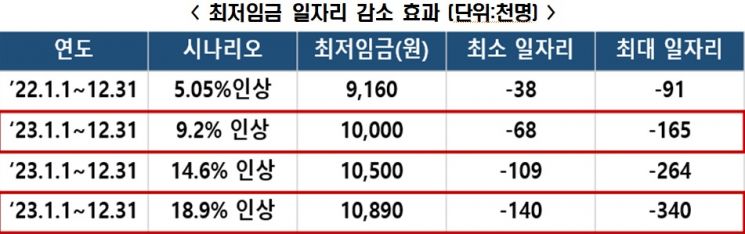
The analysis projects that raising this year's minimum wage of 9,160 won to 10,000 won next year could reduce jobs by up to 165,000. If raised to 10,890 won (an 18.9% increase) as demanded by the labor sector, job losses could reach up to 340,000. Under a mid-range scenario of 10,500 won (a 14.6% increase), up to 264,000 jobs are expected to disappear.
According to the latest employment trend data released by Statistics Korea on the 15th, employment increased by 935,000 in May, marking the highest record in 22 years for that month. However, nearly half of this increase, 459,000, were workers aged 60 and above, indicating a low "quality of employment." Workers aged 60 and above tend to be engaged more in short-term and daily jobs compared to other age groups. Looking at employment numbers by industry last month, health and social welfare services increased by 178,000, followed by public administration with 99,000. Most of these sectors are related to government-funded direct job creation projects.
In a situation where corporate investment and employment expansion are gaining momentum, a sudden increase in labor costs could lead to a gloomy outlook of "growth without employment."
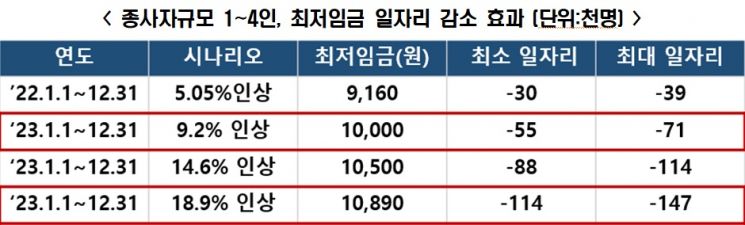
"If 10,000 won is realized, jobs in firms with fewer than 5 employees could drop by 71,000"
It is widely agreed that small business owners and self-employed individuals are likely to be hit hardest.
The report forecasts that if the minimum wage rises to 10,000 won next year, jobs in businesses with fewer than five employees could decrease by up to 71,000 (43% of the nationwide estimated 165,000 job losses). If raised to 10,890 won as demanded by labor, the decrease could reach up to 147,000.
According to the report, a 10.9% increase in the minimum wage in 2019 resulted in a loss of 277,000 jobs, with businesses having fewer than five employees accounting for up to 109,000 of those losses (39.4% of the total). This means about 40% of job losses occurred among small business operators.
Professor Choi pointed out, "Concerns about stagflation, where inflation and economic recession overlap, have grown since the analysis was conducted. Rapidly raising the minimum wage could trigger a vicious cycle of further inflation, and jobs in self-employed and small and medium-sized enterprises without the capacity to absorb these costs could be threatened more severely than expected."
"Seoul also hit hard... 50,000 jobs lost if 10,000 won realized"
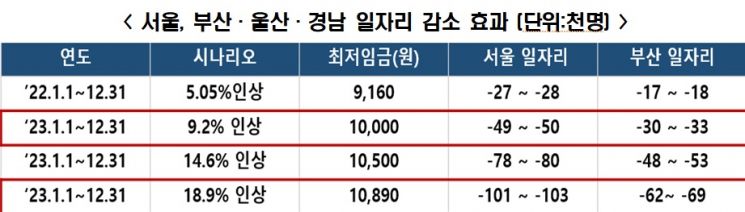
Even when separately investigating regions with statistically significant samples and large shares in the Korean economy, such as Seoul and the Busan-Ulsan-Gyeongnam area, scenarios of sharp job losses following a steep minimum wage hike could not be avoided.
In Seoul, up to 50,000 jobs are projected to be lost if the minimum wage reaches 10,000 won, while Busan, Ulsan, and Gyeongnam could see up to 33,000 jobs disappear. Particularly in Seoul, sectors like retail, accommodation, and food services, which were severely impacted by the COVID-19 pandemic, and areas with a high concentration of vulnerable youth workers, are prominent.
The FKI argued, "Seoul has many service industry employees in retail, accommodation, and food services, as well as many young workers who are vulnerable to minimum wage increases. Busan, Ulsan, and Gyeongnam traditionally have strong manufacturing sectors, but due to the decline of key industries, employment conditions have worsened, making small and medium-sized enterprises vulnerable to minimum wage hikes."
"Even after COVID ends... accommodation and food services could lose 41,000 jobs if 10,000 won realized"
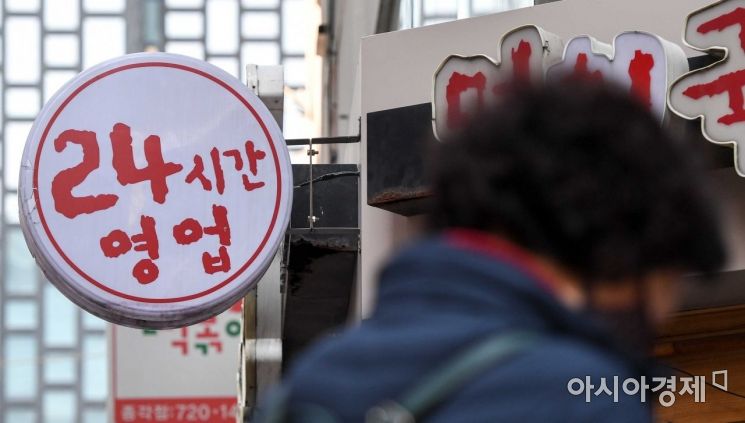
Industry and age group analyses yielded results similar to the expected job losses in Seoul. The accommodation and food service sectors, which suffered severe damage from the COVID-19 pandemic, and the youth demographic are expected to be hit hardest. If the hourly wage reaches 10,000 won, up to 41,000 jobs in accommodation and food services could be lost. Jobs among youth aged 15 to 29 could decrease by up to 45,000, and regular full-time jobs could decline by up to 28,000.
For these reasons, voices calling for the introduction of a differentiated application system by industry have grown, especially within the economic community, but the proposal was rejected at the 4th plenary meeting on the 16th.
Choo Kwang-ho, head of the Economic Policy Division at the FKI, emphasized, "With the prolonged Russia-Ukraine conflict causing global raw material supply shortages and price increases, the profitability of small businesses has deteriorated significantly. If the minimum wage also rises, the shock will inevitably be doubled. To ensure their survival, excessive minimum wage hikes should be restrained, and institutional improvements such as differentiated application by industry and region, and consideration of companies' payment capacity, are necessary to minimize side effects after the increase."
The legal deadline for next year's minimum wage deliberation is the 29th. Since the introduction of the minimum wage system in 1988, the Minimum Wage Commission has only met the legal deadline eight times, and except for 2014, it has exceeded the deadline every year in the past decade. Typically, deliberations have been conducted until mid-July, and last year, the deliberation and resolution occurred on July 12. The minimum wage announcement deadline is August 5 each year, and considering objection procedures, deliberations must be completed by mid-July at the latest.
© The Asia Business Daily(www.asiae.co.kr). All rights reserved.

![Clutching a Stolen Dior Bag, Saying "I Hate Being Poor but Real"... The Grotesque Con of a "Human Knockoff" [Slate]](https://cwcontent.asiae.co.kr/asiaresize/183/2026021902243444107_1771435474.jpg)

















