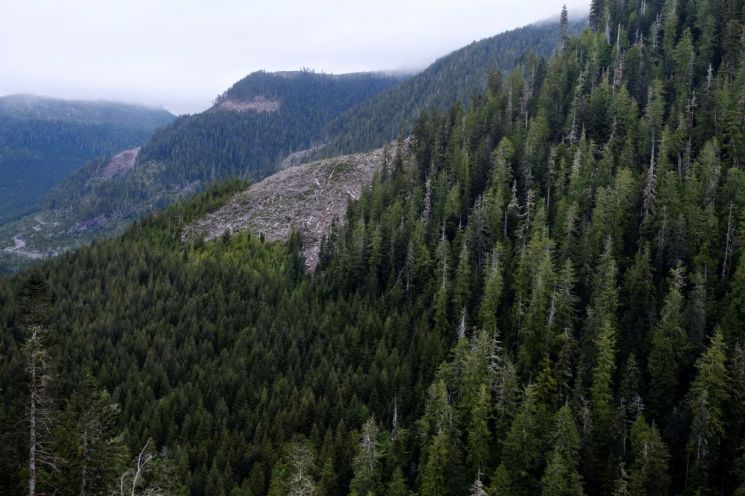
[Asia Economy Reporter Park Byung-hee] Concerns over forest destruction are growing due to the aftermath of the Ukraine war. According to major foreign media, Russia, Ukraine, and Belarus, which are involved in the war, are major timber-exporting countries, and as timber supplies from these countries decrease, logging is increasing in other countries.
Russia, Ukraine, and Belarus account for about one-quarter of the world's timber trade. Last year, they exported 850㎥ of coniferous timber to Europe, accounting for about 10% of Europe's timber demand. In particular, Russia is the world's largest exporter of coniferous timber, exporting about 4 million ㎥ of coniferous timber to Europe annually.
Currently, due to sanctions, timber exports from Russia and Belarus are impossible, and timber production in war-torn Ukraine is also difficult.
After the outbreak of the Ukraine war, as timber exports from these countries sharply declined, Estonia, Finland, and the United States expanded their timber exports, leading to increased logging.
The U.S. House Natural Resources Committee introduced a bill in April to ban imports of wood products from Russia and Belarus and allow domestic compensation for the reduced import volume. This permitted additional logging within the United States.
Estonia relaxed regulations restricting logging on state-owned land earlier this month. About half of Estonia's forests are state-owned. More than half of Estonia's timber is used as biofuel.
Finland is also expected to increase logging by about 3% annually for two years starting next year. Last year, Finland's forests decreased by more than 10% compared to the previous year, marking the largest reduction on record. With increased logging, Finland's forests were confirmed to have emitted more carbon than they absorbed for the first time this year.
Ukraine eased regulations banning logging from spring to early summer immediately after Russia's invasion on February 24 to protect forests. The purpose was to increase timber exports to secure funds for conducting the war. Environmentalists raised concerns about environmental destruction, although they acknowledged it was unavoidable during wartime. Ukraine's forests have suffered significant damage due to fires caused by the war.
To make matters worse, pests have recently appeared in forests in Central Europe and Alaska. Logging is also being carried out to prevent the spread of these pests.
In a situation where timber supply has already been tight since the COVID-19 pandemic, the war and pest outbreaks are making the situation even more difficult.
At the 26th United Nations Climate Change Conference of the Parties (COP26) held in Glasgow, UK, last November, more than 100 countries pledged to halt logging by 2030. However, few countries provided specific guidelines on how to implement this. In this context, forest protection has become even more challenging due to the Ukraine war.
© The Asia Business Daily(www.asiae.co.kr). All rights reserved.
![Clutching a Stolen Dior Bag, Saying "I Hate Being Poor but Real"... The Grotesque Con of a "Human Knockoff" [Slate]](https://cwcontent.asiae.co.kr/asiaresize/183/2026021902243444107_1771435474.jpg)











