Selection of Lead Institution for National Project
Targeting Mass Production of Hydrogen Engines for Medium and Large Commercial Vehicles by 2025
Advantages in Cost and Durability over Existing Hydrogen Fuel Cells
Emission Regulations 'Euro 7' and Carbon Dioxide Controls
"Increasing Demand for Hydrogen Engines... Market Leadership"
[Asia Economy Reporter Moon Chaeseok] As Hyundai Heavy Industries Group accelerates the establishment of a hydrogen supply chain, its construction equipment affiliate Hyundai Doosan Infracore is starting the development of hydrogen fuel engines. They plan to produce fuel engines for commercial vehicles, buses, and construction machinery. The company intends to enhance economic efficiency by leveraging over 30 years of accumulated technology in the internal combustion engine sector.
On the 26th, Hyundai Doosan Infracore announced that it was recently selected as the lead organization for the national project "Development of Hydrogen Engine Systems and Storage/Supply Systems for Construction Machinery and Commercial Vehicles," overseen by the Korea Institute for Advancement of Technology under the Ministry of Trade, Industry and Energy. Through this project, they aim to develop a 300 kW output, 11ℓ class hydrogen engine and hydrogen tank system capable of achieving "carbon zero." The goal is to equip and verify hydrogen engines in commercial vehicles such as trucks and large buses, as well as construction machinery like excavators, by 2024, and to begin full-scale mass production in 2025.
The hydrogen engine developed by Hyundai Doosan Infracore is considered one of the three major carbon-neutral powertrains alongside electric batteries and hydrogen fuel cells. A powertrain refers to all devices that generate and transmit driving force in a vehicle, including the engine. The hydrogen engine operates by modifying the fuel supply and injection systems of existing internal combustion engines to combust hydrogen, which is said to offer better price competitiveness than hydrogen fuel cells. Additionally, it can utilize existing internal combustion engine technologies and facilities, allowing for an accelerated commercialization timeline.
Fuel cells require high-purity hydrogen of 99.99% or higher, whereas hydrogen engines can operate with low-purity hydrogen, making them more economical. Electric batteries have low energy density relative to capacity, making them suitable for passenger cars. Hydrogen fuel cells have high energy density but are costly and require technological maturity to ensure durability in harsh operating environments. Considering all these factors, hydrogen engines are regarded as the most suitable engine system for construction machinery and medium-to-large commercial vehicles.
Hyundai Doosan Infracore developed Korea's first independent diesel engine in 1985. Since then, it has steadily built expertise in internal combustion engines through the production of construction heavy equipment, generators, and marine engines. With a solid foundation in internal combustion engine technology, the company plans to actively pursue market leadership in hydrogen engine development.
The market outlook is positive. Demand for eco-friendly engines in commercial vehicle brands is increasing ahead of the implementation of stricter Euro 7 emission and carbon dioxide regulations. This is why global automotive and engine manufacturers in countries such as the UK, Germany, and Japan are rushing to develop hydrogen engines. According to the global market research firm Market Statsville, the hydrogen engine market is expected to grow at an average annual rate of 8.74% from this year through 2030.
A Hyundai Doosan Infracore official stated, "The hydrogen engines we have started developing will be used not only in construction machinery and medium-to-large commercial vehicles such as trucks and buses but also in medium-to-large generators. We will do our best to develop hydrogen-related technologies, which are eco-friendly energy sources, in line with increasingly stringent carbon emission regulations to secure market leadership."
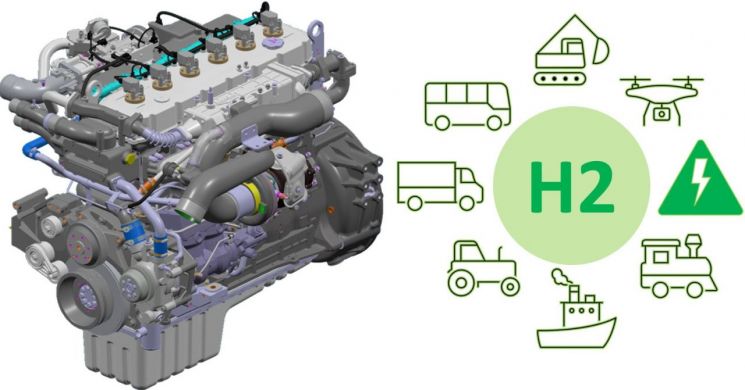 Concept image of Hyundai Doosan Infracore's carbon-free hydrogen engine 'HX12' and the product lineup it can be installed on. (Photo by Hyundai Doosan Infracore)
© The Asia Business Daily(www.asiae.co.kr). All rights reserved.
![User Who Sold Erroneously Deposited Bitcoins to Repay Debt and Fund Entertainment... What Did the Supreme Court Decide in 2021? [Legal Issue Check]](https://cwcontent.asiae.co.kr/asiaresize/183/2026020910431234020_1770601391.png)
















