UNIST Research Team Discovers Method to Convert White Adipocytes into Brown Adipocytes
Inhibition of TET Proteins in Body Induces Conversion to Brown Fat Cells
New Drug Development Target Identified, Potential Turning Point in Obesity Treatment

[Asia Economy Reporter Kim Bong-su] Domestic researchers have discovered a method to transform white fat, which accumulates in the body and causes obesity, into brown fat that burns away. This breakthrough could mark a revolutionary turning point in obesity treatment.
The Ulsan National Institute of Science and Technology (UNIST) announced that Professor Myung-Gon Ko's team in the Department of Life Sciences found that inhibiting TET proteins converts white adipocytes into brown adipocytes, while activating existing brown adipocytes, thereby promoting calorie consumption and preventing obesity.
The fat lumps we commonly know are white adipocytes. They are the main culprits that store excess nutrients inside cells, leading to weight gain. On the other hand, there are beneficial fat cells that burn nutrients away?these are brown adipocytes. In mice with suppressed TET protein expression in their adipose tissue, even when fed a high-fat diet, the size of fat cells did not increase, weight gain was inhibited, and metabolic disease indicators such as insulin resistance, hyperlipidemia, and fatty liver all improved. Professor Ko's team conducted these experiments based on the observation that TET proteins are overexpressed in the adipose tissue of obese mice.
Seong-Jun Byun, the first author and graduate student, explained, "The loss of TET proteins leads to increased expression and activation of the beta-3 adrenergic receptor." The beta-3 adrenergic receptor mediates signals from the brain that prompt fat cells to burn nutrients and generate heat.
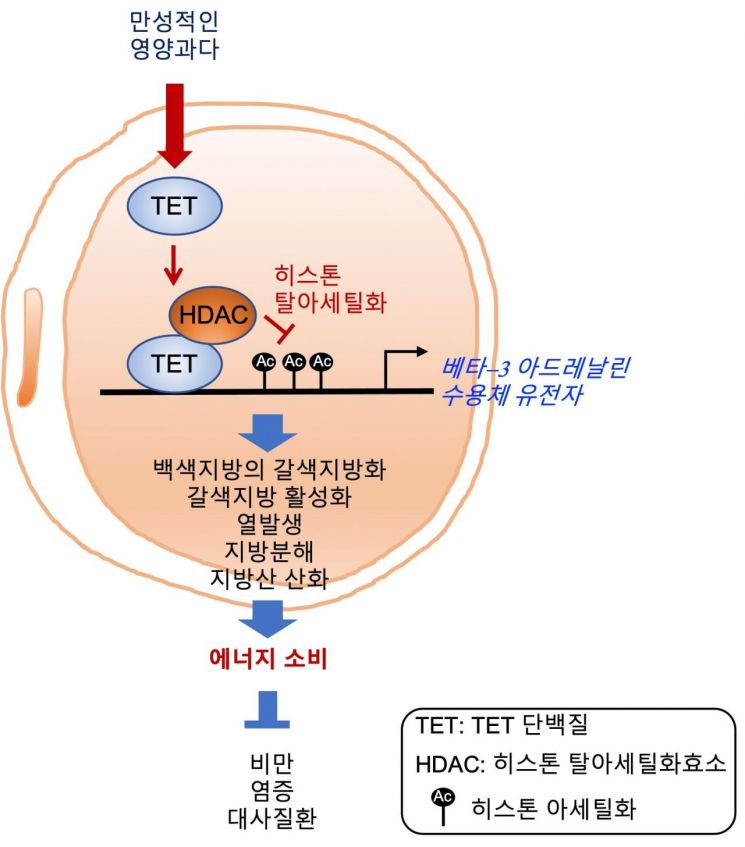
The specific role of TET proteins was also elucidated at the molecular level. TET proteins directly bind to enzymes that suppress gene expression and act as guides, directing these enzymes to the gene regions of the beta-3 adrenergic receptor.
Professor Myung-Gon Ko, who led the research, stated, "This is an important scientific discovery that proposes a treatment strategy for obesity and metabolic diseases by maximizing the body's energy consumption through the mechanism of TET proteins." He added, "It is expected to be a turning point in developing obesity treatments that can replace methods that directly act on brain nerves to suppress appetite or interfere with digestion and absorption."
Activating brown fat cells or converting white fat into brown fat cells is becoming a new target for obesity drug development. Based on these results, Professor Ko's team is conducting innovative drug development research to treat metabolic diseases such as obesity and diabetes by regulating the expression and activity of TET proteins.
This study also newly revealed that TET proteins, which regulate DNA methylation, are involved in histone protein deacetylation. DNA methylation and histone protein deacetylation are epigenetic phenomena that regulate gene expression without altering the innate DNA base sequence.
Conducted jointly with Professor Jung-Eun Ahn's team at Jeonbuk National University, this research was published on the 23rd (local time) in the Proceedings of the National Academy of Sciences (PNAS).
© The Asia Business Daily(www.asiae.co.kr). All rights reserved.
![Clutching a Stolen Dior Bag, Saying "I Hate Being Poor but Real"... The Grotesque Con of a "Human Knockoff" [Slate]](https://cwcontent.asiae.co.kr/asiaresize/183/2026021902243444107_1771435474.jpg)












