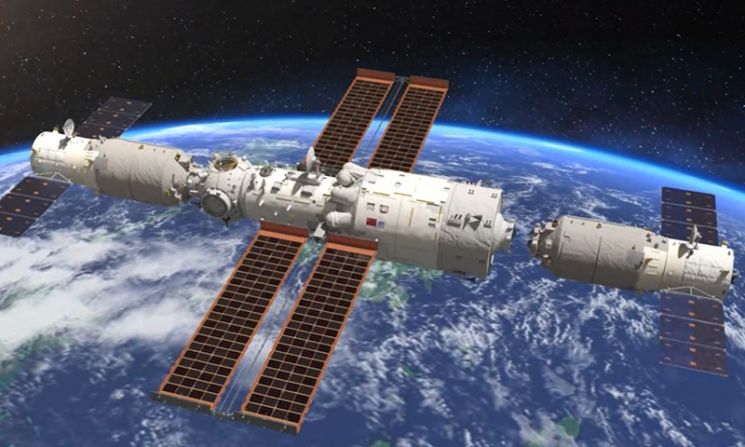
 Satellite image of China provided by the China National Space Administration (CNSA) [Image source=Yonhap News]
[Asia Economy Reporter Hwang Sumi] Amid ongoing tensions between the United States and China extending into the field of space development, it has recently come to light that a Chinese satellite conducted counter-surveillance on a U.S. reconnaissance satellite. This has led some to call for new norms in outer space, pointing out that such satellite behavior could cause misunderstandings and conflicts.
According to Yonhap News on the 25th, the U.S. space-specialized media outlet Space News reported that the Chinese satellites Shiyan-12-01 and Shiyan-12-02, which reached geostationary orbit this year, conducted counter-surveillance on the U.S. reconnaissance satellite USA 270. Upon arrival, these Chinese satellites moved in the opposite direction when the U.S. satellite approached for surveillance. Among them, the Shiyan-12-02 satellite reportedly positioned itself in a location where it could monitor USA 270.
Geostationary orbit refers to a circular orbit approximately 35,800 km above the equatorial plane, moving eastward at the same rate as the Earth's rotation, allowing satellites to remain fixed over a point on the Earth's surface. Many satellites, including communication satellites, broadcasting satellites, navigation satellites, and weather satellites, use this orbit. Due to radio interference issues, the number of satellites that can be placed in geostationary orbit is limited, so the International Telecommunication Union (ITU) coordinates orbit assignments among countries.
Notably, the United States has been monitoring this orbit with reconnaissance satellites since the 1990s. Reconnaissance satellites, also known as spy satellites, are military artificial satellites that observe the Earth's surface using optical devices and radio waves and relay information to the ground. However, in recent years, reconnaissance satellites from Russia and China have begun to follow this approach. As a result, satellites from various countries in geostationary orbit frequently engage in cat-and-mouse-like pursuits. The media viewed this as a measure to prevent the exposure of each satellite's capabilities or activities.
Some voices have emerged calling for new norms in outer space regarding encounters between U.S. and Chinese satellites. Brian Weeden, director at the Secure World Foundation, a non-governmental organization advocating for the peaceful use of outer space, pointed out, "The ambiguity and escalation of tensions caused by these satellite behaviors could lead to disputes or misunderstandings."
Meanwhile, the space development rivalry between the two countries appears to continue. Last year, China stated that SpaceX's Starlink satellites, led by Elon Musk, dangerously approached its space station Tiangong twice, prompting avoidance maneuvers. Subsequently, Chinese researchers voiced the need to develop capabilities to destroy or disable satellites that threaten their national security.
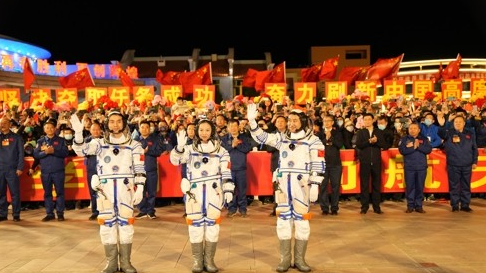
The United States is openly countering China's space ambitions and increasing pressure. In April, the Defense Intelligence Agency (DIA) under the U.S. Department of Defense identified China as a challenge and threat alongside Russia and North Korea in its '2022 Space Security Challenges Report.' Additionally, voices in the U.S. Congress accused China of stealing space technology.
This stems from the perception that China is weaponizing space and concerns about losing hegemony in the space sector. Furthermore, the presence of large deposits of helium-3 on the Moon, which can be used for nuclear power generation instead of uranium, among other mineral mining rights, is accelerating competition.
© The Asia Business Daily(www.asiae.co.kr). All rights reserved.


















