This Year's Average Retail Price of Watermelon 24,980 Won
Aftermath of Last Year's Mass Honeybee Deaths
Farmers: "Missed Pollination Period, Reduced Harvest"
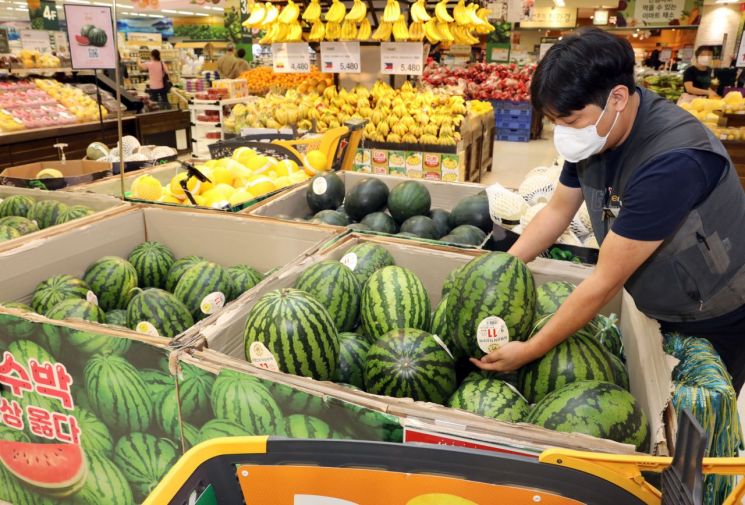
[Asia Economy Intern Reporter Lee Seohee] Farmers are facing difficulties due to the mass death of honeybees that occurred last winter. Crops such as watermelons and Korean melons, which require pollination every spring, missed their pollination period due to a nationwide shortage of honeybees. As a result, harvest volumes decreased, and wholesale and retail prices rose sharply.
According to the Agricultural Products Distribution Integrated Information System (Nongnet) on the 24th, the average wholesale price of watermelons this year is 2,184 KRW per kilogram. The wholesale price of watermelons rose from 1,462 KRW in 2020 to 1,595 KRW in 2021, and this year it exceeded 2,000 KRW. This is the first time in 10 years that the wholesale price has entered the 2,000 KRW range. The average selling price of a watermelon graded as ‘premium’ this year is 24,980 KRW, a 21% increase from last year’s 20,585 KRW.
The cause of the sharp rise in prices of fruits and vegetables such as watermelons and Korean melons is attributed to the ‘mass death of honeybees’ incident that occurred last year. Watermelons are a representative crop pollinated by honeybees, with about 90% of watermelon farms relying on honeybees for pollination. Especially to produce high-quality premium watermelons, the pollination period must be well-timed; if pollination does not occur during the short flowering period from March to early April, it is difficult to obtain large and solid fruits. However, between last winter and this spring, 7.8 billion honeybees nationwide died en masse. This is why the volume of watermelons brought into wholesale markets nationwide has significantly dropped compared to the average year.
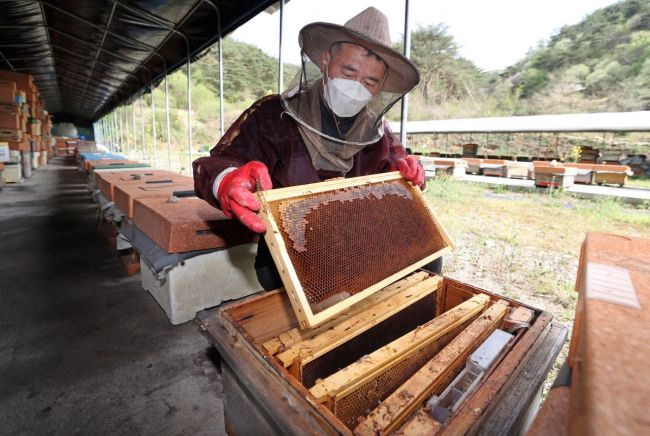
At the time, experts concluded that the mass death of honeybees was caused by a combination of abnormal climate and pests and diseases. Bees rest during winter to conserve energy for activity in spring, but last winter’s higher-than-average temperatures caused the bees to mistakenly think spring had arrived early, leading them to venture far out and die before returning to their hives. Additionally, strong winds and heavy rains last summer delayed the blooming of acacia flowers, and bees that could not consume enough nectar likely suffered weakened immunity and became infected with pests and diseases.
Farmers are seeking countermeasures by increasing artificial pollination rates or contracting with beekeepers at high prices. However, artificial pollination requires manually rubbing the stamens of male flowers onto the stigmas of female flowers, so farmers facing labor shortages are paying about 200,000 KRW per day to foreign workers to perform pollination. Farmers say it is better to hire laborers than to purchase a beehive colony, which has skyrocketed in price. Mr. Kang (39), who runs a farm in Chungju, Chungbuk, said, “The price of honeybees (beekeeping) that used to be 150,000 to 160,000 KRW has recently risen to 300,000 KRW and even up to 400,000 KRW. We had no choice but to hire laborers by paying wages, but this year we missed the pollination period and the harvest was delayed.”
Meanwhile, concerns have been raised that the mass death of honeybees could also affect the cultivation of apples and pears, whose harvest season is in autumn. Apples and pears are also representative crops pollinated by honeybees. In response, the Rural Development Administration announced on the 13th that it will “concentrate research capabilities in cooperation with the Korea Forest Service, Animal and Plant Quarantine Agency, and Ministry of Environment to solve the honeybee mass death problem.”
© The Asia Business Daily(www.asiae.co.kr). All rights reserved.
![Clutching a Stolen Dior Bag, Saying "I Hate Being Poor but Real"... The Grotesque Con of a "Human Knockoff" [Slate]](https://cwcontent.asiae.co.kr/asiaresize/183/2026021902243444107_1771435474.jpg)

















