[Asia Economy Reporter Changhwan Lee] Last month, the loss ratio of automobile insurance for domestic insurers was better than expected. There were concerns that the loss ratio would soar as social distancing measures were eased and vehicle usage increased. However, with a decrease in accident rates and insurers reducing operating expenses, the loss ratio is being managed stably.
According to the insurance industry on the 27th, the average automobile insurance loss ratio of 11 domestic non-life insurers for last month was 82.7%. This was not significantly different from 82.6% in the previous month and rose by 1.9 percentage points compared to 80.8% recorded in the same period last year.
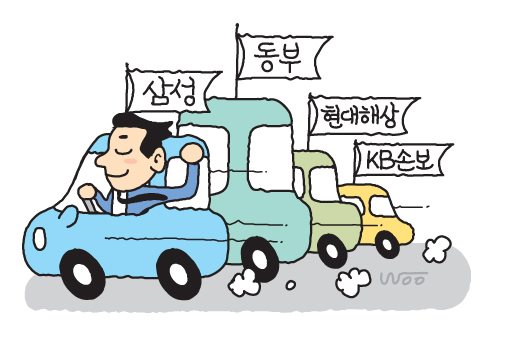
Despite the increase in traffic volume following the government's easing of COVID-19 social distancing, the automobile insurance loss ratio did not deteriorate significantly. Some insurers even showed improvements in their loss ratios. Hyundai Marine & Fire Insurance recorded an improvement of 2.8 percentage points from the previous month to 76.2%, and Meritz Fire & Marine Insurance improved by 1 percentage point to 75.4%. Lotte Insurance and MG Insurance also saw improvements in their loss ratios.
The cumulative automobile insurance loss ratio from January to May this year was 80.4%, improving by 2.4 percentage points compared to 82.8% in the same period last year. The insurance industry generally considers a loss ratio around 80% to be profitable when operating expenses are taken into account.
Despite increased traffic volume due to the endemic phase, the overall decline in accident rates, insurers' efforts to reduce operating expenses, and the rising trend in insurance premiums per vehicle have contributed to the improvement in the loss ratio.
Researcher Baeseung Jeon from Ebest Investment & Securities analyzed, "Despite the increase in driving volume, the structural decline in accident rates and the rising trend in insurance premiums per vehicle meant that the increase in automobile insurance loss ratios in April and May was not as large as feared."
With the continued improvement in automobile insurance loss ratios, there are expectations that insurers' second-quarter earnings will also be favorable. Automobile insurance, along with indemnity medical insurance, has been a representative deficit product, but due to reduced traffic during COVID-19, it recorded a surplus last year for the first time in four years.
However, as the second half of the year approaches, seasonal loss amounts are expected to increase due to the rainy season and vacation period, and some rise in loss ratios is inevitable with the continued easing of social distancing measures.
An official from an insurance company said, "The automobile insurance situation is not bad so far. However, there is a possibility that the situation may worsen compared to now in the second half of the year."
© The Asia Business Daily(www.asiae.co.kr). All rights reserved.

![Clutching a Stolen Dior Bag, Saying "I Hate Being Poor but Real"... The Grotesque Con of a "Human Knockoff" [Slate]](https://cwcontent.asiae.co.kr/asiaresize/183/2026021902243444107_1771435474.jpg)













