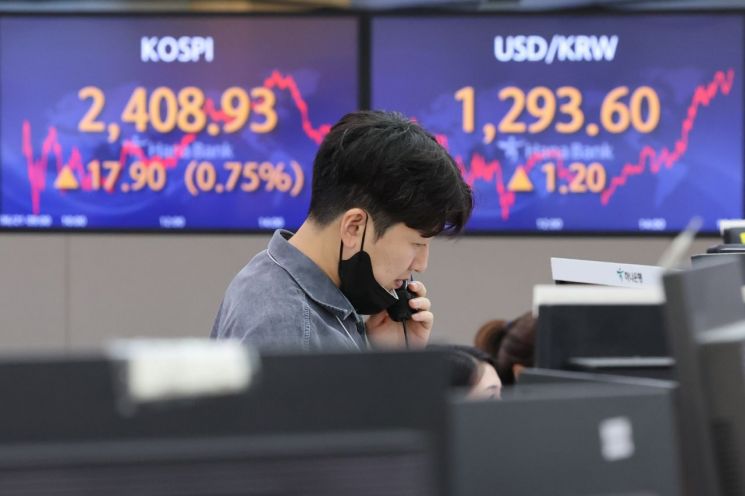
[Asia Economy Reporter Hwang Junho] The won-dollar exchange rate surpassed 1300 won, deepening the dark cloud over the stock market. With high inflation, high interest rates, and now the exchange rate peaking, fear in the stock market has intensified. Analysts suggest focusing on stocks with low price volatility risk amid all possible negative factors being in play.
On the 24th, the won-dollar exchange rate opened at 1300.00 won, down 1.8 won (0.14%) from the previous day. This is interpreted as an immediate reaction to the government hinting at market intervention. Securities firms weigh the possibility of the exchange rate rising to between 1320 and 1350 won. SK Securities researcher Ahn Young-jin said, "The dollar index was in the mid-80s back then but is now in the mid-100s," adding, "1300 won may not be an irrational level, and it is possible that the rate will temporarily stay in the 1300 won range without dropping."
It has become even more difficult to find a safe haven in the stock market. Even securities firms are struggling to recommend stocks easily. However, there is an analysis that suggests approaching the market with a strategy to create a safe zone through stocks that can control volatility.
Shinhan Financial Investment researcher Lee Jung-bin said, "The deterioration of investment sentiment due to anxiety is causing price adjustments," and added, "There is no safe haven, but such periods mostly provide opportunities to buy quality stocks at a discount." The stocks Lee focused on are those with solid earnings and that can be linked to stock price and earnings momentum. He advised, "The secret to remarkable cumulative returns in the mid-to-long term lies in earnings. It is important to find stocks with a high probability of securing strong earnings (earnings surprises) and where supply and demand align." Stocks such as Paradise, S-Oil, SK Innovation, POSCO International, Orion, Shinhan Financial Group, EcoPro BM, BH, Shinsegae International, and SL fall into this category.
Stocks that have avoided economic slowdown ahead of the second-quarter earnings announcements also deserve attention. Experts agree that a strategy to confirm this through inventory turnover indicators is effective. Kiwoom Securities researcher Choi Jae-won explained, "Generally, the inventory turnover indicator in domestic manufacturing tends to lead changes in corporate earnings forecasts," and added, "Looking at major industries separately, we can find sectors where the inventory turnover indicator is rebounding or bottoming out." The sectors he pointed out are electrical equipment manufacturing and food industries, which have seen inventory decreases and shipment increases since the beginning of the year.
There is also an opinion that a reappraisal of pharmaceutical stocks, which have a defensive nature in the economy, is necessary. In the case of prescription drugs, even if cost increases occur due to exchange rate rises, prices cannot be raised except for exit prevention products. Especially for prescription drugs tied to health insurance official prices, price increases are even more difficult. However, from a general perspective, the pure raw material cost ratio in pharmaceutical companies' sales is less than 20%. In particular, pharmaceutical companies source raw materials from China and mostly stockpile safety inventory in advance, so the impact of exchange rate increases is minimal. SangSangIn Securities researcher Ha Tae-gi predicted, "Pharmaceutical stocks will not be completely free from the influence of the exchange rate and inflation storms, but they will remain a relative safe haven in the second half of the year following the first half of 2022."
On the other hand, for KOSPI leaders Samsung Electronics and SK Hynix, which individual investors have been buying at lows, more time is expected to be needed for a rebound. Hi Investment & Securities researcher Park Sung-hyun analyzed, "As the semiconductor trade balance greatly influences the overall domestic trade balance, concerns about the semiconductor industry's downturn have increased due to reduced shipments of IT devices caused by inflation and weakened demand for memory semiconductors." Samsung Electronics and SK Hynix fell by 14.84% and 16.48%, respectively, over the course of this month.
© The Asia Business Daily(www.asiae.co.kr). All rights reserved.
![Clutching a Stolen Dior Bag, Saying "I Hate Being Poor but Real"... The Grotesque Con of a "Human Knockoff" [Slate]](https://cwcontent.asiae.co.kr/asiaresize/183/2026021902243444107_1771435474.jpg)
















