Demand Remains Strong but Transaction Share ↓
Non-Apartment Jeonje Lease Exceeds 9% This Year
[Asia Economy Reporter Hwang Seoyul] Non-apartment housing such as villas, which gained popularity as alternatives amid soaring apartment prices, has recently become highly sought after due to concerns over the rental deposit shortage. As rental deposit prices rise, there is an increasing shift to so-called ‘banjeonse’ (half-jeonse), where the existing rental deposit remains the same but the monthly rent is increased. With more landlords planning to raise rental deposits in new contracts, experts warn that the rental deposit shortage will worsen.
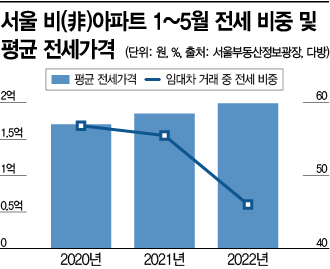
According to the Seoul Real Estate Transaction Plaza on the 24th, from January to May this year, the proportion of jeonse (rental deposit) contracts among all lease transactions for non-apartment housing such as row houses, multi-family houses, detached houses, and multi-unit houses in Seoul was 45.58%. This is a 10.39 percentage point decrease compared to the same period two years ago before the implementation of the three lease laws (55.97%), and a 9.1 percentage point drop from last year (54.68%).
However, on the ground, there are reactions that jeonse demand has actually increased. A representative from real estate agency A in Mapo-gu said, "About 5 out of 10 customers are looking for jeonse, which is more than before, but due to insufficient supply, many just leave or end up paying a bit more in monthly rent." The head of real estate agency B in Dongdaemun-gu also said, "There were students looking for jeonse just now, but we had no choice but to turn them away."
The reason for the decrease in transaction proportion despite steady jeonse demand is interpreted as the difficulty in finding properties at the price range desired by tenants due to rising jeonse prices. According to the real estate platform Dabang, the average jeonse price in Seoul from January to May this year was 198.23 million KRW (as of the 20th), a 16.85% increase compared to the same period in 2020 (169.65 million KRW). The head of real estate agency C in Nowon-gu said, "There are cases where people come looking for jeonse based on previous prices but leave without finding a property in their desired price range."
On the other hand, quasi-jeonse, where the deposit exceeds 240 months’ worth of monthly rent, has increased. From January to May this year, quasi-jeonse accounted for 9.12% (11,385 cases) of all non-apartment lease transactions, up from 8.12% (8,984 cases) last year and 7.03% (7,870 cases) in 2020 during the same period.
The market expresses concerns that tenants displaced from apartments to villas due to the sharp rise in apartment jeonse and monthly rents will face a ‘triple hardship.’ Recently, villa jeonse prices have surged significantly, and many tenants are unable to prepare the increased rental deposit, resulting in monthly cash outflows. There is even speculation that both deposits and monthly rents could rise simultaneously in August, marking two years since the lease law was enacted. A representative from agency A said, "Many landlords intend to steadily raise the contract amount by at least 5% upon renewal," adding, "For those who are not rental business operators, jeonse is priced to be let out."
© The Asia Business Daily(www.asiae.co.kr). All rights reserved.

![Clutching a Stolen Dior Bag, Saying "I Hate Being Poor but Real"... The Grotesque Con of a "Human Knockoff" [Slate]](https://cwcontent.asiae.co.kr/asiaresize/183/2026021902243444107_1771435474.jpg)















