Won-Dollar Exchange Rate Surpasses 1300 Won for the First Time in 13 Years
Duty-Free Industry Prepares Self-Help Measures Including Exchange Rate Compensation Events
Final Price Appeal Declines → Concerns Over Continued Consumer Sentiment Weakening
Consumer Burden Must Be Reduced Through Increased Duty-Free Allowance
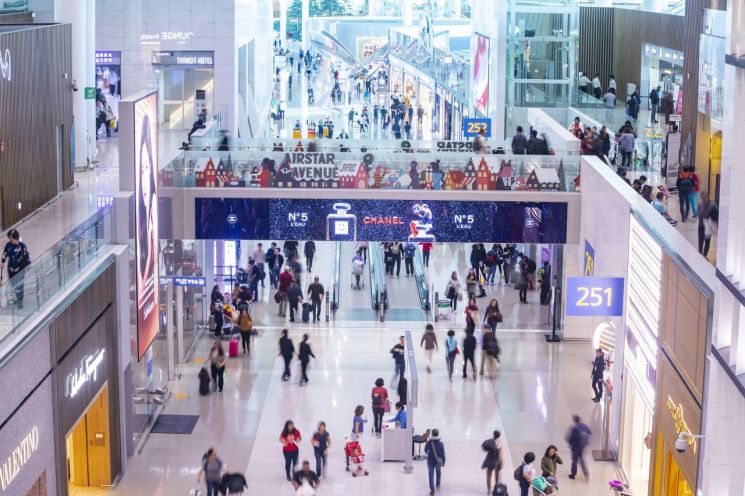
[Asia Economy Reporter Kim Yuri] The won-dollar exchange rate surpassed 1,300 won for the first time in 13 years, deepening concerns in the duty-free industry. The industry has launched self-help measures to minimize the price burden on consumers, such as exchange rate compensation events, but worries remain high as the exchange rate burden is expected to continue for the time being.
On the 23rd, the won-dollar exchange rate closed at 1,301.8 won, up 4.5 won from the previous day. This is the first time since July 13, 2009 (1,315.0 won) that the exchange rate has exceeded 1,300 won at closing. As the won-dollar exchange rate surpassed 1,300 won, the retail sector is also on edge. Especially the duty-free industry, which directly feels the impact of the exchange rate due to duty-free goods being sold in dollars, has recently taken self-help measures such as launching exchange rate compensation events amid the high exchange rate situation.
Lotte Duty Free is currently running a 'Dynamic Exchange Rate Compensation Event' for customers who feel burdened by shopping for duty-free goods due to the recent high exchange rate. Launched for the first time in April, this event provides LDF PAY based on the won-dollar exchange rate and purchase amount. At Lotte Duty Free downtown stores, if the store’s reference exchange rate is between 1,250 won and 1,300 won, customers receive up to 20,000 won worth of LDF PAY, and if it exceeds 1,300 won, up to 35,000 won worth of LDF PAY is given, reducing the perceived price for consumers. At Lotte Internet Duty Free, if the reference exchange rate is 1,250 won or higher, 'The Dream' points worth up to 175 dollars, which can be used immediately, are given according to the purchase amount.
Shilla Duty Free has also increased discount rates and launched S Rewards giveaways. At the Seoul and Jeju stores, fashion and sunglasses brands such as Bally, Kenzo, and Coach are offered at discounts of up to 70%. The Seoul store especially offers watches and jewelry brands such as Rosemont, Ferragamo, Oris, Swarovski, and Stonehenge at discounts of up to 45%. Cosmetics brands like Fresh, Clinique, MAC, and Dr.G are also sold at discounts of up to 50%. The Jeju store is holding a season-off event with fashion brands like Longchamp, Bally, Kenzo, and Coach discounted up to 70%.
The Seoul and Jeju stores are also running events giving up to 1.81 million S Rewards points (equivalent to about 2.3 million won in cash) to customers who make purchases. This is also aimed at reducing the final price burden on buyers caused by the exchange rate and other factors. They are also running vacation expense support promotions. Until July 10, at the Seoul store, customers who purchase over 700 dollars or 1,500 dollars on the same day receive 30,000 or 50,000 S Rewards points respectively. At the Incheon Airport store, an additional 10,000 S Rewards points are given for purchases over 150 dollars.
Despite these efforts, the industry is concerned that if the exchange rate burden increases and the final price attractiveness decreases, consumer sentiment may weaken. The duty-free industry, which suffered greatly from COVID-19 over the past two years, is in a situation where there is a time gap between expectations and actual recovery as it returns to normal with the endemic (periodic outbreak of infectious diseases), and the exchange rate issue is a significant burden, according to a common industry view. An industry official said, "With the exchange rate soaring, there is even a reversal phenomenon where prices applied to duty-free goods are more expensive than general retail products, which is worrisome." He added, "Each company is actively implementing exchange rate compensation and monetary promotions to lower the perceived price for customers and attract them, but since these costs are borne by each company, the burden will be significant if this becomes a long-term battle."
In this situation, the duty-free industry has raised its voice for the increased duty-free allowance it has long advocated. The key is the final price consumers feel, which includes taxes. Currently, the duty-free allowance per person is 600 dollars (about 780,000 won). Earlier in March, the government abolished the domestic consumers’ duty-free purchase limit of 5,000 dollars, but the industry agrees that without adjusting the duty-free allowance, it is difficult to expect significant changes in performance. The duty-free industry CEOs recently voiced their opinions on raising the duty-free allowance during a meeting with the Commissioner of the Korea Customs Service, who shared the current industry situation. An industry official said, "Since the Korea Customs Service has promised to prepare support measures that can be felt on the ground, there is some expectation," adding, "Government-level support is urgently needed so that the industry, which has been stagnant due to COVID-19, can turn the tide despite these difficulties."
© The Asia Business Daily(www.asiae.co.kr). All rights reserved.
![Clutching a Stolen Dior Bag, Saying "I Hate Being Poor but Real"... The Grotesque Con of a "Human Knockoff" [Slate]](https://cwcontent.asiae.co.kr/asiaresize/183/2026021902243444107_1771435474.jpg)
















