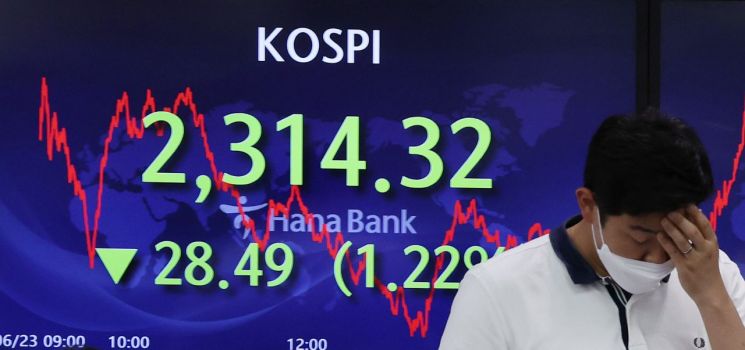
[Asia Economy Reporter Kwon Jaehee] On the 23rd, the KOSPI and KOSDAQ indices recorded new yearly lows for two consecutive days due to a near panic selling by foreign investors. Amid fears of an economic recession, the securities industry even lowered the KOSPI's lower band to the 2000 level.
On that day, the KOSPI index closed at 2314.32, down 1.22% (28.49 points) from the previous trading day. This is the lowest level in 1 year and 7 months since November 2, 2020, when it was 2300.16. The index opened at 2347.84, up 0.21% (5.03 points) from the previous close, fluctuated throughout the day, and then widened its losses to 2306.48 in the afternoon, breaking the previous day's yearly low (2342.81).
The decline in the index was largely influenced by simultaneous selling by individuals and foreigners. Individuals sold stocks worth 672.2 billion KRW, and foreigners sold 296 billion KRW worth of stocks. In contrast, institutions were the sole net buyers with 926.7 billion KRW.
On that day, the won-dollar exchange rate surpassed 1300 won for the first time in 13 years, adding pressure on foreign investors' supply and demand. In the Seoul foreign exchange market, the won-dollar exchange rate closed at 1301.8 won per dollar, up 4.5 won from the previous day's closing price. This is the first time in 12 years and 11 months since July 13, 2009 (1315.0 won) that the won-dollar exchange rate closed in the 1,300 won range.
Among the top 10 stocks by market capitalization, only Samsung Biologics (0.37%), NAVER (2.18%), and Kia (1.05%) recorded gains, while the rest fell uniformly. These include Samsung Electronics (-0.35%), LG Energy Solution (-0.25%), SK Hynix (-2.17%), Samsung Electronics Preferred (-1.70%), LG Chem (-0.36%), Samsung SDI (-0.74%), and Hyundai Motor (-0.29%).
By industry, all sectors declined except telecommunications (1.77%). These include Paper & Wood (-4.63%), Non-metallic Minerals (-4.51%), Construction (-3.67%), Transportation & Warehousing (-3.60%), Steel & Metals (-3.43%), Textiles & Apparel (-2.83%), Insurance (-2.13%), and Electricity & Gas (-2.13%).
The KOSDAQ index closed at 714.38, plunging 4.36% (32.58 points) from the previous trading day, marking a two-day consecutive decline of over 4%. The closing price is the lowest and a yearly low since June 15, 2020, when it was 693.15.
Among the top 10 stocks by market capitalization, all stocks except Celltrion Healthcare (1.48%) and Alteogen (4.72%) recorded declines. These include EcoPro BM (-9.73%), L&F (-9.50%), Kakao Games (-7.89%), HLB (-2.60%), Pearl Abyss (-2.51%), Celltrion Pharm (-1.10%), Chunbo (-4.85%), and CJ ENM (-2.47%).
By industry, all sectors recorded declines. These include General Electric & Electronics (-7.60%), Digital Content (-7.58%), IT Components (-6.25%), IT Software (-6.23%), and Publishing & Reproduction (-5.89%).
The simultaneous decline of the KOSPI and KOSDAQ indices is due to overlapping concerns about inflation, interest rate hikes, and corporate earnings slowdown, leading foreign investors to continuously sell stocks. Combined, foreign investors have sold stocks worth 5.6 trillion KRW so far this month.
Jang Hwatak, Head of Research Center at DB Financial Investment, analyzed, "The domestic stock market is experiencing compounded effects of inflation and recession concerns, continued exchange rate instability, and foreign selling pressure, which is widening the losses. Stabilization of exchange rates and raw material prices could be the market bottom momentum."
The large volume of forced sales from securities firms' Contract for Difference (CFD) transactions is cited as a factor causing greater shocks to small and mid-cap stocks.
Kang Daeseok, a researcher at Yuanta Securities, said, "The main reasons for the recent sharp decline in the domestic stock market include the emergence of forced sales such as CFDs, risks of North Korea's nuclear tests and military provocations, and concerns about decoupling between the improving Chinese economy and Korea. Above all, internal supply and demand factors have the greatest impact."
Accordingly, the securities industry has lowered the KOSPI's lower band to the 2000 level. Eugene Investment & Securities predicted that if corporate earnings decline by about 10-20%, the KOSPI will stop falling between 2050 and 2300.
Jo Byunghyun, head of the investment strategy team at Daol Investment & Securities, said, "In a volatile situation due to recession and policy variables, if US inflation comes out higher, there is a possibility of a short-term sharp drop (undershooting). We lower the KOSPI bottom from 2550-2600 to the low to mid 2200s."
He added, "We should also keep in mind the possibility of the KOSDAQ index breaking below 700. In a volatile market, the KOSDAQ has a strong growth character and relatively higher valuation burdens."
Kiwoom Securities also suggested a KOSPI fluctuation range of 2280 to 2800 for the second half of the year.
© The Asia Business Daily(www.asiae.co.kr). All rights reserved.

















