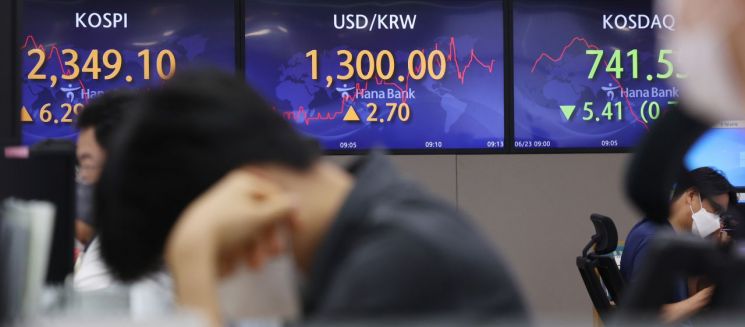
[Asia Economy Reporter Kwon Jaehee] The KOSPI index started higher but hit a new yearly low during the session as the Korean won weakened further, triggering a heavy sell-off by foreign investors.
As of 1:54 p.m. on the 23rd, the KOSPI index was trading at 2,333.42, down 0.40% (9.39 points) from the previous trading day. The index opened at 2,347.84, up 0.21% (5.03 points) from the previous day, but fell to 2,320.51 during the session, breaking the previous yearly low of 2,342.81 recorded the day before.
Despite early gains in the U.S. stock market driven by bargain hunting in tech stocks amid declines in international oil prices and government bond yields, concerns over a recession and short-term profit-taking led to a retreat in gains, closing the session slightly lower.
Meanwhile, the weakening of the Korean won is putting pressure on foreign investor flows.
On this day, the USD/KRW exchange rate surpassed 1,300 won for the first time in 12 years and 11 months. The last time the USD/KRW rate exceeded 1,300 during trading was on July 14, 2009 (high of 1,303.0 won).
By investor type, individual and foreign investors sold a net 508.7 billion won and 228.4 billion won worth of stocks, respectively. In contrast, institutions alone bought stocks worth 719.9 billion won, helping to cushion the index's decline.
Among the top 10 stocks by market capitalization, Samsung Electronics (-0.17%), LG Energy Solution (-1.00%), SK Hynix (-1.30%), and Samsung Electronics Preferred (-1.51%) recorded losses, while Samsung Biologics (1.22%), LG Chem (1.08%), NAVER (2.84%), Samsung SDI (0.74%), Hyundai Motor (0.58%), and Kia (1.31%) posted gains.
Notably, the "national stock" Samsung Electronics fell to 57,200 won during the session, hitting a new 52-week low again amid concerns over the semiconductor industry outlook.
By sector, telecommunications (2.23%), machinery (0.70%), pharmaceuticals (0.62%), services (0.52%), and medical precision (0.17%) sectors rose. Meanwhile, paper and wood (-3.70%), non-metallic minerals (-3.51%), transportation and warehousing (-3.31%), steel and metals (-2.87%), construction (-2.73%), electricity and gas (-1.53%), and finance (-1.23%) sectors declined.
At the same time, the KOSDAQ index was at 729.58, down 2.33% (17.38 points) from the previous trading day. The KOSDAQ opened at 747.49, up 0.07% (0.53 points), but turned lower during the session and extended losses into the afternoon.
By investor type, individuals and foreign investors bought stocks worth 3.2 billion won and 25 billion won, respectively, while institutions sold a net 16.2 billion won.
Among the top 10 KOSDAQ stocks by market capitalization, bio-pharmaceutical stocks recorded gains, including Celltrion Healthcare (2.63%), Celltrion Pharm (0.82%), and Alteogen (5.90%). Conversely, Ecopro BM (-8.03%), L&F (-7.68%), Kakao Games (-6.51%), HLB (-0.46%), Pearl Abyss (-1.16%), Chunbo (-4.11%), and CJ ENM (-0.51%) declined.
All sectors were down, including digital content (-6.01%), general electric and electronics (-5.97%), IT components (-4.70%), IT software (-4.69%), computer services (-4.28%), telecommunications services (-4.27%), textiles and apparel (-4.13%), and chemicals (-3.91%).
Han Ji-young, a researcher at Kiwoom Securities, explained, "Inflation is already a known negative factor, and major technical indicators point to oversold conditions, so additional price correction pressure is expected to be limited. However, it is necessary to keep open the possibility of increased noise in supply and demand due to forced selling during the session."
© The Asia Business Daily(www.asiae.co.kr). All rights reserved.

![Clutching a Stolen Dior Bag, Saying "I Hate Being Poor but Real"... The Grotesque Con of a "Human Knockoff" [Slate]](https://cwcontent.asiae.co.kr/asiaresize/183/2026021902243444107_1771435474.jpg)















