"Coal technology is world-class, but the coal industry is not being developed"
"Not the strongest in nuclear power, but must become the strongest in renewable energy"
[Asia Economy Reporter Naju-seok] The Democratic Party of Korea criticized President Yoon Seok-yeol's policy to expand nuclear power, calling nuclear power a "declining industry." The Democratic Party emphasized the need to nurture the domestic renewable energy industry, stating, "Five years from now, the Yoon Seok-yeol administration will be judged as having made a foolish mistake."
On the 23rd, Kim Seong-hwan, chairman of the Democratic Party's Policy Committee, introduced President Yoon's remark from the previous day that "If we had not done foolish things over the past five years and had firmly established the nuclear power ecosystem, there would be no competitors now," and criticized it by saying, "This statement is completely contrary to the global energy industry trends in the era of the climate crisis, so it cannot be overlooked."
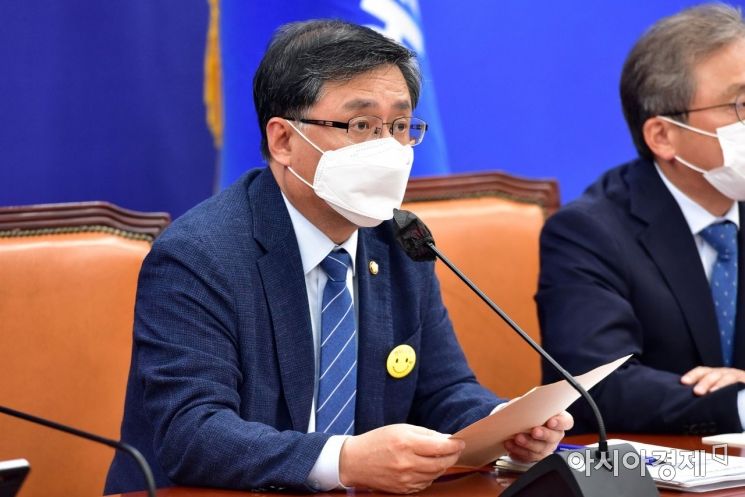 Kim Seong-hwan, Chairman of the Policy Planning Committee of the Democratic Party of Korea, is attending the Policy Coordination Meeting held at the National Assembly on the 16th and delivering opening remarks. Photo by Yoon Dong-joo doso7@
Chairman Kim said, "According to the International Energy Agency's World Energy Investment Report, as of 2021, investment in renewable energy accounts for 69.2% of total energy source investments, but investment in the nuclear power sector is only 8.3%, less than one-eighth of renewable energy investment," adding, "This is less than half the scale of investment in coal power, a declining industry in the climate crisis era."
He continued, "Currently, 441 nuclear reactors are operating worldwide, but by 2050, half of them, 203 reactors, will be shut down, and even including all announced new construction plans, only 52 new reactors are planned," and said, "As shown in the table, the world has recognized nuclear power as a declining industry following the Chernobyl accident in 1986 and the Fukushima accident in 2011." Chairman Kim added, "Although nuclear power does not emit carbon during power generation, it is critically dangerous if an accident occurs, and it has the disadvantage of requiring the safe storage of spent nuclear waste for over 200,000 years for a maximum usage period of 50 years."
Chairman Kim said, "South Korea also possesses world-leading technology in coal power," and added, "In the era of the climate crisis, this technology is not being expanded further because it would be wasteful. Similarly, although South Korea has some of the world's top engine technology for internal combustion vehicles, automakers are focusing on developing hydrogen and electric vehicles." He continued, "It is true that South Korea's nuclear technology is also world-class, but now is the era when renewable energy is the benchmark for corporate competitiveness, not nuclear power."
Chairman Kim said, "Major companies such as Apple, Google, and BMW have joined RE100, which produces products using 100% renewable energy, and they are demanding their suppliers also deliver products made with renewable energy," adding, "Considering the European Union's Carbon Border Adjustment Mechanism, which will be fully implemented from 2025, it is a reality that the share of domestic renewable energy must be rapidly increased."
He concluded, "In the era of the climate crisis, the path the Yoon Seok-yeol administration should take is not to become a nuclear power superpower, but a renewable energy superpower," and warned, "If it does not take that path, five years from now, the Yoon Seok-yeol administration will be judged as having made a foolish mistake."
© The Asia Business Daily(www.asiae.co.kr). All rights reserved.

















