High-Efficiency, Low-Carbon Next-Generation Technology
Basic Certification Obtained from Norwegian and British Classification Societies
Utilizing Engine Waste Heat... Fuel Consumption and Carbon Emissions
Reduced by 1.5% Each
"Accelerating Both Future Ship Development and Advancement of Eco-Friendly Ship Technology"
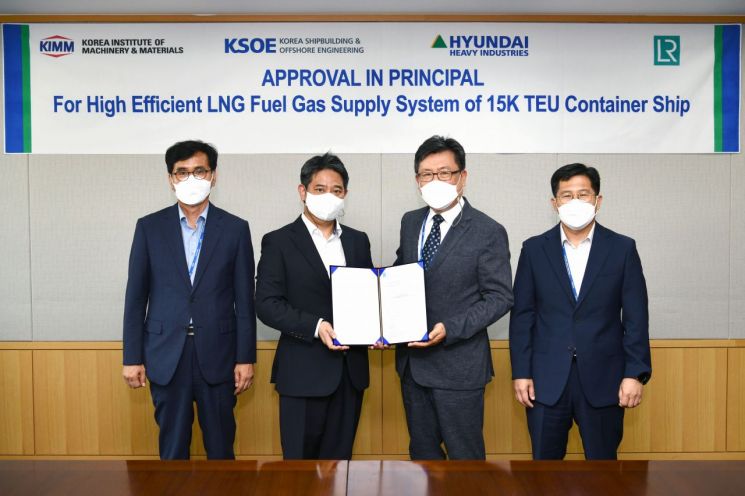 Hyundai Heavy Industries Group has developed a high-efficiency, low-carbon LNG fuel supply system called 'Hi-eGAS' and obtained basic design certification. From left to right in the photo: Byeong-il Choi, Principal Researcher at Korea Institute of Machinery and Materials; Byung-yong Yoo, Executive Director at Hyundai Heavy Industries; Young-doo Kim, Vice President and Head of Far East Asia Technology at Lloyd's Register; Seong-heon Jo, Executive Director at Hyundai Heavy Industries. Photo by Hyundai Heavy Industries
[Asia Economy Reporter Jeong Dong-hoon] Hyundai Heavy Industries Group is leading eco-friendly ship technology by developing a new concept fuel supply system that reduces fuel consumption and carbon emissions of LNG-powered ships.
Hyundai Heavy Industries and Korea Shipbuilding & Offshore Engineering recently announced on the 23rd (Thursday) that they have developed the next-generation LNG fuel supply system, Hi-eGAS (Hyundai High Efficient Gas Supply System), and received basic design certification (AIP) from Det Norske Veritas (DNV) and Lloyd's Register (LR).
This system is characterized by recycling the heat wasted during the fuel supply process of LNG-powered ships. It can reduce fuel consumption and carbon emissions by 1.5% each compared to existing systems, which is expected to result in fuel cost savings.
LNG-powered ships use liquefied natural gas at minus 163 degrees Celsius, heating it to vaporize and use as fuel, but this process has the disadvantage of additional fuel consumption and carbon emissions. However, Hi-eGAS heats LNG fuel using waste heat from the ship's engine, reducing unnecessary fuel consumption and thereby cutting fuel costs and carbon emissions.
Additionally, Hyundai Heavy Industries and Korea Shipbuilding & Offshore Engineering jointly developed the heat exchanger, a core component of Hi-eGAS, with domestic equipment manufacturers, significantly reducing the risk of freezing within the LNG fuel supply system. Last year, Korea Shipbuilding & Offshore Engineering, together with the Korea Institute of Machinery and Materials, conducted a demonstration operation test using actual LNG fuel under conditions identical to those of large LNG-powered ships, certifying the performance and stability of Hi-eGAS.
LNG-powered ships are attracting attention as eco-friendly vessels that can comply with global environmental regulations by reducing sulfur oxides (SOx) by 99% and nitrogen oxides (NOx) by more than 85% compared to ships using conventional bunker C fuel. According to Clarkson Research, a shipbuilding and shipping market analysis firm, about 60% of ships ordered worldwide in the first quarter of this year were LNG-powered ships.
A Hyundai Heavy Industries Group official stated, “High-efficiency, low-carbon ships align with the global trend of achieving carbon neutrality,” adding, “We plan to accelerate the development of next-generation future ships and the advancement of eco-friendly ship technologies.”
© The Asia Business Daily(www.asiae.co.kr). All rights reserved.
![Clutching a Stolen Dior Bag, Saying "I Hate Being Poor but Real"... The Grotesque Con of a "Human Knockoff" [Slate]](https://cwcontent.asiae.co.kr/asiaresize/183/2026021902243444107_1771435474.jpg)
















