[Measured by MB Price Index]
Half of Top 10 Items Are Food Ingredients... Prices of Manufactured Goods and Services Also Rise Significantly
Bottom 20% Income Households Spend Half of Disposable Income on Food
Urgent Need for Support Measures for Vulnerable Groups
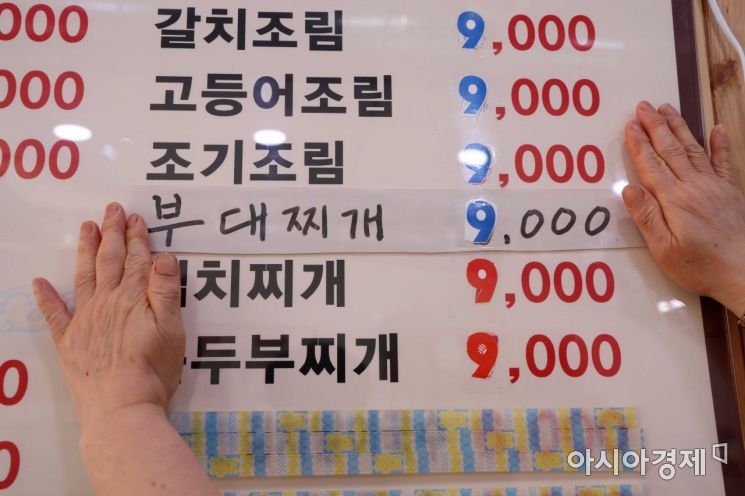 On the 22nd, a business owner is updating the menu with increased prices at a restaurant in downtown Seoul, where self-employed individuals are struggling due to soaring inflation. Photo by Mun Ho-nam munonam@
[Asia Economy Sejong=Reporter Kwon Haeyoung] #Kim Haejung (37), a housewife in her 30s living in Seohyeon-dong, Bundang, Gyeonggi-do, recently sighs every time she goes to the mart. Due to the recent sharp rise in food prices, even when she only puts essential ingredients in her shopping basket, the price quickly exceeds 100,000 won. Kim said, "These days, when I go to the mart, I don't know how many times I pick up and put down items," adding, "I feel it's cheaper to order delivery food or eat out."
Recently, prices of essential daily goods and services closely related to people's livelihoods have surged sharply along with food prices, deepening the worries of ordinary people. The rapid rise in living costs is especially fatal to vulnerable groups such as low-income households and retirees, highlighting the urgent need to prepare support measures targeting them.
On the 23rd, based on data from Statistics Korea, an analysis of last month's consumer price inflation using the 'MB Price Index'?which was composed of 52 daily necessities and services grouped for price management during the Lee Myung-bak administration?showed that food ingredient prices rose significantly.
Among the top 10 items in the MB Price Index, excluding four energy items whose prices soared due to a global supply crisis, most were food ingredients. Radish rose 31.3% compared to a year ago, ranking third after kerosene (60.8%) and diesel (45.8%). Flour increased by 26.0%, napa cabbage by 24.0%, cooking oil by 22.7%, and pork by 20.7%.
There were also many food ingredients with price increases around 10%. Beef rose 15.3%, garlic 11.6%, ramen 9.8%, bread 9.1%, and sugar 8.9%. Soju, which is often consumed as a drink after work to relieve fatigue, rose 9.4%, and milk, which growing children need to drink daily, increased by 6.9%.
Besides food ingredients, prices of manufactured goods such as shampoo (21.9%), sanitary pads (8.8%), and pants (5.5%) also rose, and service prices such as electricity bills (11%) and city gas bills (11%) increased significantly.
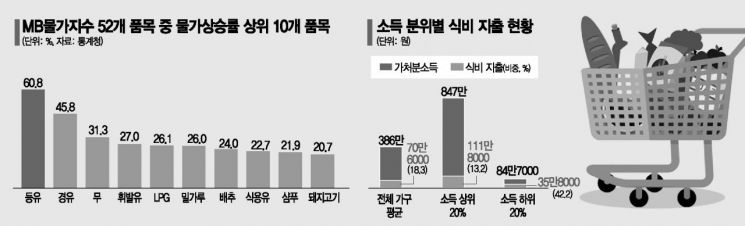
As prices closely related to people's livelihoods, including food prices, surge, the pain felt by ordinary people and vulnerable groups is growing. According to the Ministry of Economy and Finance and Statistics Korea, the average monthly disposable income of the bottom 20% income households was 847,039 won in the first quarter of this year, of which nominal expenditure on food and dining out accounted for 42.2%, or 357,754 won. This means nearly half of the disposable income?income after deducting taxes and essential expenses?is spent on food. This is more than three times the average food expenditure ratio (13.2%) of the top 20% income households.
The problem is that the rapid price increase is unlikely to ease anytime soon. Lee Seunghun, Deputy Governor of the Bank of Korea, said on the day, "Due to the prolonged Ukraine crisis and global supply constraints, as well as consumption recovery following the easing of the COVID-19 pandemic, inflationary pressures will remain high," emphasizing, "Monetary policy should focus on preventing the spread or prolongation of high inflation expectations." In the 'Price Stability Target Operation Status Review' report released on the 21st, the Bank of Korea also forecasted, "Prices of processed foods and dining out have strong downward rigidity, so the upward trend in prices may continue for a considerable period," adding, "The economic burden on low-income groups, who spend a relatively large proportion on these items, may increase."
As the real purchasing power of ordinary people and low-income groups is rapidly declining, there are calls for urgent measures to support the vulnerable groups who will suffer the most significant impact.
Professor Sung Taeyoon of Yonsei University's Department of Economics said, "Government measures against high inflation should be approached from the perspective of supporting low-income groups," emphasizing, "Especially, universal fiscal support for all citizens, as in the past, may worsen the situation for vulnerable groups due to inflation. Therefore, various measures, including targeted fiscal support for vulnerable groups, should be prepared going forward."
© The Asia Business Daily(www.asiae.co.kr). All rights reserved.


















