China with 499 Satellites Shares BRICS Member Satellite Observation Data
Launch of BRICS Space Cooperation Joint Committee... China Strengthens Political Trust Mechanism
[Asia Economy Beijing=Special Correspondent Jo Young-shin] China, the chair country of BRICS (Brazil, Russia, India, China, South Africa), has disclosed detailed plans for space cooperation among member countries ahead of the 14th BRICS Summit. This disclosure appears to highlight that BRICS cooperation is expanding beyond economic collaboration into cutting-edge scientific fields.
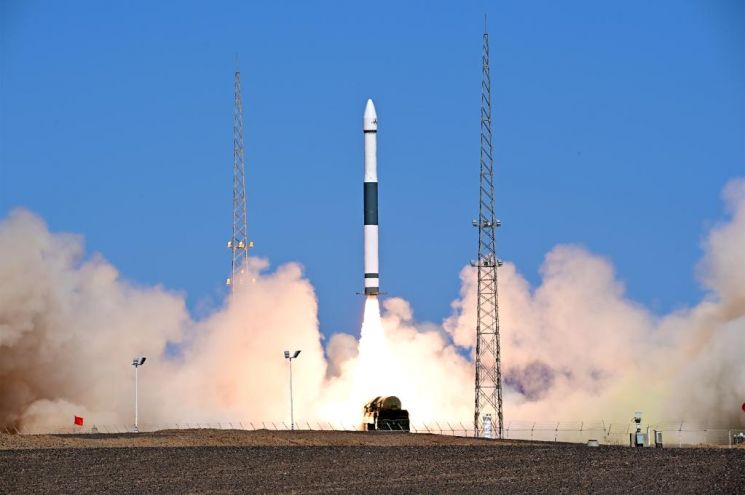
Huanqiu Shibao reported on the 23rd that a program for sharing space observation data obtained through satellites owned by BRICS countries has begun, and that 2022 will be the inaugural year of space cooperation among BRICS member countries.
Huanqiu Shibao stated that BRICS space cooperation was proposed by China’s National Space Administration (CNSA) to the space agencies of BRICS countries in 2015, and that in August last year, the space agencies of each country held a signing ceremony for space cooperation. The media explained that the "BRICS Space Cooperation Joint Committee" was officially launched at the end of last month, before the BRICS Summit, and has begun full-scale activities.
The core of BRICS space cooperation is the sharing of satellite observation data. China shares data observed by its two satellites, Gaofen-6 and Ziyuan-III 02, while Brazil (CBERS-4 satellite), Russia (Kanopus-V satellite), and India (Resourcesat-2, Resourcesat-2A satellites) provide space information obtained through their own satellites. According to Huanqiu Shibao, data collected from these six satellites is transmitted to ground stations in the five countries, where each country analyzes the satellite data.
Jiang Kejian, CNSA’s top official, said, "Cooperation among space-related institutions of BRICS member countries will help address global issues such as climate change, disaster relief, water resources, environmental protection, and food security," adding, "Space cooperation will promote higher cooperation in economic and social development among member countries."
As of January, China owns a total of 499 satellites. BRICS member countries operate a total of 745 satellites, including Russia’s 169, India’s 61, Brazil’s 13, and South Africa’s 3.
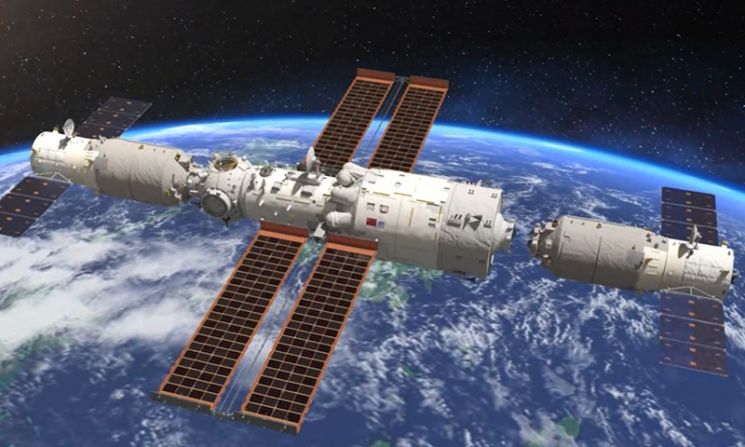
Huanqiu Shibao cited CNSA’s explanation that following the first phase of space cooperation involving satellite data sharing, a more detailed and coordinated second phase of space cooperation will be carried out according to each member country’s space development plans. It emphasized that political mutual trust among countries must be guaranteed for space cooperation.
The media reiterated that BRICS member countries face challenges from continuous suppression and containment by the Western camp, including the United States, and that space cooperation will contribute not only to strengthening political mutual trust among member countries but also to their participation in space governance. This implies that China is using space cooperation as a means to strengthen the cohesion of BRICS member countries.
Meanwhile, Chinese President Xi Jinping said in his keynote speech at the opening ceremony of the BRICS Business Forum held the previous night, "The Ukraine crisis has once again sounded an alarm for humanity," and added, "We must work together to address global crises, challenges, and recovery." President Xi also pointed out, "Sanctions are a boomerang and a double-edged sword," warning that "sanctions will ultimately result in harming one’s own interests." This remark was made with the U.S. and Western camp’s sanctions on Russia and containment of China in mind. President Xi further stated, "BRICS is an important cooperation platform for emerging and developing economies," and "The Business Forum will be a dynamic force leading effective cooperation within BRICS."
Indian Prime Minister Narendra Modi emphasized, "BRICS was established with the belief that emerging economies can be engines of global growth," and added, "As the world focuses on the post-COVID era, the role of BRICS countries will be very important going forward."
© The Asia Business Daily(www.asiae.co.kr). All rights reserved.
!["The Woman Who Threw Herself into the Water Clutching a Stolen Dior Bag"...A Grotesque Success Story That Shakes the Korean Psyche [Slate]](https://cwcontent.asiae.co.kr/asiaresize/183/2026021902243444107_1771435474.jpg)

















