Increase in Overseas Infections Doubled in Recent 7 Days Compared to 4th Week of May
Variant Detections Rose from 36 to 119 Cases
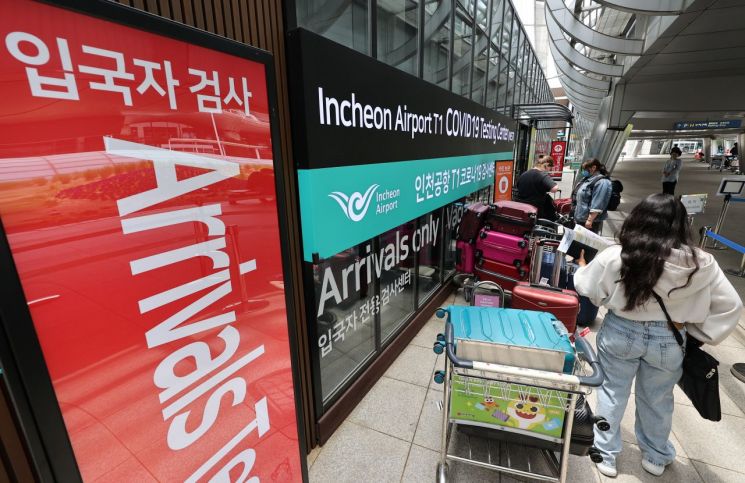
[Asia Economy Reporter Kim Young-won] As immigration and aviation restrictions have recently eased, the number of overseas arrivals is increasing, along with a rise in COVID-19 confirmed cases and variant virus detection rates among overseas arrivals.
According to the Korea Disease Control and Prevention Agency (KDCA) on the 22nd, the average daily number of arrivals in June until the 20th was 23,219, a 31.7% increase from 17,630 in the previous month. Earlier, the government relaxed regulations from the 8th by lifting quarantine requirements for overseas arrivals regardless of COVID-19 vaccination status. On the same day, restrictions on the hourly number of aircraft arrivals at Incheon Airport were also lifted, ending aviation restrictions that had been in place for over two years.
Since then, the number of imported COVID-19 cases has increased. The weekly number of imported COVID-19 cases rose from 232 in the fourth week of last month to 593 in the most recent week, nearly doubling. In contrast, the weekly number of domestic infection cases decreased by approximately 59.3%, from 122,447 to 49,772 during the same period.
Im Sook-young, the Situation General Manager of the Central Disease Control Headquarters, stated, "With the normalization of international flights, the number of overseas arrivals is increasing, and the number of imported cases is expected to rise somewhat." She added, "To respond to this, we are maintaining mandatory pre-arrival polymerase chain reaction (PCR) testing and PCR testing within three days after arrival, aiming to delay imported cases as much as possible and to thoroughly monitor variants."
However, the detection of variant viruses, which have a higher proportion among imported cases than domestic infections, is already on the rise. The number of newly confirmed Omicron sub-variants and recombinant variants in Korea, announced weekly by the KDCA every Tuesday, increased from 36 cases on the 7th of this month to 71 on the 14th, and 119 on the 21st. The detection rate of the BA.2.12.1 variant among imported cases rose from 9.4% in the fourth week of last month to 30.8% in the second week of this month. This means that 3 out of 10 imported COVID-19 cases are infected with variant viruses.
With the summer vacation season approaching, the number of overseas arrivals is expected to increase further. This is the first vacation season since the lifting of social distancing in April and the easing of aviation and immigration restrictions. On the first day of the Memorial Day holiday on the 4th, about 40,000 people used Incheon Airport, marking the highest number of users in 27 months.
The government also indicated the possibility of a resurgence due to the decline in existing COVID-19 immunity. Lee Ki-il, the First General Coordinator of the Central Disaster and Safety Countermeasures Headquarters (Vice Minister of Health and Welfare), said at a Central Disaster and Safety Countermeasures Headquarters meeting, "The immunity effect formed by the Omicron wave this spring is expected to decrease after 4 to 6 months," adding, "Many experts predict a resurgence after July or August this year."
© The Asia Business Daily(www.asiae.co.kr). All rights reserved.
!["The Woman Who Threw Herself into the Water Clutching a Stolen Dior Bag"...A Grotesque Success Story That Shakes the Korean Psyche [Slate]](https://cwcontent.asiae.co.kr/asiaresize/183/2026021902243444107_1771435474.jpg)
















