Establishing a Response System from Reporting to Investigation and Compensation... Discussions with KDCA and Korean Society of Social Security Law
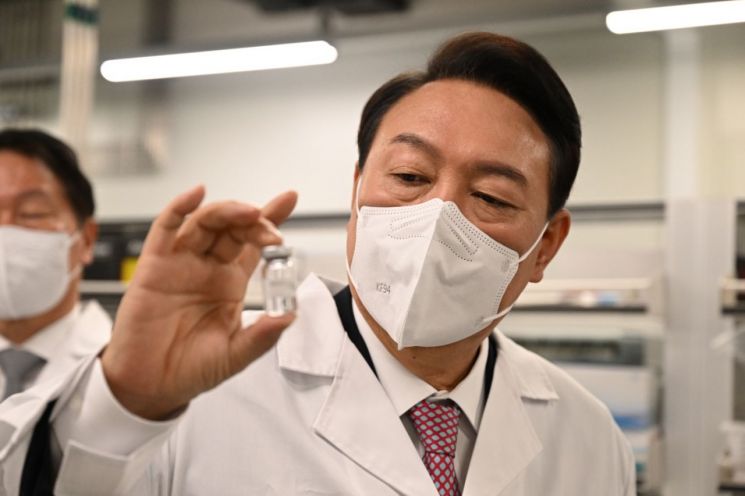
[Asia Economy Reporter Baek Kyunghwan] The Yoon Seok-yeol administration has officially begun discussions on a state responsibility system to address COVID-19 vaccine-related damages. The plan aims to expand the range of diseases eligible for compensation and support, reduce the burden of proof on the public, and systematize the entire process from reporting adverse reactions to investigation and compensation. President Yoon had pledged to completely overhaul the COVID-19 response system within his first 100 days in office.
According to political circles on the 22nd, the Presidential Office recently started working on revising laws related to compensation for adverse reactions to COVID-19 vaccines in collaboration with the Korea Disease Control and Prevention Agency (KDCA) and the Korean Society of Social Security Law. A Presidential Office official stated, "Since the Presidential Transition Committee period, efforts have been ongoing to identify cases where vaccine damage compensation was not received and to assess the scale of various damages, but more time is needed to establish a compensation system. However, since state compensation was selected as a key national agenda by President Yoon, this is a preparatory step to build an effective compensation system."
First, the KDCA will analyze the causal relationship between vaccines and adverse reactions. During this process, opinions from both the medical and legal communities will be gathered to coordinate detailed plans on the state responsibility system with the Presidential Office. The Korean Society of Social Security Law will also participate in drafting a special law. The special law for vaccine victims is expected to reduce the burden of proof on the public while significantly adjusting the scope and procedures of compensation, which is a core demand of the "COVID-19 Vaccine Victims' Families Council."
Specifically, there is discussion about adding the term "relevance" to the current criteria for damage compensation review. Currently, the criteria for vaccine damage compensation review are divided into causality, probability, and possibility, but the intention is to broaden the compensation scope as much as possible by adding standards for "relevance." As of early this month, out of a total of 77,990 compensation claims filed after COVID-19 vaccination, 52,063 have been reviewed, with only 17,949 cases approved for compensation. Previously, the limits for treatment costs and death consolation payments for vaccine adverse reactions were raised to 50 million KRW and 100 million KRW, respectively. Under the Moon Jae-in administration, cases deemed "insufficient evidence" were compensated with up to 30 million KRW for medical expenses and up to 50 million KRW for death consolation payments.
In particular, the Presidential Office is confirmed to be considering approaching vaccine damage compensation policies not only from a medical-scientific perspective but also from a social security standpoint. During the transition committee discussions on the state responsibility system, overlapping support with existing welfare programs that provide medical expenses for economically disadvantaged individuals was also a major topic.
In the National Assembly, there have already been calls for legislative reform. The National Assembly Legislative Research Office recently pointed out, "Unlike other virus vaccines, the COVID vaccine's approval time was shortened considering the urgency of the matter," and "the likelihood of adverse reactions is higher compared to other vaccines." The core argument is that since it is difficult for victims to prove adverse effects after COVID-19 vaccination, the responsibility for proving causality should be shifted from the victims to the government through legislative reform. The report stated, "In Korea, vaccinations were implemented rapidly, and various vaccine side effects have occurred during this process. However, there are doubts about whether compensation is being adequately provided."
There is also ongoing discussion about temporarily establishing a special law related to COVID-19. A representative example is the "Special Act on Relief for Victims of Humidifier Disinfectants," which was enacted to compensate victims of the humidifier disinfectant incident. A Legislative Research Office official said, "In the unprecedented COVID-19 pandemic situation, rather than applying the 'Infectious Disease Prevention and Control Act' as with general infectious diseases, it is necessary to establish a system for swift and comprehensive compensation through a temporary special law such as the 'Special Act on Relief for COVID-19 Vaccine Victims.'"
© The Asia Business Daily(www.asiae.co.kr). All rights reserved.

















