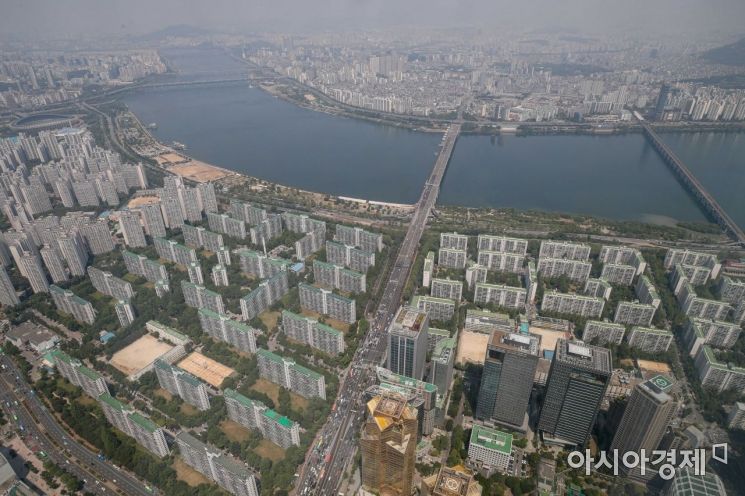
"Isn't this measure basically telling people to buy houses through gap investment and then rent them out?" Since the announcement of the June 21 real estate measures, the market's hottest issue has been the 'relaxation of the actual residence obligation.' On real estate communities, comments like "The golden age of gap investment has reopened" are common, with many actively searching for gap investment properties where the price gap between sale and jeonse (long-term deposit lease) is small.
According to the monthly housing price trend time series data from KB Kookmin Bank on the 22nd, the jeonse rate for apartments in Seoul was 54.66% as of May, showing an upward trend since it recorded 54.48% in November last year. Nationwide, the apartment jeonse rate has risen for five consecutive months, from 65.91% in December last year to 66.28% last month. Due to interest rate hikes and the spread of peak price theories, the rate of house price increases has slowed, and buyer sentiment has weakened, causing the jeonse rate to rise. Generally, a higher jeonse rate favors 'gap investment,' where buyers purchase homes with jeonse deposits.
Amid this, the government’s significant relaxation of the actual residence obligation through the June 21 measures seems to be reviving the somewhat subdued gap investment sentiment. Multiple real estate investment communities are actively engaging in Q&A about promising gap investment areas following the relaxation of the actual residence obligation. In particular, there are lively discussions about specific timelines, such as "If you purchase a house within this year, sign a jeonse or monthly lease contract, and renew or enter a new contract within two years with rent changes within 5%, you can receive tax exemption without actual residence." Go Joon-seok, CEO of J-Edu Investment Advisory, said, "Although gap investment has been criticized as speculative in the real estate market, for non-homeowners with limited funds, gap investment has been an effective means to acquire a home and has also contributed positively by supplying rental units."
However, considering the recent real estate market conditions, some point out that relying solely on the jeonse rate to engage in gap investment carries significant risks. While the relaxation of the actual residence obligation positively affects gap investment, other key variables include acquisition tax, interest rate hikes, and the possibility of a real estate market downturn. Some also evaluate that the relaxation of the residence requirement may intensify the 'smart one-home' phenomenon rather than promote gap investment. This is because for temporary two-homeowners or one-homeowners who sell their existing homes, the capital gains tax risk, which had been a concern, disappears, allowing them to sell their old home and switch to a smart single property.
Meanwhile, under the June 21 measures, when obtaining a mortgage loan for purchasing a home in regulated areas, the deadline to dispose of the existing home is extended from the current six months to two years. The obligation to move into the new home is completely abolished. Landlords who voluntarily increase rent by 5% or less are exempt from the two-year residence requirement necessary for one household one home capital gains tax exemption and long-term holding special deduction. The actual residence requirement of up to five years granted to contract holders of homes subject to the price ceiling system is also relaxed.
© The Asia Business Daily(www.asiae.co.kr). All rights reserved.
![Clutching a Stolen Dior Bag, Saying "I Hate Being Poor but Real"... The Grotesque Con of a "Human Knockoff" [Slate]](https://cwcontent.asiae.co.kr/asiaresize/183/2026021902243444107_1771435474.jpg)
















