'Small but Efficient Government', Maximizing Private Sector Role Aligned with Yoon's Will... Possibility of Independence Beyond Ministries
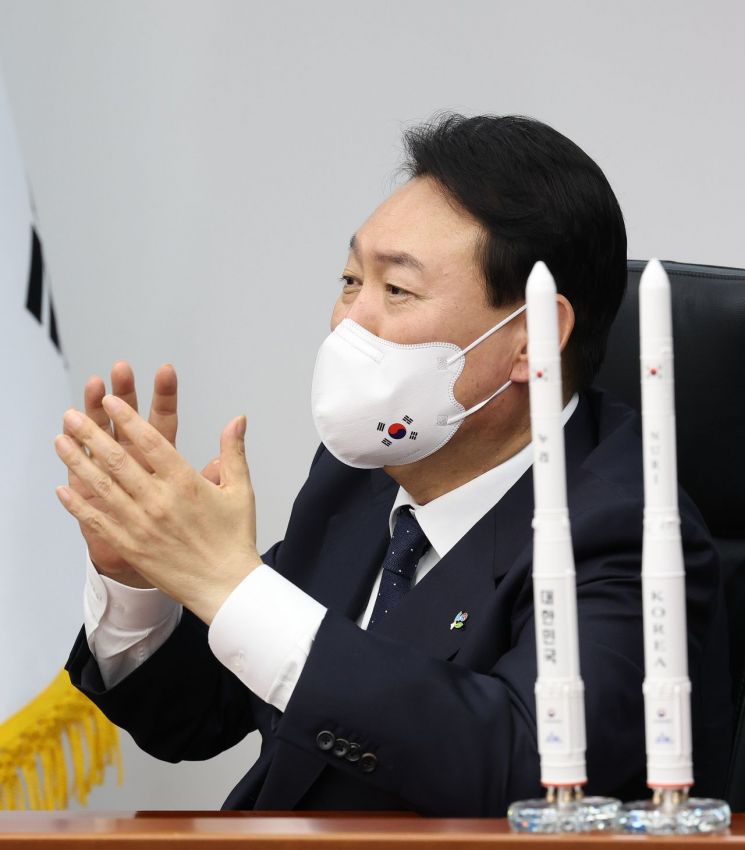
[Asia Economy Reporter Baek Kyunghwan] The 'Aerospace Administration' promised to be established by President Yoon Seok-yeol is being discussed as a public-private joint organization. The plan is to consolidate space policy tasks scattered across various ministries such as the Ministry of National Defense, Ministry of Science and ICT, Defense Acquisition Program Administration, and Korea Aerospace Research Institute into one control tower role, and through technology transfer, effectively allow the private sector to lead space projects. However, more time is needed to decide whether it will be placed under existing government ministries or operated as an independent agency.
According to the Presidential Office on the 22nd, discussions to establish the 'Aerospace Administration,' selected as a core national agenda for Yoon's goal of becoming one of the world's top seven space powers, will soon be intensified. A Presidential Office official said, "(The establishment of the Aerospace Administration) has been outlined by the transition team, but since it involves creating a new organization under the new government, discussions with the National Assembly are also necessary," adding, "However, President Yoon places great importance on the role of the private sector in basic national governance, so the Aerospace Administration will effectively be an agency led by the private sector."
Earlier, President Yoon announced a policy to establish a government-affiliated 'Aerospace Administration' in Sacheon, Gyeongsangnam-do, as part of the '110 Major National Tasks.' The plan includes creating a 'space industry cluster' in the nearby area to promote space technology development by companies and improve systems to expand private investment. Once established as a Korean-style NASA, the Aerospace Administration will facilitate joint cooperation with advanced space development countries in projects such as lunar probe launches and lunar lander development.
The key is private sector participation. Although the process involves setting up a government organization, the core goal is to entrust aerospace research fields to the private sector and transform the previously government-led aerospace industry into a private company-driven 'New Space.' A ruling party official who discussed the establishment of the Aerospace Administration during the transition team period said, "The establishment of a public-private joint organization aligns with President Yoon's intention to slim down government organizations and create a 'small but efficient government,'" adding, "If placed under existing ministries, it would face criticism for merely increasing the number of public officials and lacking independence."
Over 300 domestic private companies were behind the recent success of the Nuri rocket launch. These companies participated throughout the project based on their specialized expertise, leading to the success of Nuri. They worked closely with the Korea Aerospace Research Institute under the Ministry of Science and ICT, the lead agency for the Nuri project, playing key roles in engines, launch pads, and system assembly.
Before establishing the Aerospace Administration, legislation to support these companies is already prepared. Recently, the amendment to the 'Space Development Promotion Act,' which includes expanding space development infrastructure, designating new space technologies and promoting technology transfer, nurturing space sector talent, and encouraging startups, passed the Cabinet meeting. In the second half of the year, a preliminary feasibility study will be conducted for designating a space industry cluster and fostering the private space industry.
Variables include coordination over the location of the Aerospace Administration and political views on establishing a new government organization. President Yoon promised to establish the Aerospace Administration in Sacheon, Gyeongsangnam-do, where an air force base is located, but cities like Daejeon, home to most private aerospace companies including KAIST in the Daedeok Research Complex, are opposing this. The official said, "Following the success of the Nuri launch, government and corporate support to enhance space industry capabilities will accelerate, but the establishment of the Aerospace Administration to oversee this may become another political issue due to operational methods and personnel matters."
© The Asia Business Daily(www.asiae.co.kr). All rights reserved.

















