Already Spread Internally
Police Distrust and Organizational Control Strategy
Collective Resignation, Growing Calls for Legal Action
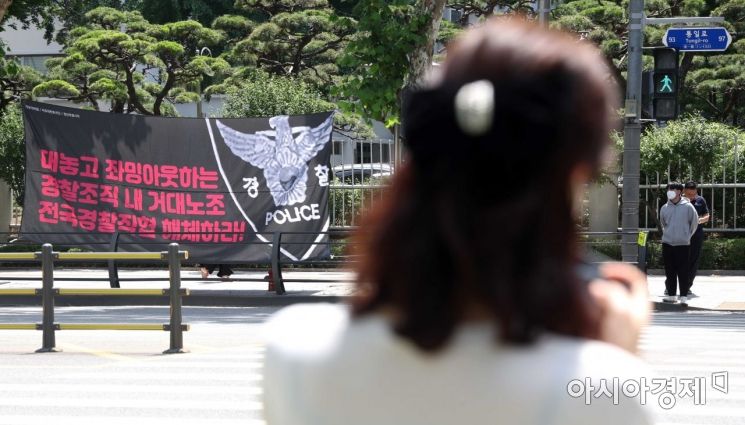 On the 21st, the day the Advisory Committee on Police System Improvement of the Ministry of the Interior and Safety announced recommendations for police control measures including the establishment of a police bureau within the ministry, a banner condemning the National Police Agency Labor Council was hung at the National Police Agency in Seodaemun-gu, Seoul. Photo by Moon Honam munonam@
[Asia Economy Reporters Jang Se-hee, Cho Sung-pil]"At this rate, won't the head of the National Investigation Headquarters be someone from the prosecution?"
This is what is being said within the police after the Ministry of the Interior and Safety's announcement of the 'Police Control Plan' on the 21st. There are concerns that the Ministry of the Interior and Safety, which has effectively seized personnel and inspection authority, could take control of the entire police organization. A frontline police officer in Seoul said on the 22nd, "Inside, the rumor that a former prosecutor will be appointed as the head of the National Investigation Headquarters has already spread," adding, "This could lead to the rare situation where a former prosecutor becomes a police officer." Although the actual possibility of such an appointment is low, names such as Park Chan-ho, Chief Prosecutor of Gwangju District Prosecutors' Office, and Jeong Soon-shin, former Director of the Legal Research and Training Institute's Yongin Branch, have been mentioned as potential candidates. There are even talks that the head of the National Investigation Headquarters might move on to become the Commissioner of the National Police Agency.
After the Ministry of the Interior and Safety officially announced the establishment of a new police command organization the day before, strong collective resistance movements have emerged inside and outside the police. The most contentious issues are ▲ the authority to recommend personnel appointments for senior police officers such as the Commissioner of the National Police Agency and the head of the National Investigation Headquarters ▲ the authority to request disciplinary action against senior police officers above a certain rank ▲ and the change of the supervisory agency for investigation reviewers. Although the expansion of police authority due to the 'complete removal of prosecution's investigative powers' (Geomsu Wanbak) was emphasized both economically and in terms of justification, the actual organizational reform presented still has many aspects that need to be revised later.
Attempting to Establish a 'Base Organization' for Investigation Command... "No Turning Point Except Resignations"
Frontline police interpret the Ministry of the Interior and Safety's 'Police System Improvement Advisory Committee' recommendations as "a strategy by the government to control the organization because it does not trust police investigations." A frontline police officer said, "The plan to change the investigation reviewer to a higher-level agency stems from a lack of trust in police investigations," adding, "They believe that if it remains at the police station level, effective investigations are difficult, and they want to establish a 'base organization for investigation command' similar to when the prosecution used to command investigations." Another investigative police officer said, "They are trying to implement the fastest and most certain way to take control of the police," adding, "If the Ministry of the Interior and Safety seizes administrative police and appoints a prosecutor as the head of the National Investigation Headquarters to control investigative police, then regardless of Geomsu Wanbak, the police will be completely under the Ministry's control."
A senior superintendent-level officer said, "Almost none of the police-related pledges announced by President Yoon Seok-yeol have been kept," and evaluated, "The command is being taken over despite budget and manpower shortages." The 130,000-strong police organization is different from typical external agencies, but if the higher ministry holds personnel and disciplinary authority, it is said to be at a level worse than external agencies.
Rather than responding directly to the Ministry of the Interior and Safety, voices are calling for collective resignation of senior officers above the superintendent level and legal action. A frontline police officer cited prosecutors who resigned in protest against Geomsu Wanbak and prosecution reform, saying, "There is no turning point in this situation except the resignation of the Commissioner of the National Police Agency."
© The Asia Business Daily(www.asiae.co.kr). All rights reserved.
![Clutching a Stolen Dior Bag, Saying "I Hate Being Poor but Real"... The Grotesque Con of a "Human Knockoff" [Slate]](https://cwcontent.asiae.co.kr/asiaresize/183/2026021902243444107_1771435474.jpg)
















