Business Community "Economic Downturn... Plus Labor Union Risks"
Labor Sector Demands Minimum Wage of 10,890 Won
Conflicts Over Salary Increases and Abolition of Implicit Wage System Accumulate
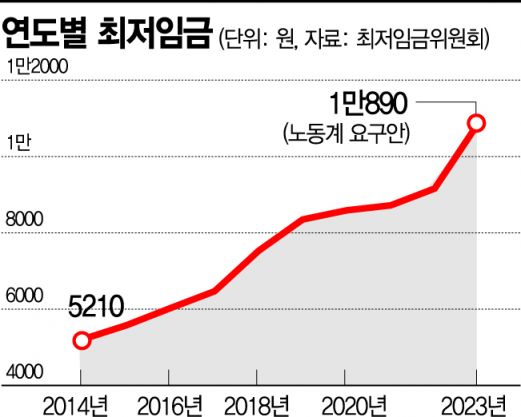
[Asia Economy Reporter Kiho Sung] The industrial sector is groaning under signs of the ‘worst summer labor struggle (夏鬪)’ yet. While major companies are embroiled in conflicts over wage and collective bargaining agreements with labor unions demanding significant salary increases and the abolition of the wage peak system, the labor sector has proposed an hourly minimum wage of 10,890 won for next year, about 20% higher than this year. Since the launch of the new government with a ‘pro-business stance,’ there are concerns that the labor sector may shift to a hardline struggle aimed at ‘seizing the initiative,’ which could act as a greater negative factor for the Korean economy amid growing economic uncertainties.
According to the Minimum Wage Commission and the industrial sector on the 22nd, the worker representatives of the Minimum Wage Commission proposed an hourly minimum wage of 10,890 won at the 5th plenary meeting held the previous day. This amount is 1,730 won (18.9%) higher than this year’s minimum wage (9,160 won). When converted to a monthly salary (applying 209 working hours per month), it amounts to 2,276,010 won.
The labor sector argued that “due to recent high inflation, workers earning the minimum wage are struggling to make ends meet, making a wage increase inevitable.” On the other hand, the business community opposed, stating, “This demand is incomprehensible amid an economic crisis hit by the triple threats of high inflation, high exchange rates, and high interest rates.” The Korea Employers Federation criticized, “An excessive increase of nearly 42% over five years has left small and medium-sized enterprises and small business owners unable to cope,” adding, “The labor sector’s demand for an 18.9% increase is detached from reality and absurd.”
Amid worsening business conditions, major companies are engaged in fierce conflicts or ongoing negotiations with labor unions over wage and collective bargaining agreements.
Samsung Electronics agreed to a 9% wage increase through this year’s labor-management council but has yet to conclude negotiations with the union and is still in a tug-of-war. SK Hynix, which has multiple unions, is conducting separate negotiations with two unions. The technical office workers’ union has demanded a 12.8% wage increase based on the basic salary this year. The Hyundai Motor union is demanding a basic salary increase twice that of last year, and Korea GM, which will start formal wage negotiations on the 23rd, is also expected to demand a large increase, signaling potential labor-management conflicts.
Violent clashes have also occurred. On the 19th, members of the Korean Tire Metal Union forcibly stopped some equipment at the Daejeon plant, during which an incident of assaulting a responsible employee took place. Meanwhile, the Hyundai Steel union has been occupying the president’s office for 50 days.
Moreover, the labor sector is voicing strong opposition to the abolition of the wage peak system and the relaxation of the Serious Accident Punishment Act enforcement decree, suggesting that struggles will intensify.
Labor dissatisfaction is expected to lead to strikes. Following the previous Cargo Solidarity general strike, the Korean Confederation of Trade Unions (KCTU) will hold a nationwide workers’ rally with 70,000 participants on the 2nd of next month. In mid-month, the Metal Workers’ Union general strike, the KCTU nationwide workers’ rally in August, the Public Transport and Construction Medical Unions in September, and the KCTU general strike in October are all scheduled, forecasting a series of large-scale outdoor struggles through the end of the year.
The business community is visibly tense as fears of a complex economic crisis involving high inflation and low growth grow, compounded by increasing ‘union risks.’ An executive at a major corporation pointed out, “Given the difficult economic situation and uncertain future, it is hard to accept the union’s pressure for wage increases,” adding, “If conflicts with unions escalate to extreme measures such as strikes, the damage will be borne entirely by the public.”
© The Asia Business Daily(www.asiae.co.kr). All rights reserved.

















