Hanmi Pharm Most Active
Holds Total 20 Designation Records
FDA Provides Strong Incentives
Including Market Exclusivity and Tax Reduction
When Designated as Orphan Drug
[Asia Economy Reporter Lee Gwan-ju] The domestic pharmaceutical industry is accelerating the development of 'rare disease treatments.' Developing treatments for rare diseases, which often lack effective therapies, is a crucial task as it offers hope to patients while securing new drug development expertise and pharmaceutical sovereignty. Globally, the technological capabilities and innovation of the domestic pharmaceutical industry have been recognized, with designations such as the U.S. Food and Drug Administration (FDA) orphan drug status.
Hanmi Pharmaceutical Holds 20 Orphan Drug Designations
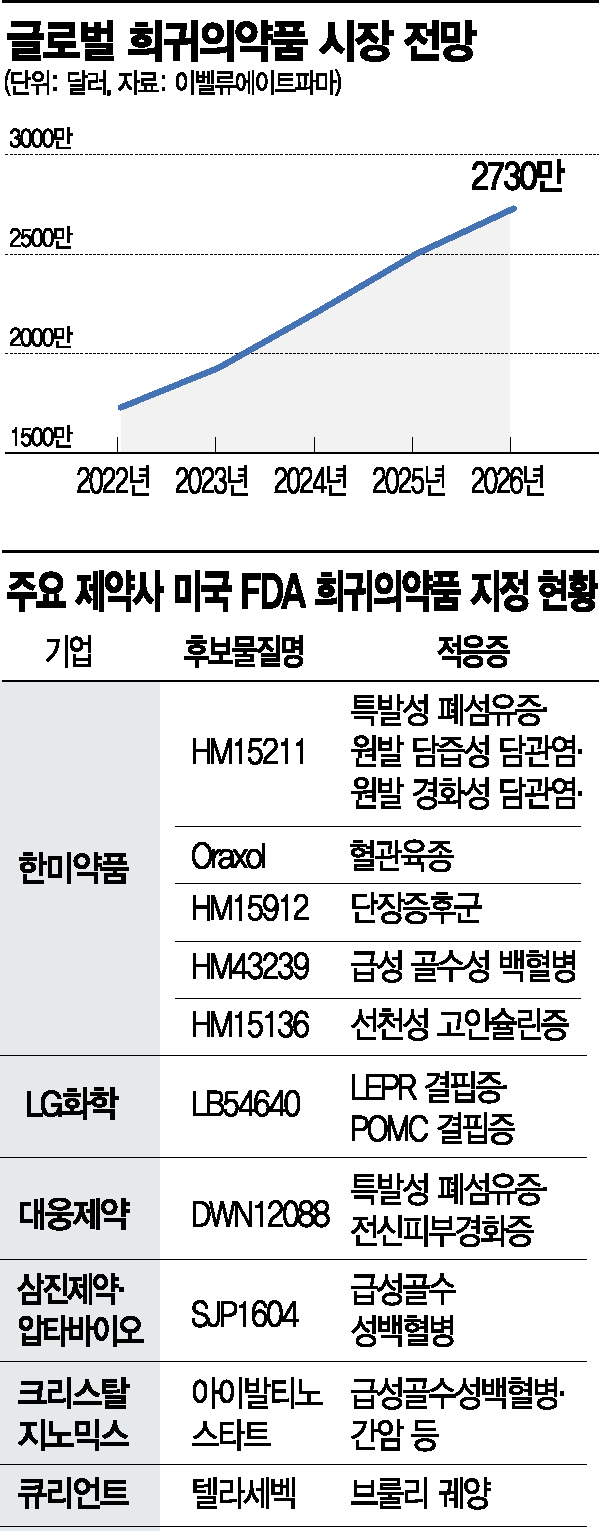
Among domestic pharmaceutical companies, Hanmi Pharmaceutical is the most proactive in developing treatments for rare diseases. According to the pharmaceutical industry on the 22nd, Hanmi Pharmaceutical currently holds a total of 20 orphan drug designations across 6 pipelines and 10 indications. By designating agencies, there are 9 from the U.S. FDA, 8 from the European Medicines Agency (EMA), and 3 from the Korea Ministry of Food and Drug Safety.
On the 9th of this month, the triple-action biopharmaceutical 'LapsTripleAgonist (HM15211)' was designated as an orphan drug by the EMA for the treatment of idiopathic pulmonary fibrosis (IPF). IPF is a disease characterized by tissue fibrosis caused by an unknown pulmonary inflammatory process and fibroblast hyperproliferation, leading to a rapid decline in lung function. It is a rare disease that can lead to death, occurring in fewer than 100 cases per 100,000 people annually, but treatment is difficult due to the insufficient efficacy of currently approved therapies.
LapsTripleAgonist is a candidate drug that simultaneously targets 'glucagon,' which inhibits fibrosis; 'GLP-1,' which aids insulin secretion and appetite suppression; and 'GIP,' which promotes insulin secretion and has anti-inflammatory effects. Anti-inflammatory and anti-fibrotic effects have been confirmed in animal experiments. It has been designated as an orphan drug for indications including idiopathic pulmonary fibrosis, cholestatic cholangitis, and sclerosing cholangitis. A Hanmi Pharmaceutical official stated, "All indications designated as rare disease treatments involve fibrosis of specific tissues and have significant unmet medical needs," adding, "It is meaningful that advanced regulatory agencies are focusing on the innovation."
"Strong Incentives" Accelerate Challenges
Other domestic pharmaceutical companies are also speeding up the development of orphan drugs. LG Chem's new genetic obesity treatment drug 'LB54640' was designated as an orphan drug by the U.S. FDA earlier this month for the treatment of 'pro-opiomelanocortin (POMC) deficiency.' This follows last September's designation for 'leptin receptor (LEPR) deficiency.' LB54640 is a once-daily oral treatment targeting the melanocortin-4 receptor (MC4R) pathway, a protein involved in satiety. It is particularly praised for its convenience as an oral drug rather than an injectable treatment. LG Chem recently completed Phase 1 clinical trials in the U.S. for LB54640 and plans to announce detailed results within the year.
Daewoong Pharmaceutical's PRS (Prolyl-tRNA Synthetase) inhibitor 'DWN12088' recently received FDA approval for a Phase 2 clinical trial (IND) targeting patients with idiopathic pulmonary fibrosis. DWN12088 is the world's first PRS inhibitor anti-fibrotic drug, designated as an orphan drug for idiopathic pulmonary fibrosis in 2019 and systemic sclerosis last year.
Orphan drug designation grants significant benefits. The FDA provides designated orphan drugs with seven years of market exclusivity in the U.S., support for clinical trial costs, tax reductions, and fee waivers. South Korea, Europe, Japan, and others also offer strong incentives such as market exclusivity for a certain period.
© The Asia Business Daily(www.asiae.co.kr). All rights reserved.

















