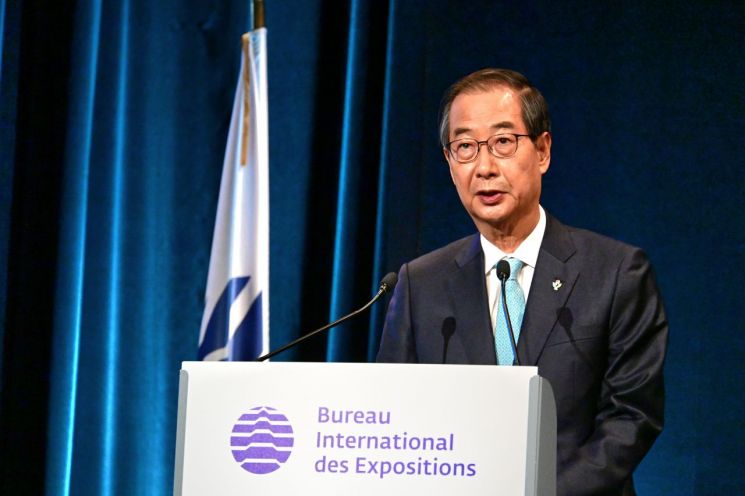
[Asia Economy Sejong=Reporter Kim Hyewon] Prime Minister Han Duck-soo stated on the 21st (local time) regarding the public institution innovation policy and the controversy over electricity rate hikes that "Korea Electric Power Corporation (KEPCO) itself has many areas that need reform."
After delivering a presentation on the 2030 Expo hosting competition at the International Bureau of Expositions (BIE) General Assembly in Paris, France, Prime Minister Han met with reporters and said, "Whenever there is talk of raising electricity rates, there are criticisms questioning whether KEPCO is doing its best. The public does not believe KEPCO is doing its best," expressing this view.
Prime Minister Han said, "Korea's electricity rates will be the cheapest in the world. Raising rates is essential," but added, "It is necessary to persuade the public. The public accepting the normalization of the currently abnormal rates does not mean that rates will be raised arbitrarily."
Regarding KEPCO's self-help efforts, Prime Minister Han pointed out, "(The public) thinks it is insufficient. They have never once said they would return half of their salaries. They sold buildings and such, but the basic duties KEPCO should perform, such as doing their best in management and employees making sacrifices, have only been done for a few months." He added, "If KEPCO were a private company, it would have gone bankrupt. If it goes bankrupt, salaries don't just get cut?they disappear."
On the recent emphasis by President Yoon Suk-yeol on public institution innovation, he said, "This time it will not fizzle out," and added, "(I) told the ministers directly."
Referring to the Moon Jae-in administration's renewable energy policy, he criticized, "KEPCO has been completely ruined," and said, "There are many side effects from rapidly increasing renewables, and at the same time, it seems there was a strong desire to 'destroy nuclear power,' but nothing has been destroyed. You cannot destroy it in five years." He continued, "Without the role of nuclear and coal as base power, relying mainly on renewables caused significant cost pressures," and emphasized again the necessity of electricity rate hikes, saying, "And since prices were not allowed to rise for years, it naturally deteriorated."
Regarding the establishment of the 'Police Support Organization' within the Ministry of the Interior and Safety, known as the 'Police Bureau,' he said, "For example, if there is an external agency like the prosecution, it is natural to have an organization that oversees and assists the external agency's work and discusses directions when necessary. That is why the Ministry of Justice has a Prosecution Bureau." He added, "The police did not have such an organization within the Ministry of the Interior and Safety, and it was only partially included in existing laws. For work efficiency, it is natural to have such an organization; it is somewhat strange that it did not exist until now."
Addressing concerns that the Police Bureau organization could undermine police independence, he rebutted, "That can be prevented by ensuring it does not undermine independence. Saying that an organization should not be created because it might undermine independence is not correct." Prime Minister Han linked the nuclear power and Police Bureau issues, arguing, "If there is a problem in the system, it must be resolved."
He said, "If the public worries about the risks of nuclear power, measures must be taken to eliminate those risks. This could be done by conducting more research to develop safer nuclear power plants or by creating an independent supervisory agency if the regulatory body is not independent." He added, "If this is not done, it is similar to saying, 'If a plane crashes and everyone dies, let's get rid of planes and just walk.'"
© The Asia Business Daily(www.asiae.co.kr). All rights reserved.

















