[Asia Economy Sejong=Reporter Dongwoo Lee] The government plans to nearly double the production of renewable energy at environmental facilities, including sewage treatment plants, within five years. Through this, it aims to additionally reduce 1.8 million tons of greenhouse gases annually.
On the 21st, the Ministry of Environment announced the "Bio and Water Energy Expansion Plan (Roadmap)" which aims to increase renewable energy production at environmental facilities such as sewage treatment plants, water purification plants, and dams by approximately 1.8 times by 2026 and about 2.7 times by 2030.
The goal is to increase the renewable energy production at environmental facilities from 3,264 GWh annually last year to up to 5,764 GWh by 2026. The 5,764 GWh corresponds to the amount of electricity that about 1.38 million households with four members can use annually.
The target is to increase production to a maximum of 8,762 GWh by 2030. This means that environmental facilities, which consumed 7,625 GWh of energy annually last year, will be transformed into production facilities that supply energy net (1,137 GWh).
Currently, there are 1,341 environmental facilities nationwide. These include 110 biogas production facilities using food waste and other waste resources, 43 large-scale water purification plants, 473 water purification plants operated by local governments, 678 public sewage treatment facilities with a capacity of over 500 tons, and 37 dams.
The Ministry of Environment plans to increase the total energy production capacity of these environmental facilities from 1.57 GW to about 3 GW by 2026. Measures to increase renewable energy production have been explored in two sectors: biogas and water energy.
For biogas, the plan is to expand production from the current 360 million Nm3 (normal cubic meters) annually to up to 500 million Nm3 by 2026 and up to 890 million Nm3 by 2030. Achieving the 2026 target is expected to replace LNG imports worth 181.2 billion KRW annually and additionally reduce 1.8 million tons of greenhouse gases per year.
The number of biogas production facilities, currently 110, will be increased to 140 with priority government funding. This is a plan to actively recycle organic waste resources such as food waste, sewage sludge, and livestock manure, which have been treated as feed or compost over 90% of the time, into energy.
There is also a plan to utilize biomethane, the main component of biogas, for green hydrogen production. The number of bio green hydrogen production facilities, currently two (Jeonju food waste biogas facility and Changwon sewage treatment plant), will be gradually expanded to up to five.
For water energy, the plan is to increase the energy production capacity of water management environmental facilities such as water purification plants, sewage treatment plants, and dams from the current 1.52 GW to a total of 2.9 GW by 2026.
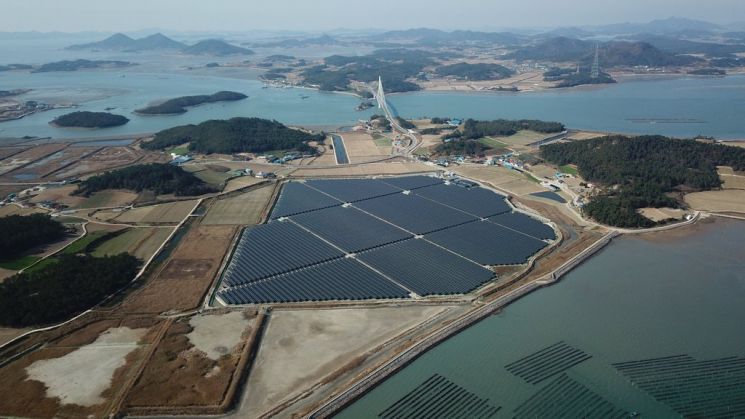
The Ministry of Environment plans to double the capacity of energy production facilities at water environment facilities, including floating solar power, from the current 1.52 GW to 2.9 GW. This will increase the annual power generation of water environment facilities by about 1,700 GWh from the current 3,104 GWh to 4,800 GWh.
An official from the Ministry of Environment said, "In the future, all infrastructure and buildings must produce energy themselves and reduce carbon emissions," adding, "We will carry out the roadmap without fail to make this future a reality."
© The Asia Business Daily(www.asiae.co.kr). All rights reserved.












