Already Crowded Low Earth Orbit Launch Vehicle Market
Even with Nuriho's Success, Immediate Profit Unlikely
Space Independence and Korea's 'Space Ecosystem' Are Crucial Nutrients
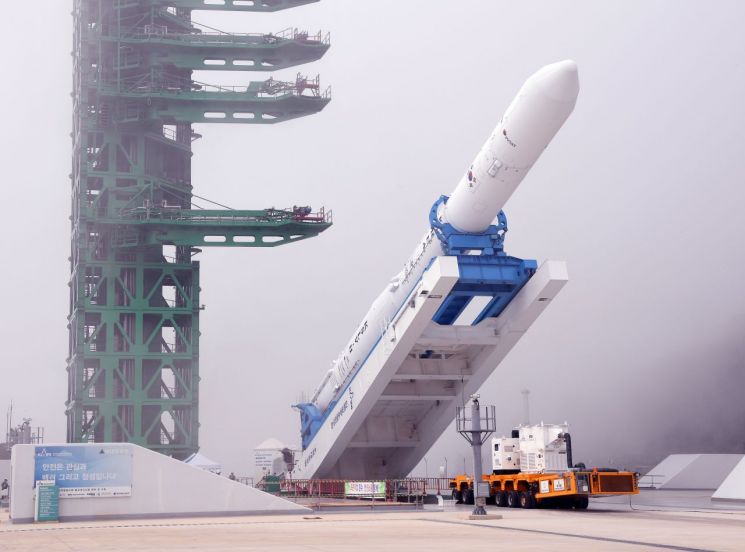 Nuri, the Korean launch vehicle (KSLV-II), stands upright on the launch pad at Naro Space Center in Goheung-gun, Jeollanam-do, one day before its second launch on the 20th. / Photo by Yonhap News
[Asia Economy Reporter Lim Ju-hyung, Intern Reporter Song Hyun-do] On the afternoon of the 21st, the Nuri rocket, which is attempting a re-launch at Naro Space Center in Goheung-gun, Jeollanam-do, is a low Earth orbit launch vehicle. However, the global low Earth orbit (600?800 km above Earth) launch vehicle market is flooded with competitors that surpass Nuri in safety and price competitiveness, making it a sector with low commercial viability. So why is the Korean government so committed to the success of Nuri?
◆A Market Overflowing with Competitors... Is There a Place for Nuri?
The Korean low Earth orbit launch vehicle Nuri rocket, after being taken down from the launch pad for sensor inspection on the 16th, is challenging flight again after five days. The development period took 12 years, with a budget close to 2 trillion won.
In fact, even if the Nuri rocket launch succeeds, it does not mean it can immediately establish itself in the commercial launch vehicle market. Space-advanced countries far ahead of Korea are still competing in developing low Earth orbit launch vehicles led by the private sector. According to the American investment bank Morgan Stanley, the commercial space market size exceeded 400 trillion won as of 2020. Among this, launch vehicles occupy the 'core' of the space industry as they send satellites into Earth's orbit, and already formidable advanced companies have entered the market.
The competitiveness of a launch vehicle is determined by the cost per kilogram of satellite weight sent into space. The 'VEGA' rocket developed by the European Space Agency (ESA) costs about $10,000 (approximately 12.9 million won) per kilogram for satellite launch, while the world's first reusable launch vehicle 'Falcon 9' developed by the U.S. company SpaceX costs only $2,700 (approximately 3.48 million won) per kilogram. Private space startups such as the UK's Orbex and Germany's Rocket Factory have taken a step forward with plans to dominate the low Earth orbit launch vehicle market by mass-producing inexpensive small rockets using 3D printers.
On the other hand, Nuri has so far poured a budget of 2 trillion won into research and development alone and must manufacture and launch four additional rockets by 2027 to verify safety. This means that both commercialization schedules and costs lag far behind global competitors.
◆Core to Space Independence and Future Growth Despite No Immediate Profitability
The future launch vehicles to be developed after Nuri are also expected to take a long time to achieve price competitiveness comparable to rockets from advanced space countries. Nevertheless, the development and success of Nuri hold very important significance for national security and the development of Korea's aerospace industry.
From a security perspective, it is essential for Korea to have launch vehicles developed independently. Satellite launches are not merely cargo transport but a business where sensitive information such as the satellite's specific size, weight, and performance is shared with the launch vehicle operator. Commercial satellites like 'Arirang 6,' launched in 2020 for disaster observation, can be launched on foreign launch vehicles without issue, but military satellites directly linked to national security should preferably use domestic companies to prevent information leaks.
ESA member countries such as the UK, France, and Germany use rockets jointly produced by Europe, and the U.S. also launches military satellites exclusively with domestically made launch vehicles. Now Korea can also launch military satellites independently without sharing confidential information with other countries.
Moreover, the development of Nuri is an important task for creating Korea's future space industry 'ecosystem.' Over 300 private companies, including the Korea Aerospace Research Institute, Hanwha Aerospace, Korea Aerospace Industries (KAI), and Hyundai Heavy Industries, participated in manufacturing Nuri. The data, design know-how, and skilled personnel accumulated through the Nuri project can become 'nourishment' for Korean private sectors to design and manufacture new launch vehicles in the future.
Even the U.S., which has the world's largest launch vehicle business including SpaceX, grew its industry through government-led initiatives during the early days of its space program. NASA, which accounted for an annual budget of $23.3 billion (about 30 trillion won) as of last year, led rocket design and new technology development, after which private companies completed commercial launch vehicles through follow-up projects.
◆A Tumultuous Launch Process
Nuri is the result of the '2nd Korean Space Launch Vehicle (KSLV-II)' project that began in March 2010. It was produced over about 12 years with a total development cost of 2 trillion won. All processes from design to rocket manufacturing and launch were realized domestically under the leadership of the Korea Aerospace Research Institute. This differentiates it from Korea's first launch vehicle 'Naroho,' which succeeded in launching in 2013 but used Russian-made products in its first stage rocket.
If the Nuri launch succeeds, Korea will become the seventh country capable of independently launching practical satellites (weighing 1.5 tons). However, the development process was not smooth. The first launch in October last year was a 'half success' as the third-stage engine shut down early and failed to enter orbit.
The second rocket was scheduled to launch on the 15th but was postponed by a day due to weather conditions. On the 16th, it was taken down from the launch pad for inspection due to a sensor anomaly in the rocket's internal oxidizer tank. After a five-day inspection, Nuri has stood up on the launch pad again and is waiting for ignition.
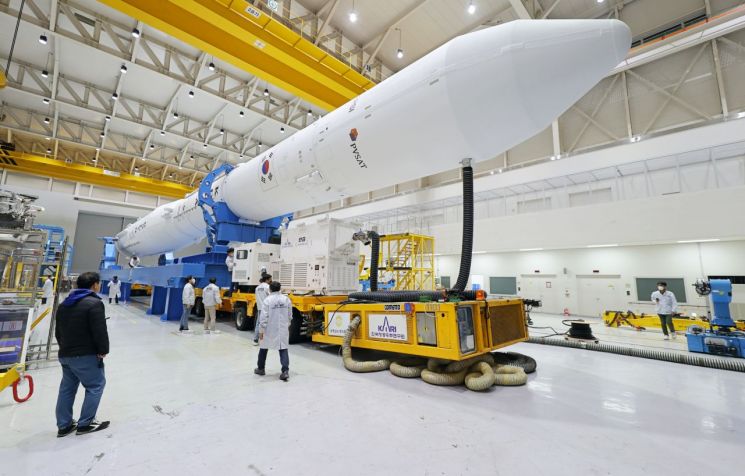 On the 16th, Nuriho, which had an abnormality detected in the oxidizer tank sensor inside the rocket before launch, was taken down from the launch pad for inspection. / Photo by Yonhap News
© The Asia Business Daily(www.asiae.co.kr). All rights reserved.













