[Tech War, Birth of Advanced Nations] Visiting the US Salk Institute
Government Builds Growth Infrastructure for California Bio Cluster
Actively Reforms Laws and Systems
Associations Share Exchange and Talent Development through Industry Groups
China Aims for 4200 Trillion KRW Bioeconomy by 2025
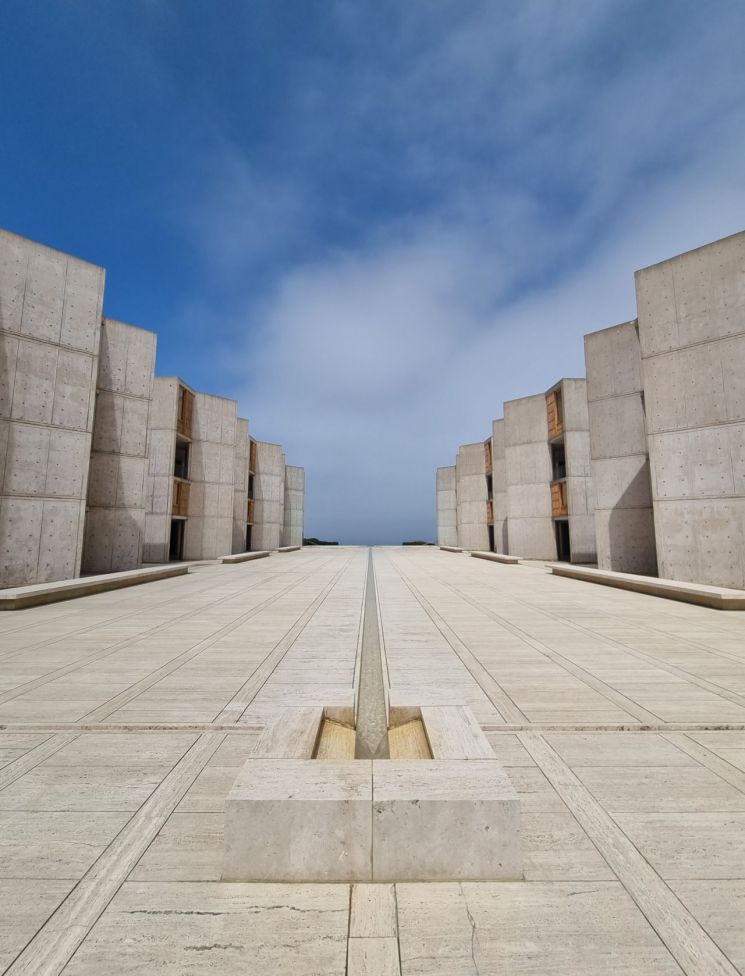
[Asia Economy San Diego (USA) = Reporters Chunhee Lee, Youngwon Kim] On the 15th (local time), the Salk Institute in San Diego, USA. The institute, located where the vast land meets the sea, felt like a playground where scientists could freely run and play.
The institute building, designed by Louis Kahn, who is credited with opening the door to modern architecture, and founded by Jonas Salk, who developed the polio vaccine, features an interior space resembling a large playground, with all interior walls made of movable partitions. This design maximizes flexibility, allowing researchers to expand or combine laboratories as needed. This is in stark contrast to the Richard Medical Research Institute, which Kahn had designed earlier but was criticized for overly segmenting the building, thereby failing to support the institute’s functions.
Through this, the Salk Institute made literally ‘wall-less research’ possible. Professor Reuben Shaw, who leads cancer research here, explained, "Researchers are not confined but actively interact with each other," adding, "Creating an environment where smooth communication occurs without partitions was set as a core value."
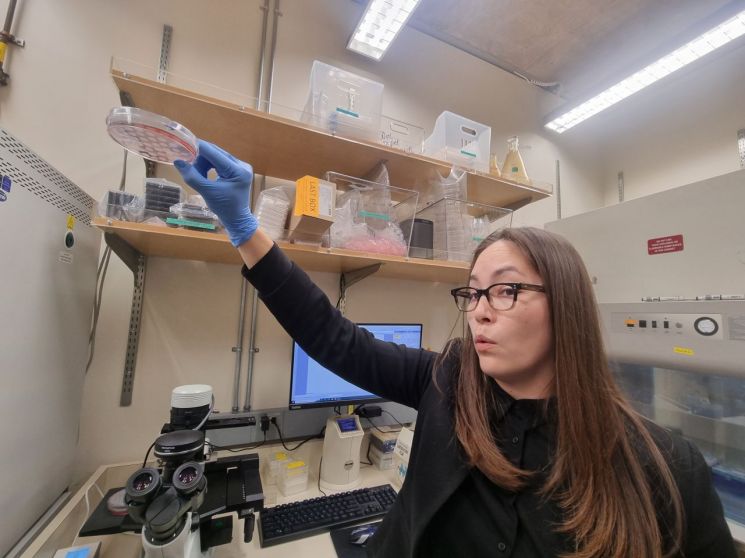 Professor Dannielle Engle of the Salk Institute is introducing her research related to cancer cells. Photo by Chunhee Lee, San Diego, USA
On the other hand, there are places within the institute that are perfectly sealed off. Spaces for piping and ventilation facilities are completely separated on different floors from the research facilities and are not visible from outside. This reflects a philosophy that only research results should be in the spotlight, while government support should remain hidden. The Salk Institute’s annual budget is $150 million (approximately 194 billion KRW), nearly matching the 237.1 billion KRW that South Korea’s Ministry of Trade, Industry and Energy supported for bio R&D last year. Of this, 60% is funded by the U.S. government.
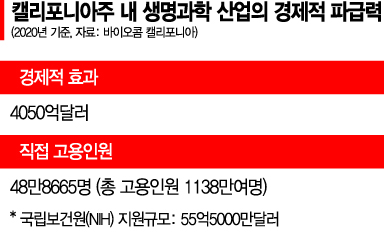
Those met locally agreed that government support is essential for the growth of the bio industry. Joe Panetta, CEO of Biocom California, a coalition of California bio companies, emphasized, "The government must build infrastructure for growth and create laws and systems necessary for the industry." He introduced, "The bio industry requires a large amount of water, but San Diego is a water-scarce region. Through continuous consultation with the government, we overcame this by recycling water." He also added, "The large-scale support from the U.S. National Institutes of Health (NIH) was absolutely crucial in helping basic bio research and the growth of early bio ventures."
Talent development is also indispensable for growth as a bio cluster. Biocom California organizes meetings by industry and continuously provides opportunities for interaction among them, while also sharing talent development methods among companies. Panetta said, "We must invest in nurturing both current and potential employees," adding, "Rapid talent development is essential to move from research to the next stage." The Salk Institute is also focusing on talent development by operating doctoral programs in collaboration with the University of California San Diego (UCSD), located just across the street.
John Rim, President of Samsung Biologics, who visited San Diego to attend Bio International 2022 (BIO USA), stated, "Factories can be bought with money, but talent development cannot," emphasizing, "The most important thing for sustainable growth is nurturing talent."
In South Korea, government and local governments have established bio clusters in Seoul Hongneung, Incheon Songdo, Chungbuk Osong, Daejeon Daedeok, Gyeonggi Pangyo, Gangwon Wonju, and Daegu-Gyeongbuk. Songdo, where SK Bioscience is about to move in after Samsung Biologics, Samsung Bioepis, and Celltrion have established headquarters, research centers, and production facilities, has advantages in global networking and marketing due to its geographical accessibility to Incheon Airport and Seoul.
China’s bio development efforts also deserve attention. On the 10th of last month, China’s National Development and Reform Commission announced a plan to achieve a bioeconomy scale of 22 trillion yuan (approximately 4,242 trillion KRW) by 2025, with the core industry’s total volume growing to 7.5 trillion yuan. This plan includes creating bioeconomic pilot zones. The Chinese government is focusing on developing regions with concentrated bio industrial complexes such as the Yangtze River Delta (Shanghai), Pearl River Delta (Guangzhou), and Jing-Jin-Ji (Beijing, Tianjin, Hebei), and actively supporting the construction of new R&D institutions in these zones.
San Diego (USA) = Reporters Chunhee Lee, Youngwon Kim spring@
© The Asia Business Daily(www.asiae.co.kr). All rights reserved.



















