Postponement of Q3 Fuel Cost Adjustment Unit Price Decision... Announcement Within This Week
KEPCO Requests 3 Won Increase per kWh... Limited to 3 Won per Quarter
Government Struggles with High Inflation... Last Month Hit 14-Year High
Choo Kyung-ho "Electricity Rates Directly Affect Citizens' Burden... KEPCO's Increase Proposal Insufficient"
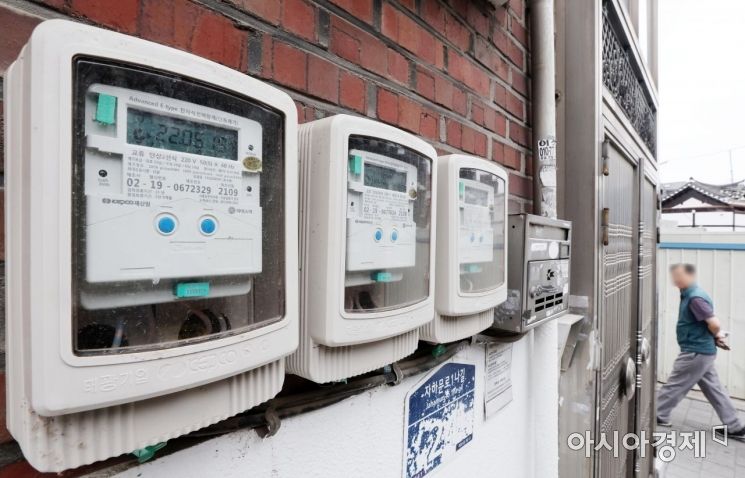 The electric meter installed in a residential area in Seoul on the 19th, as the announcement on whether to raise electricity rates approaches. With prices of essential goods and energy soaring across the board, and even public utility charges such as electricity, water, and gas increasing, these have become major causes of rapid inflation, deepening the concerns of inflation authorities. If the government accepts Korea Electric Power Corporation's request for an electricity rate hike, there are concerns that the consumer price inflation rate, which has already recorded the mid-5% range, could exceed 6%. Photo by Kim Hyun-min kimhyun81@
[Asia Economy Sejong=Reporter Lee Jun-hyung] The government has abruptly postponed the decision on the fuel cost adjustment unit price for electricity rates in the third quarter of this year. Analysts suggest that the government is deeply concerned about the balance between high inflation and electricity rates.
According to related ministries on the 20th, the Ministry of Trade, Industry and Energy notified Korea Electric Power Corporation (KEPCO) on the same day of the decision to postpone the determination of the fuel cost adjustment unit price for the third quarter. This was based on the judgment that additional discussions are necessary to decide whether to raise electricity rates. The Ministry plans to finalize the decision on whether to increase the fuel cost adjustment unit price within this week. A KEPCO official stated, “We received a notice from the Ministry of Trade, Industry and Energy that consultations with related ministries regarding the calculation details of the fuel cost adjustment unit price for the third quarter are still ongoing.”
The fuel cost adjustment unit price is a component of electricity rates adjusted quarterly according to the fuel cost linkage system. Previously, the government introduced the fuel cost linkage system last year to reflect fluctuations in fuel costs such as international oil prices in electricity rates.
Accordingly, KEPCO sent an official letter to the Ministry of Trade, Industry and Energy and the Ministry of Economy and Finance on the 16th of this month, stating that the fuel cost adjustment unit price for the third quarter should be raised by 3 KRW per kWh. Considering that the maximum fluctuation in the fuel cost adjustment unit price is 3 KRW per kWh, KEPCO effectively requested the maximum increase from the government. KEPCO also conveyed the opinion that the upper and lower limits of the fuel cost adjustment unit price, currently restricted to 3 KRW per quarter and 5 KRW annually, should be expanded.
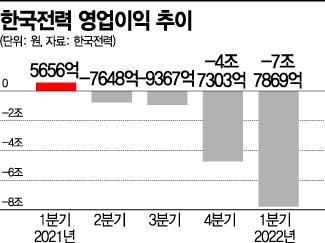
KEPCO requested the maximum increase in electricity rates because it has been selling electricity at a loss. Since the Ukraine crisis, energy prices such as international oil prices have soared, but electricity rates have not kept pace with the increase in fuel costs. This has created a distorted structure where the more electricity KEPCO sells, the greater its losses become. According to the Korea Power Exchange, as of the first quarter, KEPCO’s electricity purchase price was 181 KRW per kWh, while the electricity selling price was only 110 KRW per kWh.
Because KEPCO has been selling electricity at a loss, its deficit has already ballooned. In the first quarter alone, it recorded a deficit of 7.8 trillion KRW. This figure exceeds by about 2 trillion KRW the total deficit of approximately 5.9 trillion KRW recorded last year, which was the largest operating loss in history on an annual basis.
However, the government is deeply concerned about high inflation. Last month, the consumer price inflation rate was 5.4%, the highest in 14 years since the 2008 financial crisis. Since the high inflation situation is expected to continue in the second half of this year, the government cannot hastily raise electricity rates, which are directly linked to the burden of inflation.
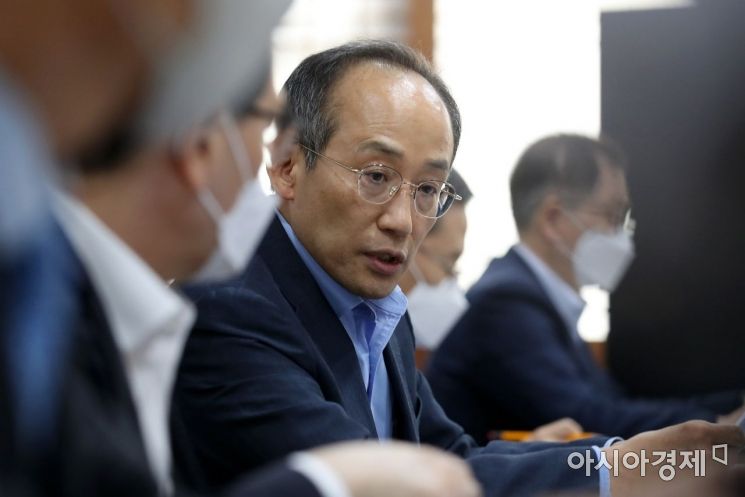 Deputy Prime Minister and Minister of Economy and Finance Choo Kyung-ho is delivering opening remarks at the 1st Emergency Economic Ministers' Meeting held at the Government Seoul Office in Jongno-gu, Seoul, on the afternoon of the 19th. Photo by Hyunmin Kim kimhyun81@
The Ministry of Economy and Finance, which is responsible for price stability, also indicated that electricity rates cannot be raised recklessly without considering inflation. At a press briefing on the same day, Deputy Prime Minister and Minister of Economy and Finance Choo Kyung-ho said, “KEPCO has the mission to supply electricity stably, but electricity rates are also directly related to the burden on the public,” adding, “We are making judgments by comprehensively considering the public’s position and the national economic perspective.”
Deputy Prime Minister Choo also pointed out that KEPCO’s self-help efforts must be supported. He said, “KEPCO should have initially presented various options at a level acceptable to the public, but this part was insufficient,” and added, “KEPCO itself needs to reflect on why it has ended up in this situation over the past five years.” He further stated, “If electricity rates need to be raised, public enterprises must naturally make efforts to gain corresponding understanding.”
In response, KEPCO is accelerating its efforts to devise self-help measures. Since the start of last month, KEPCO has been actively working on improving its financial structure and has recently disposed of real estate and equity stakes worth about 130 billion KRW. Additionally, as part of restructuring its overseas business, KEPCO plans to sell its Cebu power plant in the Philippines within this year. Through such asset restructuring, KEPCO aims to reduce costs by about 1.5 trillion KRW by the end of this year.
© The Asia Business Daily(www.asiae.co.kr). All rights reserved.
!["The Woman Who Threw Herself into the Water Clutching a Stolen Dior Bag"...A Grotesque Success Story That Shakes the Korean Psyche [Slate]](https://cwcontent.asiae.co.kr/asiaresize/183/2026021902243444107_1771435474.jpg)


















