The Global Community Struggling with Abnormal Climate... Increasing Number of People Reporting Depression Due to Environmental Concerns
2 out of 3 People "Felt Anxiety Related to Abnormal Climate"
"Climate Anxiety Can Seriously Disrupt Daily Life, Including Sleep"
Calls for Establishing Mental Health Support Systems in Response to Climate Change
 The number of people experiencing depression after encountering negative news related to climate change is increasing. The photo is unrelated to specific expressions in the article. [Image source=Pixabay]
[Asia Economy Reporter Park Hyun-joo] # "I feel depressed when I watch the weather news." Mr. A, in his 20s, confessed that he felt deep depression after seeing news about the increasing damage to rural areas due to ongoing droughts. When he hears negative news related to climate change, such as photos of penguins dying en masse because they cannot find food due to changes in water temperature or reports of poor crop yields due to record-breaking heatwaves, he worries so much about the future that he cannot sleep.
Symptoms like those experienced by Mr. A, who suffers from worries about climate change, are called 'climate grief' or 'eco-anxiety.' These refer to negative psychological symptoms such as sadness, anger, and anxiety caused by the climate crisis. Some people go beyond feeling depressed about future crises and express feelings of helplessness, guilt, and despair because they believe they cannot solve these problems.
As record-breaking droughts and heatwaves continue day after day, many people complain of such symptoms. According to a 2019 survey by the American Psychological Association of 2,017 adults aged 18 and older, two out of three respondents (68%) said they felt anxious about abnormal weather. In particular, half (47%) of those aged 18-34 said that the stress they feel about climate change affects their daily lives.
Regarding this, Professor Im Myeong-ho of Dankook University’s Department of Psychology explained, "It is well known that climate affects emotions. There is a claim that aggression increases on hot or humid days, leading to more incidents and accidents." He added, "In contrast, climate grief refers to feelings of helplessness and depression caused by social situations such as climate disasters. Because the future feels dark and bleak due to abnormal weather, people show depressive symptoms."
There are also cases where people express deep depression not because of the bleak climate outlook itself but due to society’s indifference. They feel despair at a society that does not take measures despite the seriousness of climate disasters. Swedish youth environmental activist Greta Thunberg also confessed to suffering severely from climate grief. When she was 11 years old, she was stressed after watching videos related to climate disasters, stopped eating and drinking, and reportedly lost 10 kg over two months.
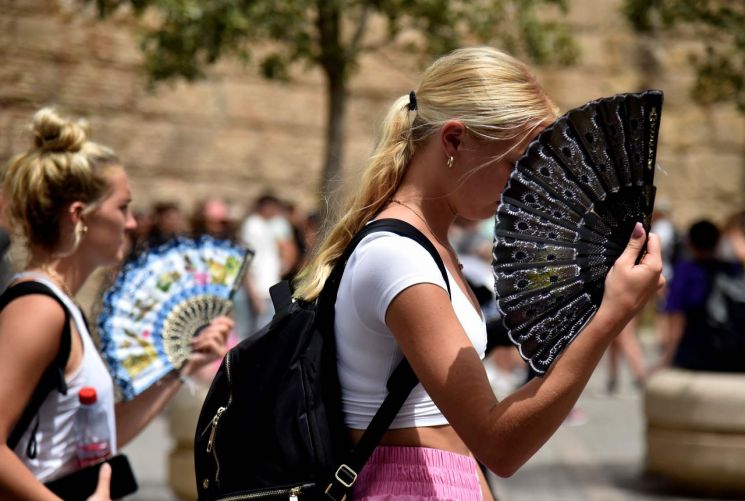 Pedestrians are fanning themselves as they walk on the streets of Seville in southern Spain, where the abnormal heat wave continues. [Image source=Yonhap News]
The problem is that if such climate grief continues, there is a risk of worsening mental health. The 6th report of the Intergovernmental Panel on Climate Change (IPCC) released in February also assessed that the climate crisis increases the risk of mental illnesses, depression, anxiety, and other mental health deteriorations. Additionally, meteorologist Bonnie Schneider warned in a January interview with CNN, "Environmental anxiety reflects people’s worries and fears about climate change and the future of the Earth," adding, "Climate anxiety can seriously disrupt daily life, such as interfering with sleep."
There are also research findings indicating a correlation between global warming and increased suicide rates. According to a CNN report in July 2018, a research team led by Marshall Burke, professor of Earth System Science at Stanford University, found that when the average monthly temperature rises by 1°C, the monthly suicide rate increases by 0.68% in the United States and 2.1% in Mexico. This means that unusually high temperatures tend to coincide with higher suicide rates for that month. The research team projected that if carbon dioxide emissions are not curbed, between 9,000 and 40,000 additional suicides will occur in the United States and Canada by 2050 due to temperature increases caused by climate change.
Consequently, voices are emerging calling for mental health support measures in response to climate change. It is argued that governments should establish mental health support systems for humanity suffering emotional distress due to rapidly changing climates. At a World Health Organization (WHO) meeting held in Stockholm, Sweden, on the 2nd and 3rd of this month, Maria Neira, Director of the WHO Department of Environment, Climate Change and Health, pointed out, "The impacts of climate change are becoming part of our lives, yet there is almost no mental health support related to it."
© The Asia Business Daily(www.asiae.co.kr). All rights reserved.


















