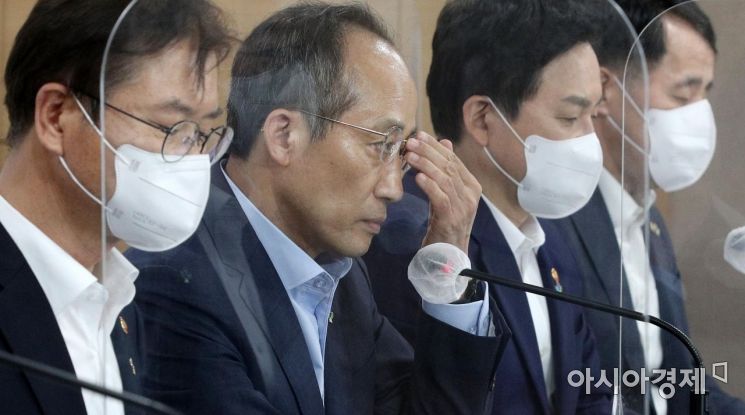
 Deputy Prime Minister and Minister of Economy and Finance Choo Kyung-ho is announcing the new government's economic policy direction at the Government Seoul Office in Jongno-gu, Seoul, on the 16th. From the left, Minister of Employment and Labor Lee Jeong-sik, Deputy Prime Minister Choo, Minister of Land, Infrastructure and Transport Won Hee-ryong, and 1st Vice Minister of Trade, Industry and Energy Jang Young-jin. Photo by Kim Hyun-min kimhyun81@
[Asia Economy Reporter Kim Jong-hwa] Regarding measures to revitalize business succession, the small and medium-sized enterprises (SME) sector is closely watching the 'tax reform plan' that the government is scheduled to announce next month.
The '2022 New Government Economic Policy Direction' announced by the government on the 16th included key measures to revitalize business succession, such as deferral of inheritance tax payments and relaxation of criteria for companies eligible for business succession.
The deferral of inheritance tax payments aims to prevent companies from selling their shares to pay inheritance and gift taxes when succeeding a business, which could weaken control or lead to external sales. In this reform plan, the government decided to introduce a system that defers inheritance tax payments until the time of transfer, inheritance, or gift for heirs who inherit a business meeting certain conditions.
The business succession deduction is a system that deducts up to 50 billion KRW from taxable assets when small and medium-sized or mid-sized enterprises meeting certain requirements become inheritance targets. To qualify for the deduction, SMEs and mid-sized companies with sales under 400 billion KRW had to meet a management condition of at least 10 years. In this reform plan, the sales threshold for companies eligible for business succession was expanded from 400 billion KRW to 1 trillion KRW, and the post-management period was relaxed from 7 years to 5 years. However, the deferral of payment and the business succession deduction cannot be applied simultaneously; the more favorable option can be chosen.
The current special tax exemption limit for pre-business succession gift tax, which is 10 billion KRW, will also be expanded to the same level as the business succession deduction. Although it has been criticized for being less effective due to a lower limit than the post-business succession deduction, increasing the limit to 50 billion KRW allows business owners to plan their succession strategically during their lifetime.
In response, the SME sector is taking a cautious stance, stating that since punitive inheritance tax rates remain unchanged and specific details such as deferral conditions and abolition of industry restrictions have not been discussed, they will monitor future developments.
July's 'Tax Reform Plan' as a Turning Point... "Must Watch Whether Core Industry Restrictions in Business Succession Support System Are Lifted"
The SME sector views the 'tax reform plan' to be announced by the Ministry of Economy and Finance next month as a turning point. Song Gong-seok, co-chairman of the Business Succession Revitalization Committee and CEO of Watos Korea, said, "Most of the demands we made to the government have been reflected, but the key issue of whether industry restrictions in the business succession support system will be lifted was not mentioned, so we need to wait until the tax reform to see." He added, "The ruling of the major opposition party, the Democratic Party, likely determined the success or failure of the reform. At this point, it is not a situation where we can make definitive judgments."
The punitive tax rate, which reaches up to 50%, remains unchanged, so the burden on heirs is still high. Among the 22 OECD countries imposing inheritance tax, Korea's rate is the fourth highest after Belgium, France, and Japan. In Belgium and France, the tax rate is lower when direct ascendants, descendants, and spouses inherit, so Japan is the only country with a higher inheritance tax rate than Korea in practice.
Furthermore, sensitive issues such as whether the deferral of inheritance tax payments applies only when the first generation passes to the second generation, how deferral conditions will be set, whether industry restrictions will be abolished, and easing of shareholding requirements for major shareholders were all excluded from this reform plan and deferred to government tax reform and subsequent parliamentary discussions.
Kim Hee-seon, a research fellow at the Korea Institute for Small and Medium Enterprises and Startups, said, "I think many field opinions have been reflected and relaxed to some extent," but added, "However, I think more time is needed before the abolition of industry restrictions. Since the classification changed from minor to medium in 2019, it will take some time before it changes again." This implies that discussions on sensitive issues such as lifting industry restrictions may be further postponed in the July tax reform plan.
According to the current Inheritance and Gift Tax Act, after the second generation inherits company shares, changing the business category beyond the medium classification is not allowed. If a new business succeeds and the sales proportion exceeds that of existing products, changing the company's 'main business' will disqualify it from receiving the business succession deduction.
According to the National Tax Service's National Tax Statistics Portal, from 2016 to 2020, the average annual number of business succession deduction cases in Korea was only 75.8, with a deduction amount of 264.6 billion KRW. This contrasts sharply with Germany, where the business succession deduction system is most developed, with an average of 13,169 cases annually and a deduction amount of 27.6 billion euros (approximately 37.1 trillion KRW).
Accordingly, the Korea Federation of SMEs' Business Succession Revitalization Committee and experts have persistently demanded the abolition of industry restrictions, stating that the criteria for industry and asset disposal required by the business succession support system are not suitable for the rapidly changing business environment. They also played a midwife role in the birth of this reform plan.
Yang Chan-hoe, head of the Innovation Growth Headquarters at the Korea Federation of SMEs, said, "I understand that most of the issues requested by the SME sector, including the abolition of industry restrictions and easing of shareholding requirements for major shareholders, have been accepted," adding, "There was no strong opposition from the opposition party during the discussions. I expect the new government to push forward with the reform at a rapid pace."
© The Asia Business Daily(www.asiae.co.kr). All rights reserved.
![Clutching a Stolen Dior Bag, Saying "I Hate Being Poor but Real"... The Grotesque Con of a "Human Knockoff" [Slate]](https://cwcontent.asiae.co.kr/asiaresize/183/2026021902243444107_1771435474.jpg)
















