Rising Food Prices Due to Export Restrictions Greatly Stimulate Domestic Feed, Meat, and Processed Food Prices
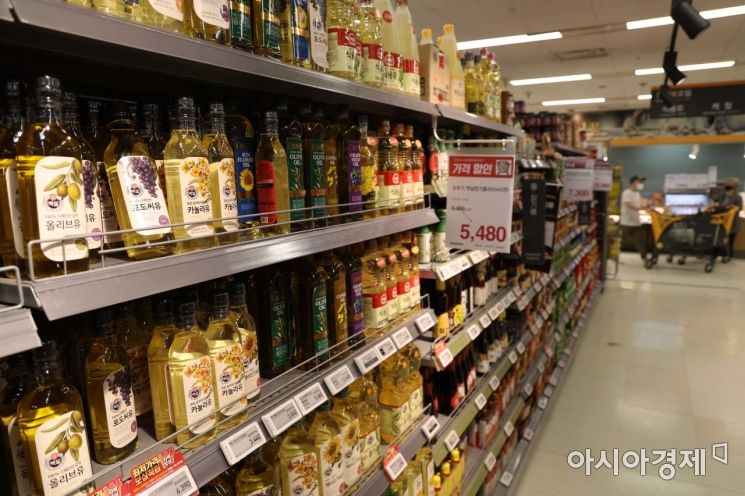 On the 19th, as concerns over edible oil supply increase due to Indonesia's palm oil export ban, citizens are purchasing edible oil at a large supermarket in downtown Seoul. Photo by Moon Honam munonam@
[Asia Economy Reporter Park Sun-mi] As food prices surge due to export restrictions imposed by countries around the world, the burden on domestic food industries and consumers is increasing, prompting calls for the establishment of a stable food supply chain.
According to the report "Supply Chain Disruptions and Impacts Due to Food Export Restrictions" released on the 20th by the Korea International Trade Association's International Trade and Commerce Research Institute, there were 57 food and fertilizer export restrictions imposed worldwide this year, with 45 of these implemented after the outbreak of the Russia-Ukraine war. Among major items, wheat (18 cases), soybean oil (10 cases), palm oil (7 cases), and corn (6 cases) were the most frequently restricted.
The report states that South Korea primarily imports food to process and consume, making it directly vulnerable to risks from disruptions in the international food supply chain. As of 2020, the proportion of imported raw grains used in domestic industries reached 79.8%, and the domestic self-sufficiency rates for major food items such as wheat, corn, palm oil, and soybean oil are only around 0 to 1%.
Although the food imported from countries implementing export restrictions accounts for only 11.6% of South Korea's total imports (based on calories), the rise in international prices due to export restrictions is affecting import prices and domestic inflation. Furthermore, major fertilizer-exporting countries such as Russia and China have also imposed export restrictions on fertilizers, increasing costs across the feed and food industries.
An analysis by the Trade Association on the impact of food and fertilizer export restrictions by major countries on domestic prices by item found that after the export restrictions, prices of grains, oils, and fertilizers rose by 45%, 30%, and 80%, respectively. This had the greatest impact on domestic prices for feed (13.6%), processed food products (6.1%), and meat and dairy products (6%). Agricultural products such as grains and food crops (3.9%) and vegetables and fruits (3.2%) were also affected by price increases.
Researcher Kim Na-yul of the Trade Association said, "Disruptions in the food supply chain will worsen South Korea's trade balance and corporate profitability while fueling inflation," adding, "To stabilize the food supply chain, it is necessary to build relevant statistics to identify risk items in advance and secure alternative import sources." She also emphasized, "In the long term, efforts should be made to expand overseas agricultural development to establish a stable food supply chain."
© The Asia Business Daily(www.asiae.co.kr). All rights reserved.
![Clutching a Stolen Dior Bag, Saying "I Hate Being Poor but Real"... The Grotesque Con of a "Human Knockoff" [Slate]](https://cwcontent.asiae.co.kr/asiaresize/183/2026021902243444107_1771435474.jpg)
















