Consumer Sentiment Hits Lowest in 42 Years Due to Inflation
"Likely Due to Concerns Over Household Debt and Rising Prices"
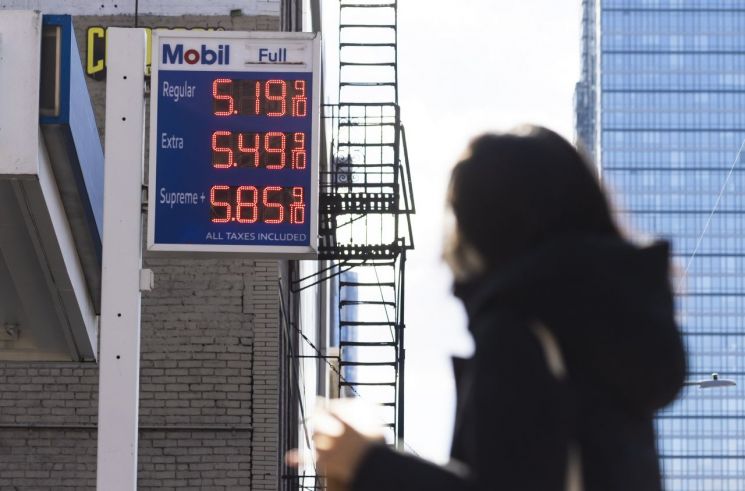 A pedestrian is passing by a gasoline price display board installed at a gas station in New York City, USA.
 [Image source=Yonhap News]
[Asia Economy Reporter Park Hyun-joo] As American consumer sentiment has fallen to an all-time low, concerns about an economic recession are growing. This consumption contraction phenomenon has been observed in both low-income and high-income groups.
According to the Washington Post (WP) on the 18th (local time), the consumer sentiment index released by the University of Michigan plummeted from 58.4 last month to 50.2 this month. This figure is lower than the all-time low of 51.7 recorded in May 1980. WP reported that Americans are sharply reducing their demand for everyday services such as dining out, travel, haircuts, and cleaning.
According to an analysis by investment bank Barclays, service demand has been hit harder than goods demand. Service expenditures such as travel and dining, which had risen by 30% compared to last year at the beginning of this year, have now seen their growth rate halved, while goods expenditures continue to increase by around 10% compared to last year. WP analyzed this decline in service spending as overturning the conventional belief that Americans prioritize spending on goods like cars and furniture over services like travel and dining.
The contraction in American consumer sentiment appeared regardless of income level. Barclays' analysis of credit card data showed that both high-income and low-income groups have reduced service consumption over the past 4 to 6 weeks. Although low-income groups have been hit hardest by inflation, it can be interpreted that high-income groups have also reduced consumption as asset values such as stocks have fallen.
This contraction in consumer sentiment is largely driven by concerns about household debt and rising prices. According to the U.S. central bank, the Federal Reserve (Fed), as of the 1st, U.S. household debt reached $8.68 trillion (approximately 1,124 trillion won), an increase of nearly 16% compared to the same time last year. Consumer prices also rose 8.6% over the past year, marking the highest level in 41 years.
© The Asia Business Daily(www.asiae.co.kr). All rights reserved.
!["The Woman Who Threw Herself into the Water Clutching a Stolen Dior Bag"...A Grotesque Success Story That Shakes the Korean Psyche [Slate]](https://cwcontent.asiae.co.kr/asiaresize/183/2026021902243444107_1771435474.jpg)
















