Different Dreams on Minimum Wage Increase Amid Inflation
Labor: "Must Raise" vs. Management: "Freeze"
Initial Proposals to Be Revealed Next Week... Big Gap Expected
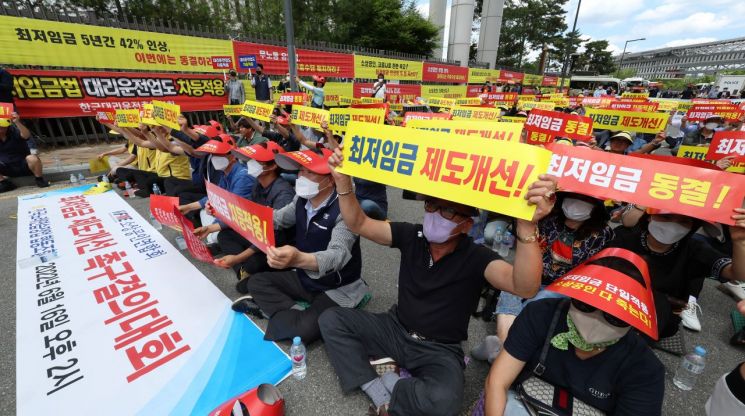 Officials from the Korea Federation of Small and Medium Business held a rally urging improvements to the minimum wage system in front of the Ministry of Employment and Labor at the Government Complex Sejong in Sejong City on the afternoon of the 16th, when the 4th plenary meeting was held, shouting slogans. [Image source=Yonhap News]
Amid steep inflation and growing economic uncertainty, the scale of the minimum wage increase has emerged as the top issue between labor and management. Labor groups argue that the minimum wage must be raised significantly as workers' lives have become more difficult due to rising prices, while the business sector counters that the burden on companies has increased due to rising raw material costs and insists on freezing the minimum wage.
With President Yoon Seok-yeol's campaign pledge to apply differentiated minimum wages by industry effectively shelved for now, the business community is expected to push even harder for a 'minimum wage freeze,' making the tug-of-war between labor and management even more intense.
According to the Minimum Wage Commission on the 18th, at the 6th plenary meeting scheduled for the 21st, labor and management will each present their initial proposals for next year's minimum wage level. Earlier, labor groups stated at a forum held by the two major trade unions that a minimum wage of 11,860 won is appropriate. This amount is 29.5% higher than this year's minimum wage of 9,160 won. On the other hand, the business sector is expected to demand a freeze at the usual level.
The problem lies in the recent soaring inflation. Due to the Ukraine crisis, rising raw material prices, and high oil prices, inflation is accelerating worldwide. Last month, the domestic consumer price inflation rate rose to 5.4%, the highest in 13 years and 9 months, and this trend is expected to continue for some time. The United States has recently taken a 'giant step' (a 0.75 percentage point hike in the benchmark interest rate at once) to counter inflation, tightening monetary policy, which is increasing instability in the domestic financial and foreign exchange markets.
On the 16th, Ryu Ki-jung, Executive Director of the Korea Employers Federation (KEF), emphasized in his opening remarks at the 4th plenary meeting, "Our economy is currently facing a complex crisis of 'high inflation-high exchange rate-high interest rate-low growth,'" adding, "Stability in the minimum wage is more urgent than ever." He stressed that since small and medium-sized enterprises and self-employed businesses are suffering greatly from rising producer prices, wage burdens must be reduced.
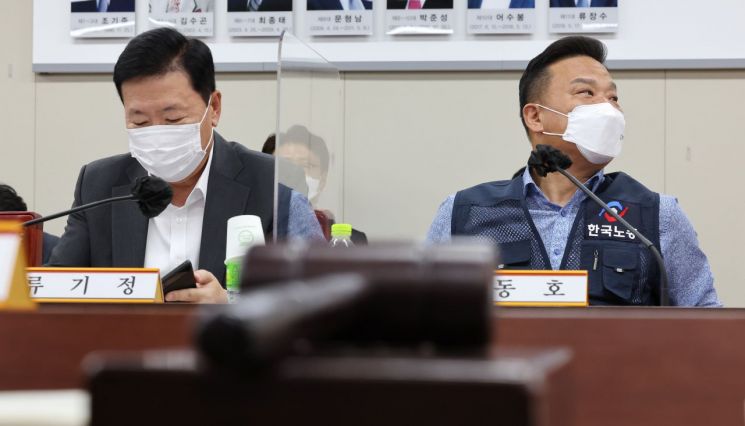 On the afternoon of the 9th, at the 3rd plenary meeting held in the Minimum Wage Commission meeting room of the Government Complex Sejong in Sejong City, Ryu Ki-jung, Executive Director of the Korea Employers Federation, a user committee member (left), and Lee Dong-ho, Secretary General of the Korean Confederation of Trade Unions, a worker committee member, were seated.
 [Image source=Yonhap News]
Especially since it was concluded at the last plenary meeting not to apply President Yoon's pledged differentiated minimum wage by industry next year either, the business sector is expected to take a stronger stance on freezing the minimum wage. At that meeting, a vote was held among 27 attendees, resulting in 16 votes against and 11 in favor. The KEF stated that this "ignored the desperate reality and wishes of small and micro enterprises and small business owners."
However, labor groups continue to demand nearly a 30% increase in the minimum wage, making smooth discussions unlikely. Lee Dong-ho, Secretary-General of the Korean Confederation of Trade Unions (KCTU), emphasized the need for a minimum wage increase at the 2nd plenary meeting last month, saying, "Last year, the operating profits of leading domestic conglomerates reached record highs, resulting in a bonus bonanza and wage increases approaching 10%."
A labor representative said, "Low-wage workers find it difficult to maintain a basic livelihood unless their wages rise above the inflation rate," adding, "Deputy Prime Minister Choo Kyung-ho asked for restraint, saying that if wages rise, inflation could accelerate further, but by that logic, the supplementary budget of 62 trillion won, which negatively affects inflation, should not have been enacted either."
The minimum wage is deliberated and decided by the Minimum Wage Commission, which consists of 27 members: 9 employer representatives, 9 worker representatives, and 9 public interest members. A decision must be made by the minimum wage announcement deadline set annually on August 5.
© The Asia Business Daily(www.asiae.co.kr). All rights reserved.


















