The First Step in Semiconductor Production: The Core 'Photo Process'... Exclusive 'EUV' Manufacturer
Started in a Wooden Building Next to Philips in 1984... Tripled Growth After EUV Mass Production
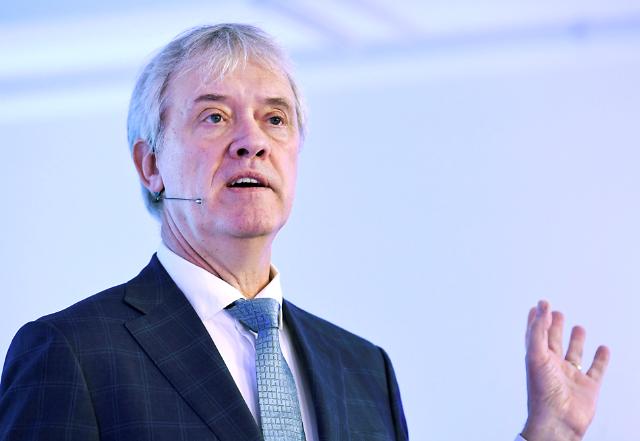
 Samsung Electronics Vice Chairman Lee Jae-yong discussed cooperation plans with Peter Wennink, CEO of ASML, at the ASML headquarters located in Eindhoven, Netherlands, on the 14th (local time). / Photo by Samsung Electronics
[Asia Economy Reporter Lim Juhyung, Intern Reporter Song Hyundo] Lee Jae-yong, Vice Chairman of Samsung Electronics, visited the headquarters of semiconductor equipment company 'ASML' in Eindhoven, Netherlands, on the 14th (local time). This was his return visit after 1 year and 8 months since October 2020. Lee is not the only global semiconductor industry leader visiting ASML. Pat Gelsinger, CEO of the American comprehensive semiconductor company 'Intel,' which recently declared strengthening its semiconductor foundry business, also contacted ASML directly earlier this year to discuss equipment supply plans. Taiwan's 'TSMC,' the world's largest foundry company, has also maintained a close and long-standing relationship with ASML. ASML is the sole producer of the essential equipment for semiconductor production, the 'EUV lithography machine.'
◆Gaining 'Super Eul (乙)' status with EUV that draws the semiconductor 'blueprint'
The reason ASML has emerged as a superpower in the global semiconductor industry is thanks to EUV. Without this equipment, which ASML exclusively manufactures, semiconductor companies cannot even begin fine processing. EUV plays a key role in the 'photolithography process' during semiconductor production. It projects extreme ultraviolet (EUV) light onto a wafer coated with a special photoresist (a liquid that undergoes a chemical reaction when exposed to light) to engrave fine patterns. These patterns become semiconductor integrated circuits after further processing. In other words, EUV is the equipment that draws the semiconductor blueprint.
Especially, to engrave circuits smaller than 5 to 7 nanometers (nm), EUV must be used. The production volume of high-performance semiconductors is linked to the number of EUV machines possessed.
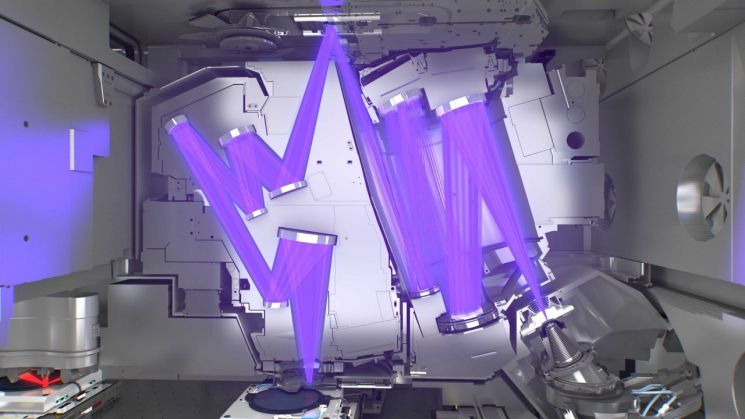 Schematic diagram of EUV operation. The extreme ultraviolet light source repeatedly hits a special lens, becoming progressively clearer, and then reaches the wafer surface to draw circuits. / Photo by ASML website capture
EUV manufacturing is extremely difficult. Since the EUV light has a short wavelength and is easily absorbed by air, the equipment must operate in a vacuum state internally, and because the light patterns must be drawn at the nm scale, mechanical movements that ignore inertia must also be implemented.
The price per EUV machine ranges from $120 million to $150 million (approximately 154.5 to 193.1 billion KRW), making it very expensive. Due to the high manufacturing difficulty and limited annual supply, no matter how much semiconductor companies worldwide want to purchase, ASML cannot quickly expand production volume. Last year, ASML produced 43 EUV machines, and this year it is expected to increase to 53. Meanwhile, the cumulative demand from semiconductor companies like Samsung, TSMC, and Intel overwhelmingly exceeds this. This is why a fierce 'EUV acquisition competition' inevitably occurs among global semiconductor companies.
◆From a wooden building to a global semiconductor equipment company
ASML had humble beginnings. It was established in 1984 as a joint venture between Dutch electronics company 'Philips' and semiconductor equipment company 'ASMI.' Its headquarters was an old wooden building next to the Philips headquarters in Eindhoven, and it had fewer than 100 employees.
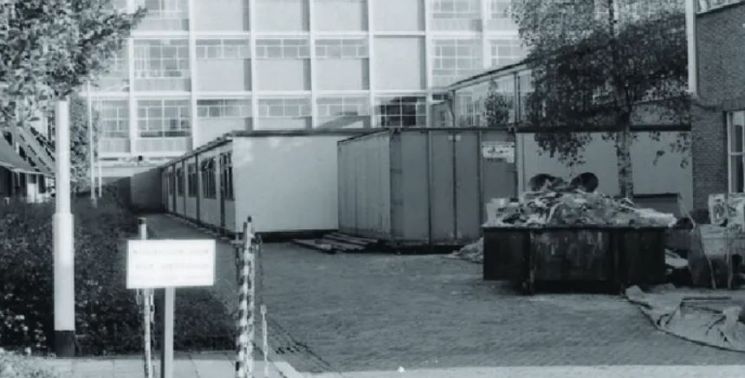 ASML started in 1984 in a wooden building near the headquarters of the Dutch electronics company Philips. / Photo by ASML website capture
The turning point for ASML to gain its current status came 17 years later in 2001 with the development of a technology called 'TwinScan.' TwinScan is a technology that projects light onto the wafer from one side while adjusting the wafer's position from the other side. Thanks to this technology, ASML was able to improve both the productivity and accuracy of lithography equipment, and later succeeded in developing a new device called 'Immersion,' which can project light even more precisely, laying the foundation for mass production of EUV.
The development process of EUV was not smooth. EUV is an ultra-high-priced device with limited customers, and the risks of research and development and production costs are extremely high. Japanese semiconductor equipment companies Nikon and Canon Tokki, which were making similar equipment, viewed the success potential of EUV as low and did not invest actively for these reasons.
Nevertheless, ASML's management did not lose faith in EUV and continued to invest steadily. Eventually, ASML completed a prototype EUV machine in 2010 and has since become a monopoly by supplying products to global semiconductor companies.
The company's scale has also grown explosively. Revenue, which was 5.2 billion euros (about 7 trillion KRW) in 2013, increased more than threefold to 18.6 billion euros (about 25.69 trillion KRW) last year, and it has become a global giant employing about 32,000 people in 122 countries worldwide.
ASML is also expanding its influence in Korea. It has offices in four locations: Hwaseong, Icheon, Cheongju, and Pyeongtaek. The Korean branch of ASML serves as customer support, logistics network support, and a training center for customer engineers.
◆Fierce technological competition... friction with Samsung over 'technology spying'
Although ASML has cooperated with foundry companies like Samsung for a long time, their relationship has not always been smooth. Peter Wennink, CEO of ASML, caused controversy in a 2019 interview with Dutch media 'NOS Journal' by claiming that "our largest customer in Korea" had previously traded with a Chinese company that stole their technology. Although CEO Wennink did not specify the company name at the time, the context suggests that 'the largest customer in Korea' is presumed to be Samsung.
According to CEO Wennink, in 2015, the Chinese tech company 'XTAL' hired some employees from ASML's China branch and stole software technology necessary to operate EUV. Subsequently, Samsung reportedly purchased EUV software not from ASML but from XTAL at a much cheaper price. Since Samsung bought the technology stolen from ASML at a low price, there are claims that Samsung played some "role" in this spying incident.
However, after reports by Dutch media, Samsung immediately issued a rebuttal statement. Samsung stated that their transactions with XTAL at the time included a clause prohibiting the use of third-party intellectual property, so it was impossible for ASML's software to have been illegally transferred to Samsung. Later, ASML released an official statement agreeing with Samsung's rebuttal, calming the controversy.
This incident shows the reality of fierce technological competition in the semiconductor industry, where partners involved in transactions worth trillions of won annually can be accused as suspects of technology spying.
◆How long will the monopoly last... Will ASML continue to thrive?
ASML controls about 85-90% of the EUV market. The technological gap with former rival companies Nikon and Canon Tokki has widened significantly. Additionally, ASML acquired the American company 'Cymer,' which exclusively manufactured EUV light source components, in 2013, securing the core technology patents. This early move blocked potential competitors.
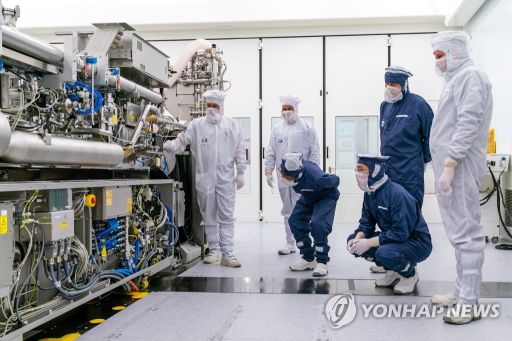 In October 2020, Vice Chairman Lee visited the ASML headquarters and viewed the actual EUV lithography equipment. / Photo by Yonhap News
However, whether ASML can maintain its current monopoly position remains uncertain. EUV is the core equipment for ultra-fine processes in the 10nm range, but this year, foundry companies like Samsung and TSMC are competing in single-digit nanometer processes, reaching down to 3nm. Intel even announced a future roadmap last year that includes a process called 'angstrom,' which is ten times smaller than 1nm.
For processes smaller than 1nm to become a reality, equipment capable of much finer work than current EUV may be required. The research and development know-how and core technology patents that ASML has built since 2001 to solidify its EUV monopoly could risk becoming obsolete.
However, ASML is also accelerating the development of 'next-generation EUV' to secure future technology. ASML plans to mass-produce a new EUV model equipped with a new lens technology called 'High-NA' next year. The High-NA lens can reflect EUV light sources much more clearly than existing lenses, enabling much more precise patterning work.
© The Asia Business Daily(www.asiae.co.kr). All rights reserved.



















