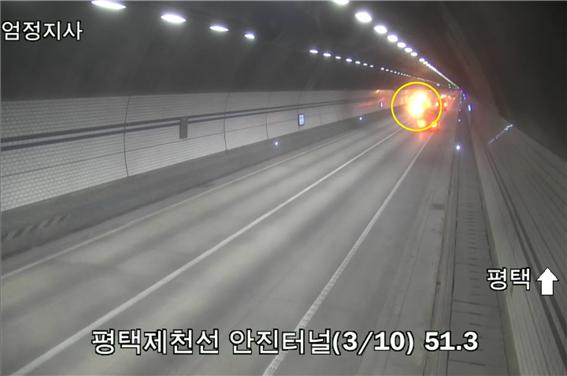
 On the 14th of last month, a 1-ton cargo truck collided with the rear of a Spark and an Optima vehicle that were stopped in the first lane inside the Anjin Tunnel on the Pyeongtaek-Jecheon Expressway, causing a fire. This accident, presumed to be due to inattentive driving, resulted in the deaths of a couple in the Spark vehicle.
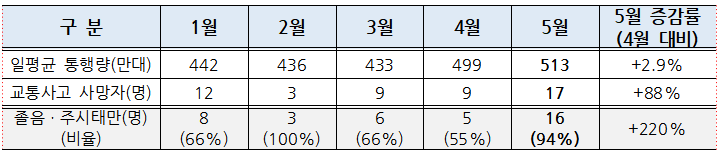
 Korea Expressway Corporation announced that the number of highway traffic accident fatalities in May this year increased by 8 from April to 17, of which 16 were deaths caused by drowsiness and inattention.
The number of drowsiness and inattention-related deaths in May increased by 220% compared to April. This is attributed to the increasing highway traffic volume throughout the year and the large temperature differences that easily cause driver fatigue.
In June this year, during the travel week (2nd to 30th), the average daily highway traffic volume is expected to increase to 5 million vehicles (as of the 12th), higher than in May. Since the large temperature differences are expected to continue until the end of the month, special caution against drowsy driving on highways is necessary.
Drowsy driving reduces the driver's crisis response speed and vehicle control ability, similar to drunk driving with a blood alcohol concentration of 0.17%. This is twice the license cancellation standard of 0.08%.
In particular, drowsy driving accidents result in collisions without braking, leading to a fatality rate of 4.51%, which is 1.75 times higher than the 2.58% fatality rate of drunk driving.
To prevent drowsy driving, drivers should get more than 6 hours of sleep the night before long-distance driving. If drowsiness is felt while driving, it is essential to take a break at rest areas or drowsiness shelters.
Also, driving with the windows closed and the air conditioner on increases the carbon dioxide concentration inside the vehicle and reduces the amount of oxygen going to the brain, inducing drowsiness. To reduce carbon dioxide concentration, windows should be opened or the external circulation button that allows outside air to enter should be pressed periodically to ventilate the vehicle interior.
Carbon dioxide concentration above 2000 ppm causes fatigue, and concentrations above 5000-6000 ppm reduce concentration and cause headaches. When four adults drive with the windows closed and the air conditioner on, the carbon dioxide concentration rises to 3000 ppm within 10 minutes.
A Korea Expressway Corporation official said, "Drowsiness is not something to fight against; when you feel sleepy, you should take a break even if only briefly," and added, "Please use the rest areas and drowsiness shelters located throughout the country to safely use the highways."
© The Asia Business Daily(www.asiae.co.kr). All rights reserved.


















