Unveiling of Unified Silla Gilt Metalwork with Twin Bird Pattern from Donggung and Wolji
Most Detailed Metal Craft Artifact Discovered to Date
"So Detailed and Meticulous That Modern Artisans Cannot Reproduce"
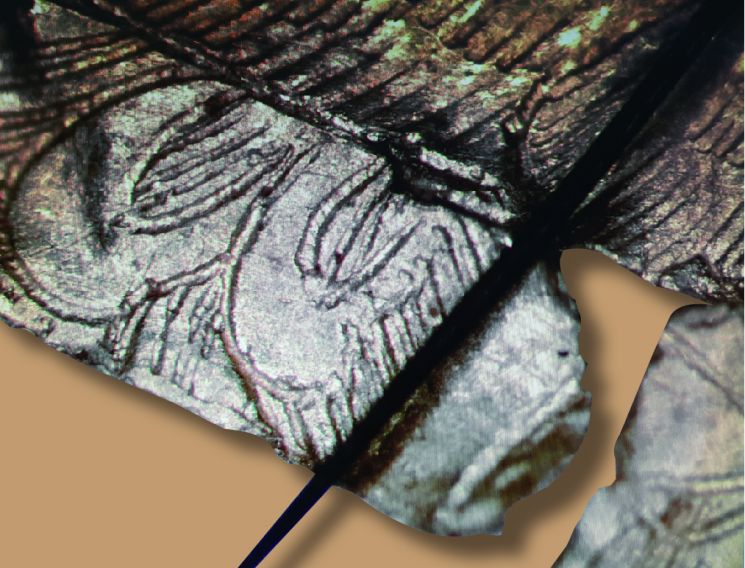
In 2016, a gold leaf with incised floral and paired bird patterns from the Unified Silla period was excavated at Donggung Palace and Wolji Pond in Gyeongju. The thickness of the pure gold leaf (weighing 0.3g) is 0.04 mm. The ultra-fine lines of the patterns, engraved with an iron stylus, are less than 0.05 mm thick. They are thinner than a human hair (0.08 mm). This is the most delicate metal craft artifact discovered to date. The intricacy of the patterns is equally impressive. Two wild pigeons and a floral motif (dan-hwa, a decorative design resembling a flower viewed from above) are depicted realistically. Experts have marveled that it could be interpreted as a painting.
The incised floral and paired bird gold leaf, which fully conveys exquisite metalworking skills, is being publicly exhibited for the first time. The National Gyeongju Cultural Heritage Research Institute will hold a special exhibition titled "Golden Bird-and-Flower Painting in 3 cm" at Cheonjongo from the 17th until October 31. When discovered, the piece was so crumpled and separated into two parts that its shape was difficult to discern. After long-term preservation treatment, it has regained its intact form (3.6 cm wide by 1.17 cm high). A Cultural Heritage Administration official stated, "We were able to remove contaminants and stabilize it physically, confirming the joining."
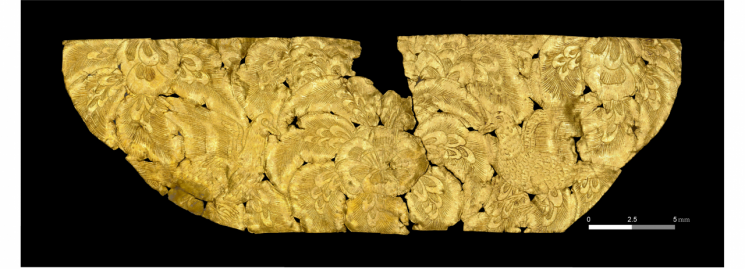
The gold content of Silla gold crowns ranges from 80 to 89%. The incised floral and paired bird gold leaf approaches 99.99%. This indicates that Unified Silla had secured high-purity refining technology. The patterns can only be seen with a magnifying glass or microscope. Centered on the floral motif, wild pigeons are arranged on both sides. The outer lines were engraved first, followed by internal decorations and expressions. A Cultural Heritage Administration official estimated, "At least two or more tools were used," and commented, "The detail and meticulousness are such that modern artisans cannot replicate it."
The floral motif is one of the decorative patterns of Unified Silla. It is also found in gilt-bronze mirror tube decorations excavated from Guhwang-dong in Gyeongju and gilt-bronze phoenix decorations from the western ruins of Hwangnyongsa Temple. Unlike the stylized four-winged Persian and other Western motifs, the shapes are realistic. The wild pigeons are also differentiated by body size and tail feathers to distinguish male and female, with diverse feather representations.
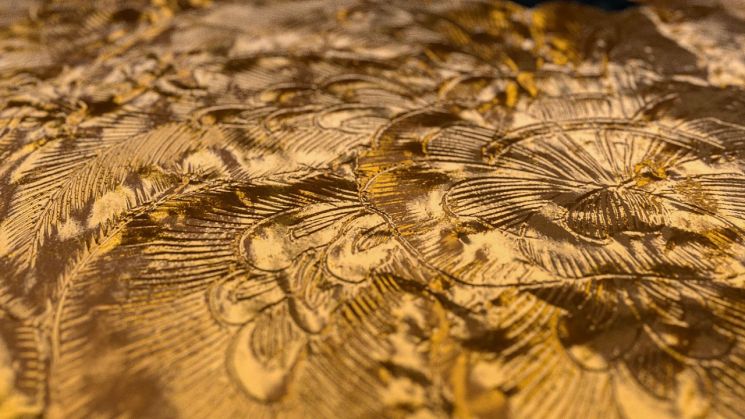
There is no hole for hanging separately. For this reason, it is presumed to have been an ornament attached to a specific object. A Cultural Heritage Administration official said, "Currently, there is no comparable example, but judging by its shape, it is presumed to be the end cap (maguri) of an object with a trapezoidal cross-section (a long piece, such as the two end faces of a box)." They added, "The design is so fine that it is difficult to identify with the naked eye, suggesting that beyond being decorative, it may have served a function for offering to a deity."
© The Asia Business Daily(www.asiae.co.kr). All rights reserved.



















