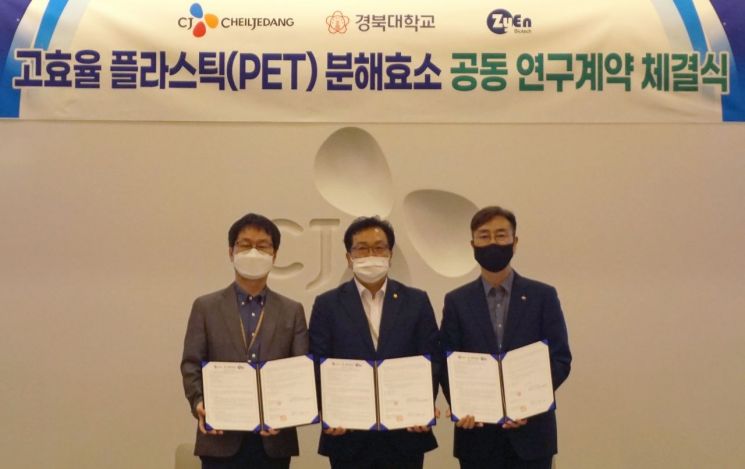
 (From right) Hwang Yoon-il, Head of Bio Business Division at CJ CheilJedang, Kim Si-oh, Vice President for External Cooperation at Kyungpook National University, and Kim Kyung-jin, CEO of Zien and professor at Kyungpook National University, are posing for a commemorative photo after signing a "Joint Research Agreement on High-Efficiency Plastic Degrading Enzymes" on the 15th at CJ Blossom Park in Suwon, Gyeonggi-do.
[Asia Economy Reporter Eunmo Koo] CJ CheilJedang announced on the 16th that it has partnered with Kyungpook National University to develop and commercialize enzymes that biologically decompose plastics.
The two parties plan to improve and produce high-efficiency enzymes that break down PET, a plastic material widely used worldwide, and develop plastic decomposition and raw material purification processes. They are also actively considering forming a consortium to involve companies and academia with excellent competitiveness.
CJ CheilJedang intends to commercialize an environmentally friendly "biological recycling" technology that replaces "mechanical recycling," which currently accounts for more than 90% of plastic recycling methods. This technology has the advantages of causing almost no negative environmental impact during the plastic decomposition process, consuming relatively less energy, and producing recycled materials of superior quality.
Currently, most plastics are recycled through a mechanical process involving separation collection, label removal, crushing, washing, and raw material conversion. Although this method is widespread due to its low cost, the quality of recycled materials is poor, and its economic feasibility is insufficient. Recently, some companies in North America and Europe have introduced chemical recycling technologies that melt plastics with heat or decompose them using solvents to produce high-quality raw materials; however, these methods have a considerable environmental impact and have not become a perfect alternative.
Hwang Yoon-il, head of CJ CheilJedang's Bio Business Division, said, "This collaboration is a meaningful first step toward changing the paradigm of plastic recycling methods to a more eco-friendly and sustainable direction," adding, "We will actively pursue the development of plastic natural decomposition enzymes as well as the discovery and cultivation of new businesses from an ESG (Environmental, Social, and Governance) perspective."
© The Asia Business Daily(www.asiae.co.kr). All rights reserved.

















