WHO Discusses Declaration of 'International Public Health Emergency'
Korea Disease Control Agency to Introduce Antiviral Drugs for 500 People Next Month
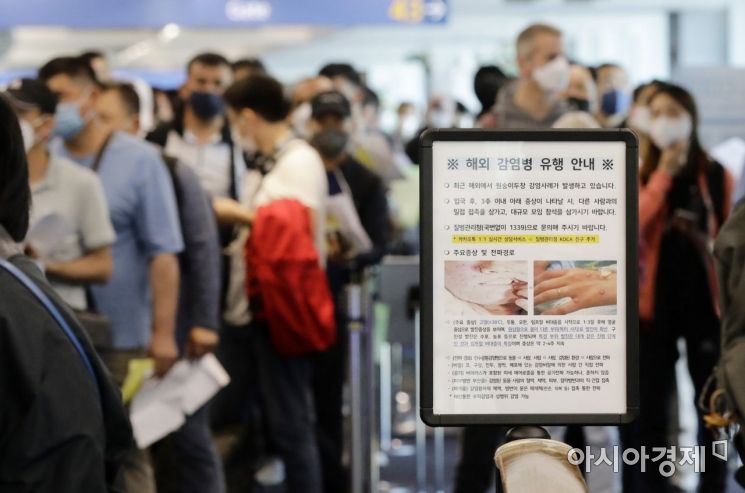 Passengers arriving on a flight from Europe at Incheon International Airport Terminal 1 are waiting to undergo quarantine for overseas infectious diseases such as monkeypox. Photo by Mun Ho-nam munonam@
[Asia Economy Reporter Jo In-kyung] As the World Health Organization (WHO) is considering declaring a 'Public Health Emergency of International Concern (PHEIC)' regarding monkeypox, our government is promoting the introduction of treatments in preparation for domestic confirmed cases.
According to major foreign media reports on the 15th, WHO Director-General Tedros Adhanom Ghebreyesus said at a press briefing the previous day, "The outbreak of monkeypox is unusual and concerning," and "We have decided to convene an emergency meeting to assess whether this situation qualifies as a PHEIC under the International Health Regulations."
PHEIC is the highest level of alert issued by WHO for diseases that are spreading globally, currently applied to COVID-19 and polio. The WHO Emergency Committee meeting, composed of infectious disease experts, is scheduled for the 23rd.
Director-General Ghebreyesus also emphasized international cooperation, stating, "As the monkeypox virus is spreading abnormally and affecting more countries, it is time to consider raising the level of response." He added that discussions are underway to assign a new name to monkeypox, as the current name may cause discomfort to certain cultures, societies, countries, regions, occupations, or ethnic groups.
According to WHO, as of today, over 1,600 confirmed cases of monkeypox have been reported in 39 countries worldwide, including endemic regions in Africa, with about 1,500 suspected cases. Among the 39 countries with confirmed cases, 32 are non-endemic countries in Europe and the Americas.
Experts point out that due to the approximately three-week incubation period characteristic of monkeypox, its introduction into the country is a matter of time.
The Korea Disease Control and Prevention Agency announced the 'Monkeypox Occurrence Preparedness and Response Plan' the previous day and held a countermeasure meeting with related ministries including the Ministry of Agriculture, Food and Rural Affairs, Ministry of Environment, Ministry of Health and Welfare, and the National Fire Agency, and has begun detailed discussions to import about 500 doses of the antiviral drug Tecovirimat into the country next month.
In the event of a monkeypox patient occurring domestically, quarantine and inpatient treatment will be provided at the Central Infectious Disease Specialist Hospital (National Medical Center) until the confirmed patient's infectiousness disappears. Additionally, contacts of confirmed patients will be classified into three levels (high risk, medium risk, low risk) based on exposure level, and limited 21-day quarantine is being considered only for high-risk contacts (cohabitants and sexual contacts within 21 days of symptom onset of the confirmed patient).
© The Asia Business Daily(www.asiae.co.kr). All rights reserved.
![Clutching a Stolen Dior Bag, Saying "I Hate Being Poor but Real"... The Grotesque Con of a "Human Knockoff" [Slate]](https://cwcontent.asiae.co.kr/asiaresize/183/2026021902243444107_1771435474.jpg)











