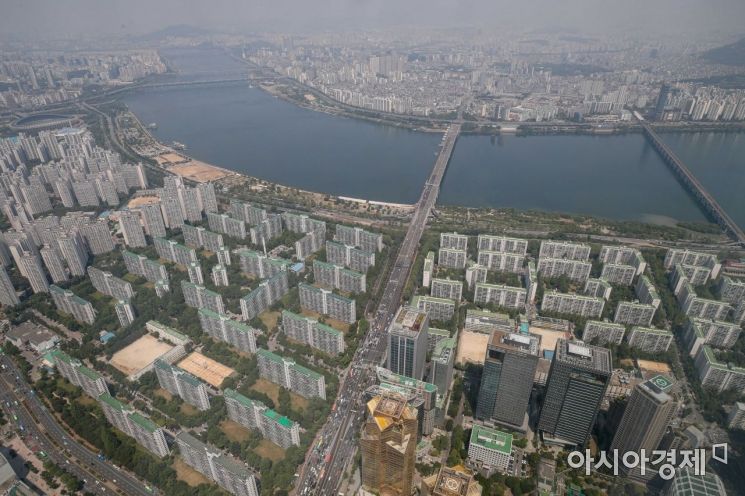
As loan regulations that had suppressed the housing sales market shift toward relaxation, the complete ban on mortgage loans for apartments exceeding 1.5 billion KRW (the December 16 real estate measures) is coming under scrutiny.
According to industry sources on the 15th, the Constitutional Court will hold a public hearing on the unconstitutionality confirmation case of the Ministry of Strategy and Finance's housing market stabilization plan at the grand bench of the Constitutional Court in Jaedong, Jongno-gu on the 16th. This comes about two and a half years after the constitutional petition was filed in December 2019. The Moon Jae-in administration, through the December 16, 2019 measures, completely banned mortgage loans for houses priced over 1.5 billion KRW in regulated areas such as speculative zones and speculative overheating districts. As a result, it is currently impossible to even apply for mortgage loans intended for purchasing apartments priced over 1.5 billion KRW.
Attorney Jeong Hee-chan, the petitioner of the constitutional petition, filed the petition the day after the announcement of the measures, arguing that the clause banning mortgage loans for purchasing ultra-high-priced apartments (market price exceeding 1.5 billion KRW) is unconstitutional. He claimed that it infringes on constitutional rights such as the pursuit of happiness, equality, and property rights. Professor Seong Jung-tak of Kyungpook National University Law School, participating as a reference witness for the petitioner, also stated that "a complete ban on loans for ultra-high-priced houses, whose collateral value is sufficient and safety is guaranteed, violates the principle of proportionality." The government countered by saying, "It does not infringe on the essential content of property rights." They argued that during the low-interest period, there was an 'Eolkka' (borrowing to the limit) phenomenon among demanders, causing the housing market to overheat, and that the government’s measures are limited in location and target, thus recognizing the minimal infringement of rights. The Constitutional Court plans to continue deliberations after hearing opinions from both sides and reference witnesses during the public hearing. The date for the ruling has not yet been decided.
The 1.5 billion KRW loan ban has already been judged a failure in the market. The loan regulation caused side effects that pushed housing prices up according to the price ceiling. Houses priced around 500 to 600 million KRW rose to 900 million KRW, and apartments that were around 1 billion KRW climbed up to the loan ban threshold of 1.5 billion KRW. The loan ceiling set by the government became a housing price guideline, ironically driving prices higher. In Gangnam and Seongdong-gu, even small one-room apartments exceed 1.5 billion KRW. According to the Ministry of Land, Infrastructure and Transport’s real transaction price disclosure system, a 35㎡ unit in ‘Trimage’ located in Seongsu-dong, Seongdong-gu, was traded for 1.63 billion KRW in April.
Moreover, despite the complete ban on loans, the volume of transactions for properties exceeding 1.5 billion KRW is increasing, leading to criticism that only cash-rich buyers are allowed to purchase homes. Ko Jun-seok, CEO of J.Edu Investment Advisory (former adjunct professor at Dongguk University Law School), pointed out, "Excessive regulation reveals more dysfunction than function," adding, "Although the 1.5 billion KRW loan ban partially suppressed sales demand, it rather stimulated the overall market." He emphasized, "The number of apartments exceeding 1.5 billion KRW has significantly increased in recent years, and a complete ban on loans restricts the choices of genuine buyers."
Meanwhile, this is not the first time the government’s real estate policies have faced constitutional court review. In 1994, the Excess Land Profit Tax, and in 1999, the Land Ownership Limit System were ruled unconstitutional or partially unconstitutional due to infringement on citizens’ property rights and the recovery of unrealized gains. The Development Gain Recovery Act was upheld by the Constitutional Court but was abolished during the foreign exchange crisis due to the burden it placed on companies.
© The Asia Business Daily(www.asiae.co.kr). All rights reserved.

















