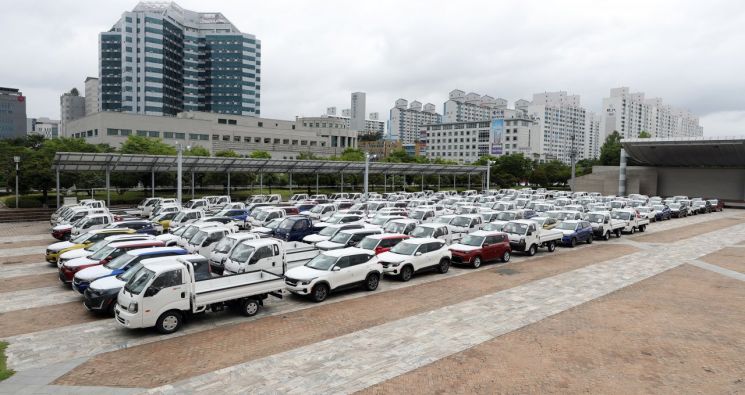
 On the afternoon of the 14th, completed vehicles produced at the Kia Gwangju plant are displayed at the outdoor music hall of the Gwangju City Hall in Seo-gu, Gwangju. / Photo by Yonhap News Agency
[Asia Economy Honam Reporting Headquarters Reporter Park Jin-hyung] Kia Autoland Gwangju is struggling with vehicle shipments due to the Cargo Solidarity Union strike.
Production is proceeding normally as parts supply is smooth, but the circulation chain has been blocked since car carriers transporting finished vehicles to ports such as Mokpo Port joined the strike on the 7th.
Since Kia Gwangju must prevent the factory lines from stopping starting the next day, it has used temporary measures by storing produced vehicles at the Pyeongdong shipment yard and Jangseong logistics center.
A total of about 8,000 vehicles have been stored at these two locations so far, reaching saturation.
Additionally, the outdoor music hall at Gwangju City Hall, which has parking space for about 400 vehicles, is being utilized.
Internal employees, temporary workers, and Glovis staff were involved in moving the vehicles, and the process was carried out under temporary operation permits using individual delivery methods.
The Gwangju plant produces about 2,000 vehicles daily, including the Sportage, Seltos, Soul, and Bongo trucks.
If the strike prolongs, it will be inevitable to find other places to store production volumes. Internally, alternatives such as the emergency runway in Naju, local university sports fields, and areas around the Honam Expressway are reportedly being discussed.
If factory operations stop due to various factors, it will inevitably impact about 50 primary suppliers and hundreds of secondary, tertiary, and quaternary suppliers, causing the local economy to closely monitor the situation.
A Kia official said, "If the factory stops, the damage to the company as well as partner companies and the local economy will be enormous, so we are putting all our efforts into preparing countermeasures to prevent this."
Meanwhile, the Cargo Solidarity Union has launched a general strike demanding the abolition of the sunset clause on the safe freight rate system. Their five demands are ▲abolition of the safe freight rate sunset clause ▲expansion of safe freight rates to all vehicle types and items ▲increase in transportation fees ▲abolition of the consignment system ▲expansion of labor basic rights.
© The Asia Business Daily(www.asiae.co.kr). All rights reserved.

















