US Startup 'Amoji' Secures $30M Investment
Company with Ammonia Fuel Cell Drive Technology
"Future Development of 500kW Ammonia Fuel Cell Products Possible
5MW Power Generation Through Modularization... Equipped on 1000t Medium-Sized Ships"
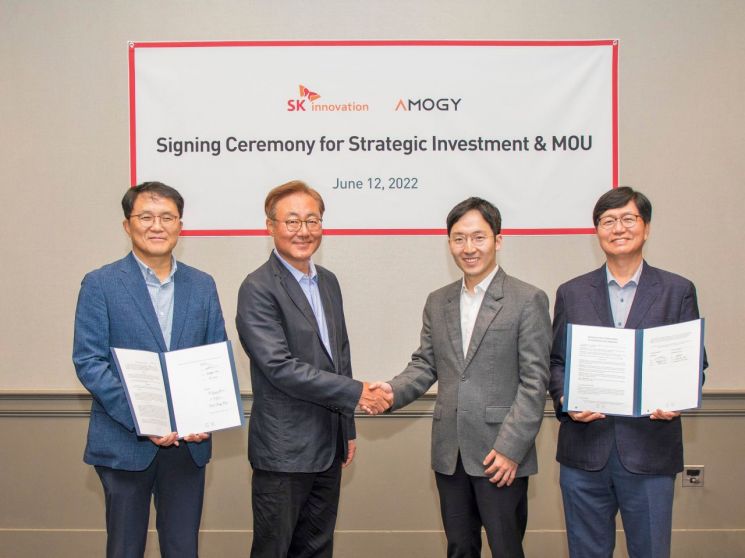 On the 12th (local time), SK Innovation signed a $30 million (approximately 38 billion KRW) investment agreement and a memorandum of understanding (MOU) to strengthen technological cooperation with Amoji, an ammonia-based fuel cell system startup, in San Jose, California, USA. From left: Kim Cheol-jung, Head of SK Inno Portfolio Division; Kim Joon, Vice Chairman of SK Innovation; Woo Seong-hoon, CEO of Amoji; Lee Sung-jun, Head of SK Innovation Environmental Science and Technology Institute.
[Asia Economy Reporter Moon Chaeseok] SK Innovation is accelerating the discovery of new businesses to build an eco-friendly portfolio. Just two days after Vice Chairman Kim Jun announced at a global forum held in the U.S. that the company would speed up its nuclear power, electric vehicle battery, and spent battery recycling businesses, SK Innovation presented a new 'ammonia' card. The company decided to invest in a local startup that produces fuel cells using ammonia, which is gaining attention as a future energy source. By expanding its investment scope to ammonia, one of the alternative fuels before the hydrogen transition, SK Innovation is taking a step closer to achieving carbon neutrality (net zero) by 2050.
On the 14th, SK Innovation announced that it would invest $30 million (approximately 38 billion KRW) in Amogy, a U.S.-based ammonia fuel cell system specialist, and engage in technological cooperation. On the 12th (local time), the two companies held an investment contract and memorandum of understanding (MOU) signing ceremony in San Jose, California. They agreed to join forces to develop ammonia-based fuel cell system technology and expand the market. The ceremony was attended by SK Innovation officials including Vice Chairman Kim Jun, Portfolio Division Head Kim Cheoljoong, Director of the Environmental Science and Technology Institute Lee Seongjun, and Amogy CEO Woo Seonghoon.
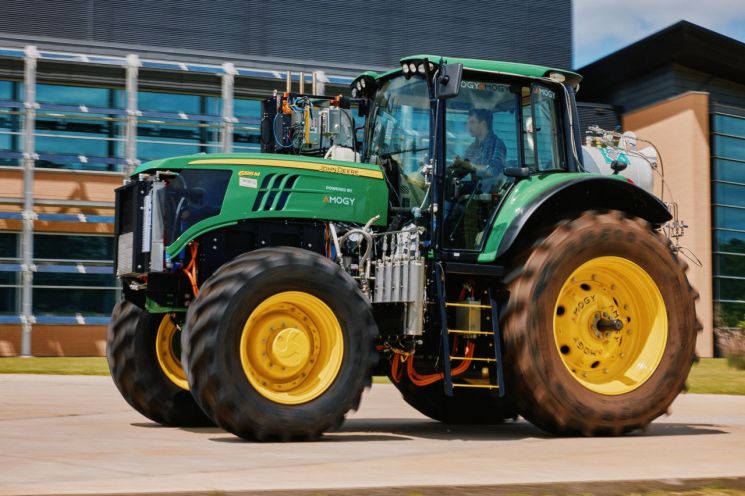 A scene from Amogy's demonstration test in the United States last month. A tractor equipped with an ammonia-based fuel cell system is undergoing a test run. (Photo by SK Inno)
Ammonia is one of the alternative fuels that serve as a stepping stone before the hydrogen transition, requiring time to secure technology and economic feasibility. SK Innovation decided to invest because it judged that securing ammonia technology is necessary until the eco-friendly hydrogen economy is activated. For hydrogen fuel cell technology to be widely adopted, it is essential to maximize the ability to store and transport hydrogen from production sites to usage points, thereby lowering costs and securing economic feasibility.
The problem is that with current technology levels, hydrogen can only be transported by cryogenic liquefaction at minus 253°C. For this reason, SK Innovation judged that ammonia must be used as an alternative fuel for a certain period. The liquefaction point for storing and transporting ammonia is minus 33°C. It has the advantage of requiring less total energy and emitting less carbon than hydrogen liquefaction. When importing 1 kg of hydrogen from Australia, liquefied hydrogen costs $3.4, whereas liquefied ammonia costs only $1.7. Additionally, more hydrogen can be stored in the same space compared to liquefied hydrogen. The international ammonia production scale reached 180 million tons annually as of 2017, with a transportation volume of 18 million tons. This means the distribution infrastructure is already established.
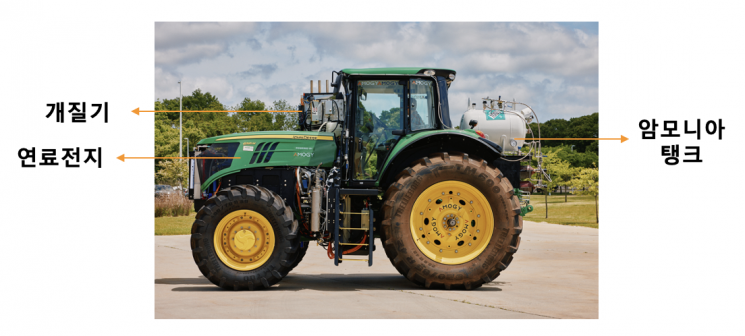
Amogy is a promising company led by PhD-level personnel from the Massachusetts Institute of Technology (MIT) who oversee management and research and development (R&D). Although it is only in its third year since establishment, it possesses advanced technology related to small ammonia fuel cell systems. It has secured shareholders such as the U.S. retailer Amazon and the UK hydrogen industry specialist investment firm AP Ventures. Amogy has completed demonstration tests applying ammonia-based fuel cell systems to 5kW-class drones and 100kW-class tractors. By next year, it plans to apply the technology to large industrial mobility such as trucks and ships. In the future, it aims to develop 500 kW-class single ammonia fuel cell products as well as modularized 5 MW power generation technology. The 5 MW scale is suitable for medium-sized ships of about 1,000 tons.
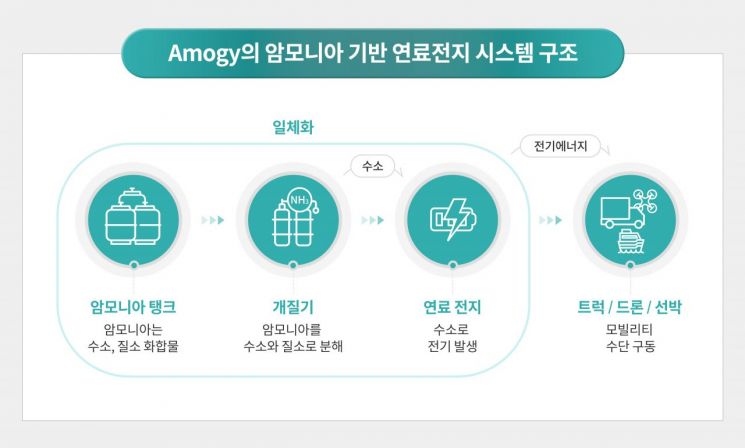 Infographic of Amoji's ammonia-based fuel cell system structure and operation concept. (Source: SK Inno)
SK Innovation sees high commercialization potential in Amogy's ammonia fuel cell system technology. Amogy's ammonia fuel cell system integrates an ammonia tank, reformer (hydrogen extraction), and hydrogen fuel cell into a compact unit. With high output, it is expected to be applicable to commercial transportation such as large ships and trucks where decarbonization is urgently needed, as well as to the growing eco-friendly industrial mobility markets including zero-carbon forklifts, agricultural machinery, and drones.
Division Head Kim Cheoljoong said, "SK Innovation's 'Carbon to Green' strategy combined with Amogy's differentiated technology has borne its first fruit," adding, "We will continue to build an eco-friendly portfolio by actively developing and utilizing zero- and low-carbon energy sources such as nuclear power and hydrogen, as well as succeeding in the ammonia business."
CEO Woo Seonghoon said, "Reducing carbon emissions in large transportation sectors is very important to achieve net zero by the mid-21st century, and ammonia is an easily accessible and sustainable carbon reduction means," adding, "We will accelerate the development of decarbonization-related technologies and become a leading company in greenhouse gas removal."
© The Asia Business Daily(www.asiae.co.kr). All rights reserved.



















