Future Change Analysis of River Flood Occurrence
If Current Carbon Emission Levels Are Maintained, Extreme Precipitation Will Increase by 53% in 2081
After 60 Years, Hangang East Sea Basin Increases by 73%, Nakdonggang East Sea Basin by 69%
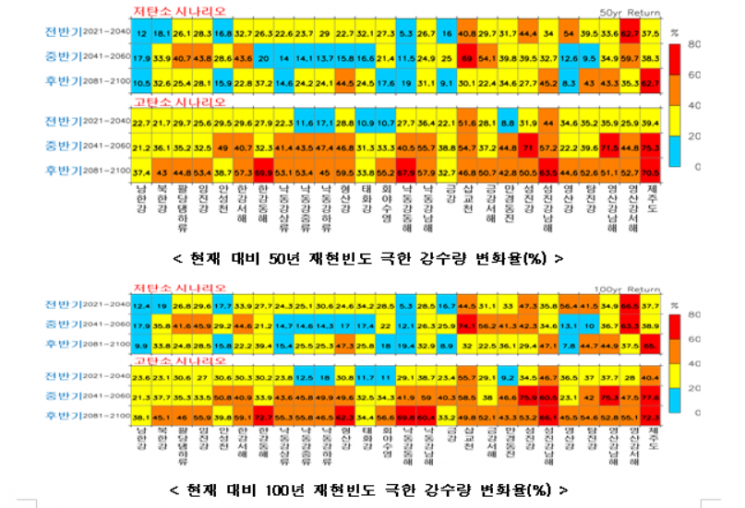
If greenhouse gas emissions are not reduced, extreme rainfall in rivers such as the Nakdong River and the Han River is expected to increase by up to 70%, raising the possibility of floods.
On the 14th, the Korea Meteorological Administration (KMA) and the Asia-Pacific Economic Cooperation (APEC) Climate Center announced the results of an analysis on future changes in extreme rainfall by watershed related to river flooding.
The KMA subdivided the Han River and Nakdong River basins into 26 major regions and estimated the recurrence frequency (extreme rainfall occurring once every several decades) for analysis. The extreme rainfall by watershed was analyzed to see how the recurrence frequency of extreme rainfall changes compared to the present (2000?2019) under climate change scenarios.
If greenhouse gas emissions remain similar to or higher than current levels, extreme rainfall occurring once every 100 years is projected to increase by up to 53% in 60 years (2081?2100). Currently, major region rainfall ranges from 187.1 to 318.4 mm, but it could increase by approximately 70.8 to 311.8 mm in 60 years.
If carbon emissions are reduced compared to current levels, the increase in extreme rainfall during the same period is expected to be around 31% (39.5 to 168 mm). The KMA explained, "This implies that the effect of carbon neutrality policies could slow the progress of global warming, thereby lowering the possibility of floods caused by a decrease in extreme rainfall."
When carbon emissions are maintained, the number of regions where the change rate of extreme rainfall occurring once every 100 years exceeds 50% is expected to reach up to 16 in the latter half of the 21st century. The Han River East Sea region is expected to increase by 73%, and the Nakdong River East Sea region by 69%. The region with the largest increase, Jeju Island, is analyzed to already have an increase of up to 78% in extreme rainfall 20 years from now, between 2041 and 2060.
If carbon emissions are reduced, the number of regions where the change rate of 100-year frequency extreme rainfall exceeds 50% is expected to be around one. The increase rates of extreme rainfall in the Han River East Sea region and Nakdong River East Sea region will significantly decrease to 39% and 19%, respectively.
Park Kwang-seok, Administrator of the KMA, said, "As the intensity of extreme rainfall is expected to increase, raising the possibility of floods, we will strive to provide various watershed-specific climate change analysis information based on climate change scenarios."
© The Asia Business Daily(www.asiae.co.kr). All rights reserved.

















