Average Monthly Cumulative Rainfall at 5.6% of Normal
Agricultural Crop Conditions Worsen... Factory Operations Halt
Drought Crisis Spreads Worldwide
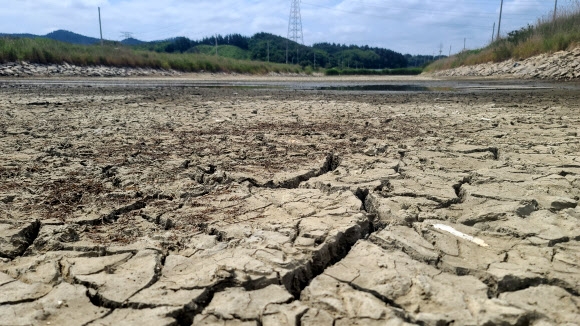 On the 2nd, due to the ongoing spring drought, the water in the irrigation canal of Iwon Reclaimed Land in Iwon-myeon, Taean-gun, Chungnam has dried up, causing the bottom to crack. / Photo by Yonhap News
[Asia Economy Reporter Na Ye-eun] Due to an unprecedented drought continuing since winter, the condition of domestic agricultural products has worsened, and damages have spread across the board, including factory shutdowns.
According to the Korea Meteorological Administration, the average cumulative precipitation nationwide from the 2nd of last month to the 1st of this month was 5.8mm, which is only 5.6% of the normal 104.2mm. From the beginning of this year to the 3rd of this month, the cumulative precipitation was 160.7mm, less than 50% of the normal 327mm.
Although up to 111mm of rain fell nationwide from the 4th to the 6th, it is far from enough to resolve the prolonged drought. As the drought continues, damage such as reduced crop growth has spread, and prices have risen sharply.
According to the National Statistical Portal (KOSIS) of Statistics Korea on the 13th, the consumer price index for agricultural, livestock, and fishery products rose 0.2% compared to the same month last year. Prices surged significantly with radish up 56%, green chili peppers 36%, garlic 63%, green onions 86%, perilla leaves 28%, and potatoes 55%.
Spinach rose 15.1%, water parsley 13.6%, broccoli 12.3%, bracken 12.3%, garlic 11.6%, mushrooms 10.6%, and balloon flower root 10.4%, all showing double-digit increases.
The drought has hit the production of open-field crops grown in fields. In particular, potato prices in April rose 15.4% compared to the same month last year, and the increase more than doubled in May. Garlic also recorded double-digit growth rates for five consecutive months.
Furthermore, the drought has made it difficult to operate factories. At Daesan Industrial Complex in Chungnam, one of the three major petrochemical complexes in Korea, the water level of nearby Daehon Lake, which supplies water, dropped to around 30%.
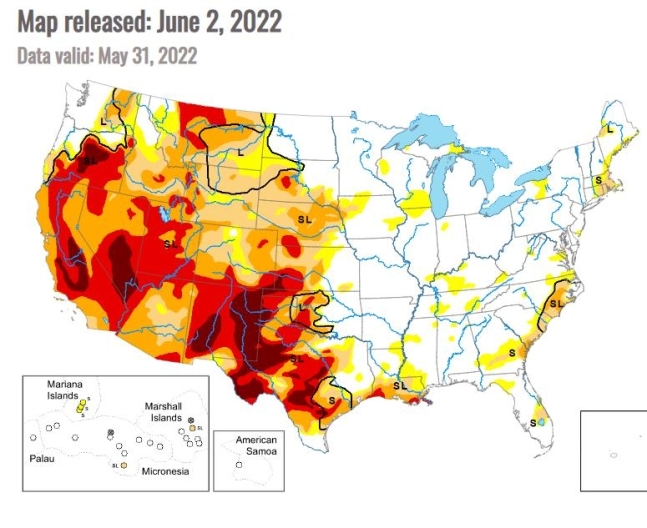 As of the 2nd (local time), the drought status in the United States. The red areas indicate regions of extreme drought. / Photo by US Drought Monitor (USDM) website, Yonhap News
Meanwhile, the drought is not only a domestic issue. Globally, many parts of the world are suffering from drought due to lack of rainfall.
According to the U.S. Drought Monitor (USDM), as of the end of last month, 49.3% of the U.S. territory was in drought conditions. While conditions somewhat improved in the Northwest, northern Rocky Mountains, and the Great Plains, drought worsened in parts of the Southwest, West, and Northeast, USDM reported.
In response, the U.S. has introduced unprecedented outdoor water use restrictions. In Los Angeles, outdoor water use is limited to twice a week, and sprinkler operation is restricted to 8 minutes. Violators of water-saving guidelines face fines up to $600 (approximately 750,000 KRW).
In Africa, countries such as Kenya, Somalia, and Ethiopia are experiencing the longest drought in 40 years due to almost no rain during four consecutive rainy seasons. Major crops in these areas have withered, and livestock have been left collapsed and unattended due to lack of water.
Also, in France, the largest wheat exporter within the European Union (EU), unusually hot and dry weather since the beginning of this year is expected to sharply reduce wheat shipments. Cumulative precipitation until mid-May recorded the lowest level in 32 years.
Spain and Portugal have also experienced severe drought since last autumn, and southern France faces similar conditions, raising concerns that not only wheat but also major crops such as corn and sunflowers will be damaged.
India, the world's second-largest wheat producer, also saw a sharp decline in wheat production due to hot and dry weather. The Indian government banned wheat exports, which, along with the Ukraine war, contributed to driving up international grain prices.
The United Nations stated that 2 million children are at risk of starving to death due to drought in northeastern Africa and the Ukraine war. More than 15 million people are already suffering from severe famine, and 3 million livestock have died, according to the UN.
On the 6th, UN agencies issued a joint statement saying, "More than 200,000 people in Somalia are facing extreme hunger," but "fundraising for humanitarian response this year has reached only 18% of the target amount."
The United Nations Children's Fund (UNICEF) warned on the 7th, "If the world continues to focus only on the Ukraine war, the number of child deaths in the 'Horn of Africa' region in northeastern Africa will explode."
© The Asia Business Daily(www.asiae.co.kr). All rights reserved.


















